Get AI Briefings, Transcripts & Alerts on Local & National Government Meetings — Forever.
Committee advances bill letting courts offer religious programs and psychotherapy as optional DUI treatment
Loading...
Summary
The Arizona House Committee on Transportation Infrastructure on Feb. 6 approved House Bill 2728 in committee, a measure that would allow courts to offer an approved religious program or evidence‑based psychotherapy as an option for people convicted of DUI, with participation affirmed as voluntary under an on‑the‑record amendment.
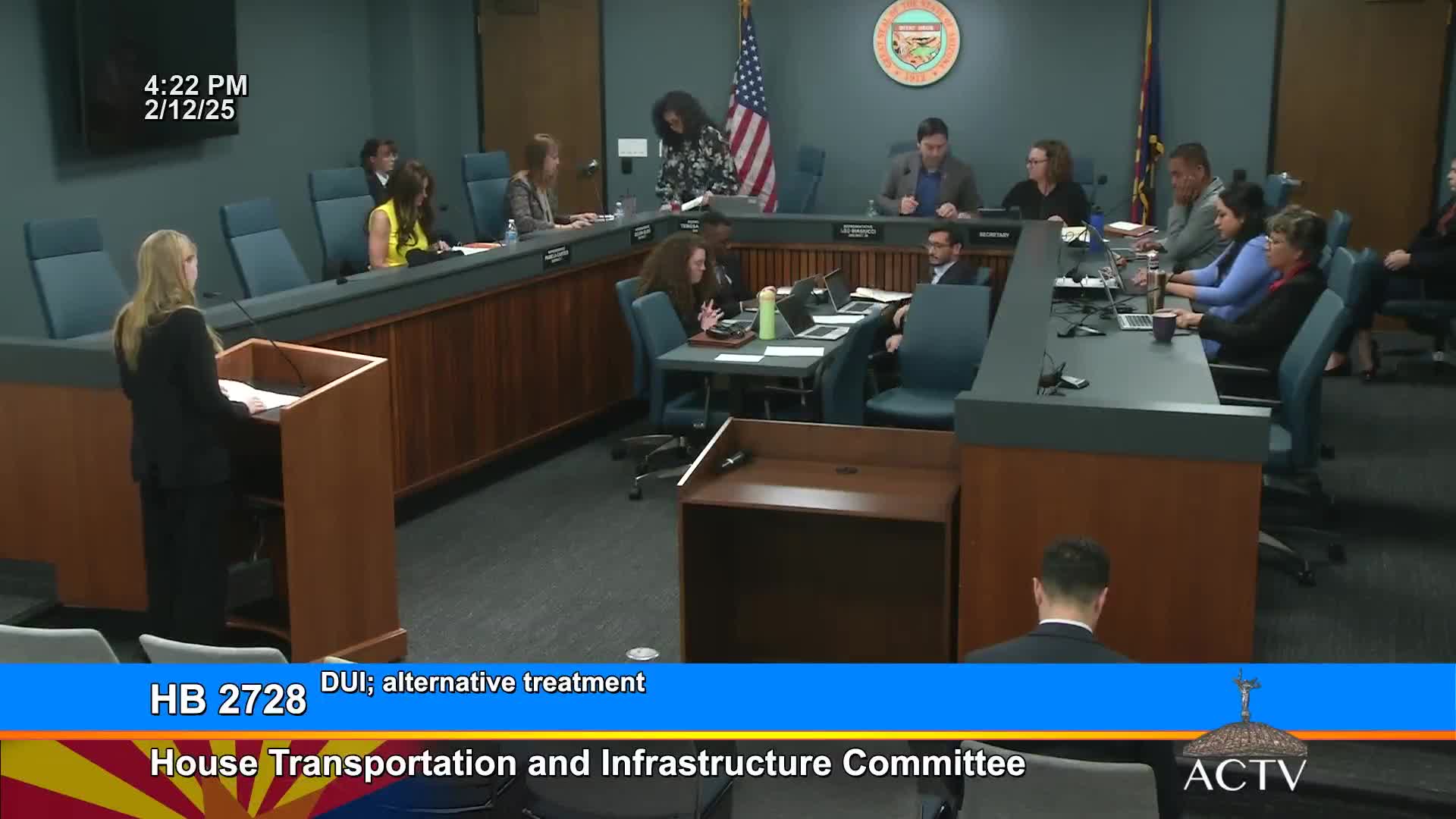
The Arizona House Committee on Transportation Infrastructure on Feb. 6 returned House Bill 2728 with a do‑pass recommendation after debate, a proposed friendly amendment and public testimony raising constitutional concerns.
Sponsor Representative Teresa Martinez said HB 2728 would expand the list of court‑approved options judges may offer people convicted of DUI, allowing courts to order participation in a religious program approved by the court or to require evidence‑based psychotherapy as an alternative treatment. Martinez emphasized the option is voluntary and would be one choice among several forms of community restitution or treatment a judge may list for a defendant.
"This bill does not mandate that you go to church," Martinez said. "If the person says, no, I don't want to go to church, I'd rather go outside and clean graffiti or pick up trash or drive meals to senior citizens, they can still do that." She described a personal family experience in Ohio in which a 72‑hour program — including psychotherapy — led to a positive change and said Arizona currently lacked an equivalent option.
Opposition and constitutional questions: Levi Bevis, who identified himself as an Arizona State University law student speaking in a personal capacity, urged the committee to vote no, saying the bill as written risked violating the Establishment Clause of the First Amendment and Article II, Section 1 (citizenship) of the Arizona Constitution by having courts approve religious programs and potentially favoring religious over secular options. "Court orders are not necessarily voluntary," Bevis said, arguing the transcript language could be read to coerce participation.
Jeanie Castine of Secular AZ echoed the constitutional concern and also questioned the bill's lack of a definition for "evidence‑based psychotherapy," noting that without clearer definition the statute could be vague about what programs qualify and whether they must be secular.
Sponsor changes and committee amendment: Committee members discussed language from a prior juvenile diversion bill (HB 2511) that had allowed voluntary participation in religious programs with explicit protections against coercion. Representative Soses (committee member) offered language modeled on the juvenile bill clarifying that participation be voluntary and that programs must not coerce a person to adopt or change religious affiliation; Martinez accepted that as a friendly amendment on the committee floor.
Several committee members said they intended to work on clarifying language further and to reference existing court lists or licensing requirements for psychotherapists so courts and defendants have clear, secular options. Supporters argued the bill merely adds more options for judges and defendants and does not replace existing mandated sanctions (such as jail, ignition interlocks or traffic school).
Committee action: After discussion and public testimony, the committee returned HB 2728 with a do‑pass recommendation. The transcript records the committee outcome as 6 ayes and 1 nay.
Next steps: Committee members said they would work on clarifying statutory language about voluntariness, non‑coercion, and definitions or crossreferences for "evidence‑based psychotherapy" before additional legislative steps. Sponsor Martinez said the provision mirrors language adopted previously for juvenile diversion and that courts already maintain lists of approved programs for community restitution, though witnesses and committee members urged explicit statutory references to avoid ambiguity.