Get AI Briefings, Transcripts & Alerts on Local & National Government Meetings — Forever.
Committee fails to restore full funding for college-credit incentive program; $4.21M appropriation proposal rejected
Loading...
Summary
House Bill 2420, which would appropriate $4,214,700 for the College Credit by Examination Incentive Program, failed in the House Appropriations Committee on Feb. 12 after debate on equity and whether the program creates uneven pay and access for teachers and students.
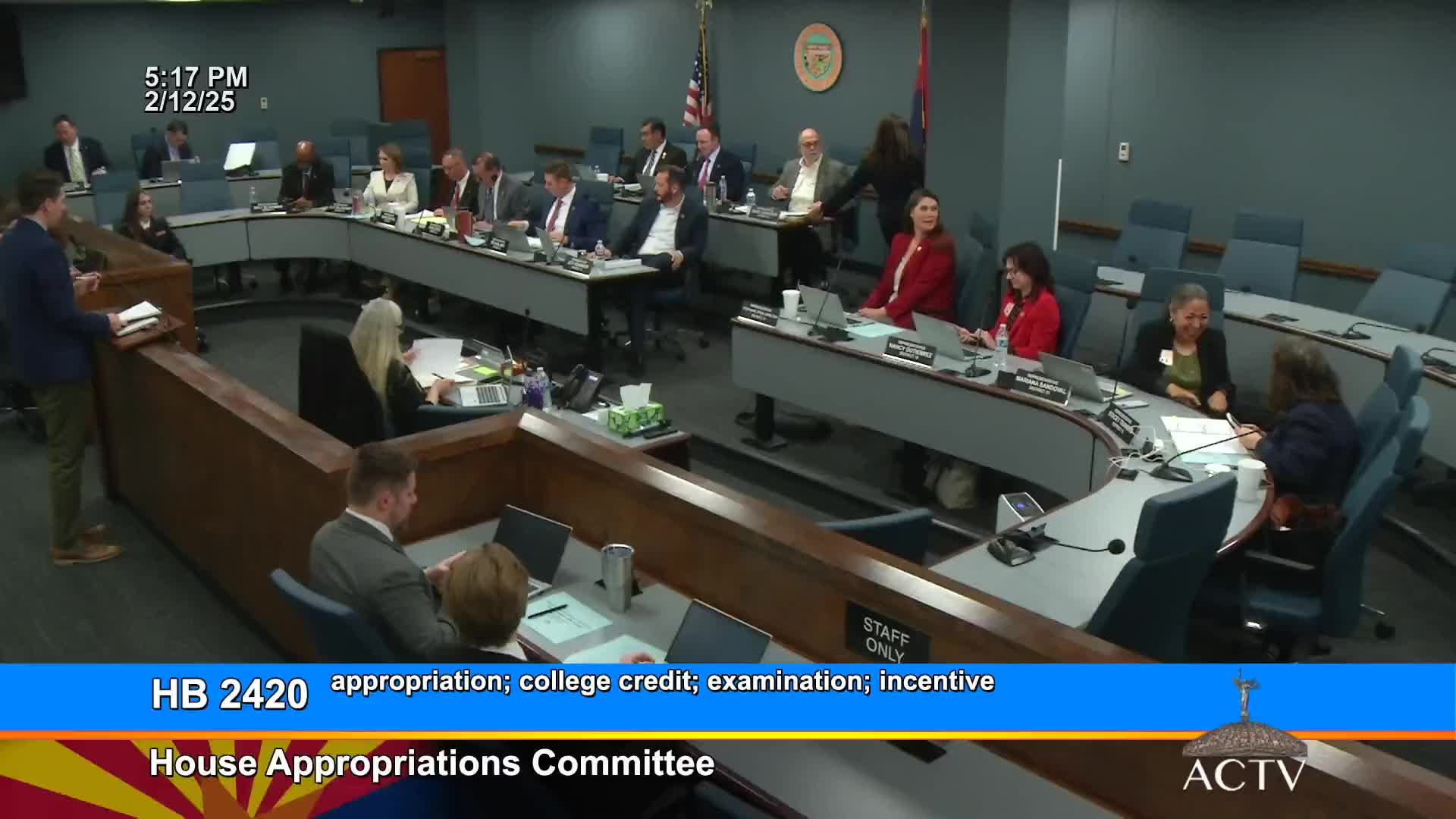
Feb. 12, 2025 — The Arizona House Appropriations Committee on Feb. 12 considered House Bill 2420, a proposal to appropriate $4,214,700 from the state general fund in FY2026 for the College Credit by Examination Incentive Program (CCEIP). The committee voted the bill down after extended debate about program equity and whether the incentive primarily benefits teachers and students in certain districts and schools.
Representative Alexander Collin (R‑LD03), the bill sponsor, described the request as a restoration of prior funding that had been reduced in the most recent budget and said the program motivates teacher performance tied to students passing Advanced Placement (AP), Cambridge International and International Baccalaureate exams. Chase Hauser, the committee research analyst, told members the program has been funded in prior years and that the FY2026 appropriation would bring the state closer to fully funding estimated incentive payouts based on the most recent qualifying exam counts.
Teachers and classroom presenters testified in favor. One teacher said the program provides essential supplemental pay and supports classroom rigor; a second teacher told the committee she would not still be teaching without the program’s merit payments. Supporters urged committee members to restore funding to levels that match current qualifying-exam participation.
Opponents — and several members who voted no — argued the program is inequitable because it applies only to certain college-level exams and does not cover concurrent-enrollment courses or other teacher work; they said the incentive can disadvantage teachers who work in schools that do not offer AP/IB/Cambridge options, including many rural and elementary schools. Several members said they would prefer an approach that raises teacher pay more broadly rather than continuing a selective merit program. That tension produced a lengthy floor-style debate in committee.
The committee conducted a roll-call vote after public testimony. The committee tally recorded 7 yes, 9 no, 1 present and 1 not voting, which the chair announced as a failure to pass the bill in committee. Committee members who supported the bill said they considered it a targeted, performance-based policy that can encourage college credit attainment and reduce college costs for students; members who opposed it cited fairness and teacher-pay equity concerns.
Ending: HB2420 did not receive a due‑pass recommendation. The committee debate underscored a recurring budget and policy question for lawmakers: whether to sustain or scale incentive-based teacher bonuses or pursue broader, systemwide teacher-pay changes.