Get Full Government Meeting Transcripts, Videos, & Alerts Forever!
Get email alerts on the School Meals Nutrition topic
No spam. Unsubscribe anytime.
Committee recommends funding free meals for reduced-price students, adopts restriction on ultra-processed food
Summary
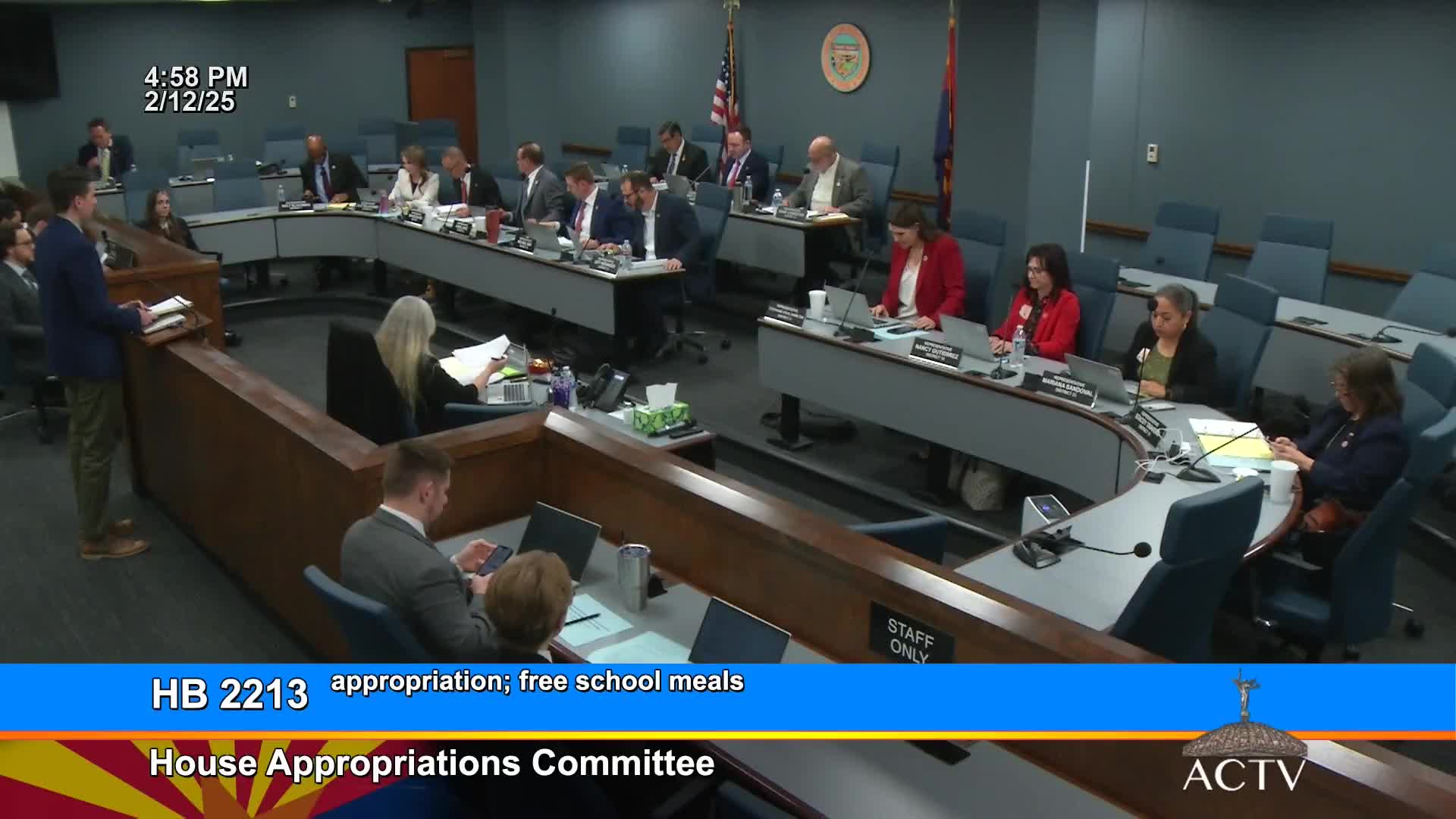
House Bill 2213 received a due-pass recommendation Feb. 12 after the committee adopted an amendment that prohibits sale of defined ultra-processed foods during the school day and directs ADE to publish a compliance form. The bill appropriates $3.8 million to cover co‑pays for students eligible for reduced‑price meals.
Feb. 12, 2025 — The Arizona House Appropriations Committee on Feb. 12 gave a due-pass recommendation to House Bill 2213, which would appropriate $3.8 million from the state general fund in FY2026 to the Arizona Department of Education (ADE) to cover co‑payments for students eligible for reduced‑price school meals. The committee also adopted an amendment that prohibits certain defined ultra‑processed foods from being sold or served on campus during the normal school day and directs ADE to post a standardized compliance form and a public list of certified schools on its website.
Representative Nancy Gutierrez (D‑LD18), a public-school teacher and the bill sponsor, told the committee that students who qualify for reduced-price meals (families between roughly 131% and 185% of the federal poverty line) often rely on school meals and that covering co‑pays increases meal participation and reduces administrative burdens for schools. "When children don't eat, they are unable to learn," Gutierrez said.
Witnesses who testified in support included the American Heart Association, the Arizona Food Bank Network and school nutrition professionals. Jennifer Gordon, a child nutrition director in the Levine Elementary School District, told the committee that covering co‑pays in prior years substantially increased participation; she also described district efforts to reduce processed ingredients and said transitioning menus has procurement and cost implications.
The Gress amendment (adopted Feb. 10) added a prohibition that would bar public schools from serving, selling or allowing third-party sales of ultra‑processed foods during the normal school day, supplied a definition of what ingredient elements constitute an ultra‑processed food, and required ADE to post a standardized certification form and a list of schools that certify compliance. Committee members and witnesses discussed that school meal operators already plan menus in advance and that removing ingredients can raise costs and require changes to procurement and menus that may take time to implement.
Representative Gutierrez said the state previously used federal funds and one‑time state dollars to cover similar co‑pays and that the bill reflects an intent to continue support; the bill language states it is the legislature's intent that the FY2026 appropriation be considered ongoing. The committee adopted the Gress amendment and then voted the bill out of committee with a 16‑yes, 2‑no roll-call tally.
Ending: House Bill 2213, as amended, proceeds with a due-pass recommendation. The measure carries a $3.8 million FY2026 appropriation for ADE and an ADE posting requirement related to ultra‑processed foods and school certification.