Get Full Government Meeting Transcripts, Videos, & Alerts Forever!
Get email alerts on the School Safety Aed topic
No spam. Unsubscribe anytime.
Committee backs bill requiring AEDs at school athletic events, $500,000 appropriation added
Summary
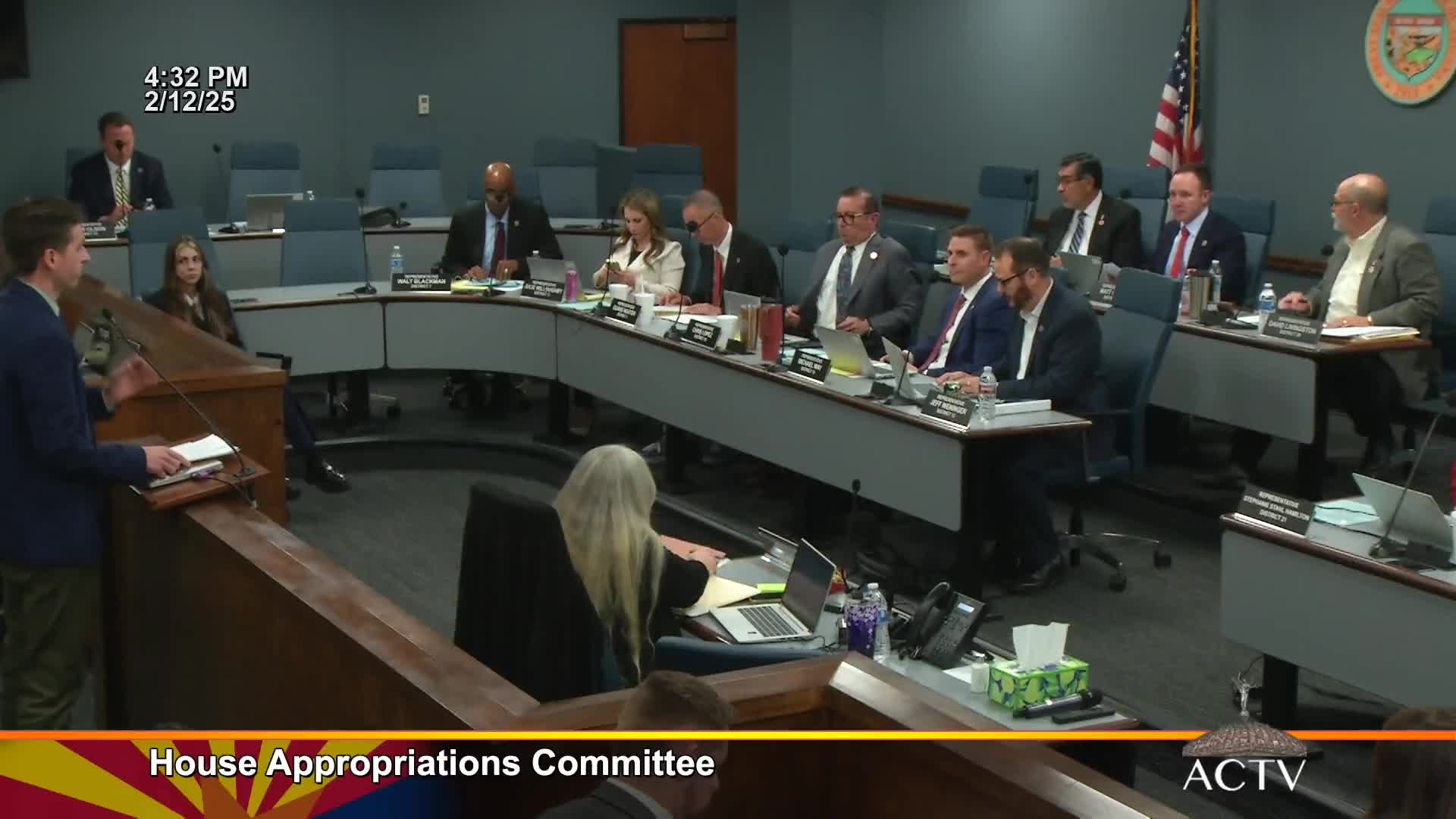
The House Appropriations Committee gave a due-pass recommendation Feb. 12 to House Bill 2196, which requires an automated external defibrillator (AED) at school-sponsored athletic events and coach training. An amendment filled an appropriation at $500,000 and narrowed campus coverage to school-sponsored athletic events where students are present.
Feb. 12, 2025 — The Arizona House Appropriations Committee voted Feb. 12 to give House Bill 2196 a due-pass recommendation after adopting an amendment that set a $500,000 appropriation and modified the AED requirement.
The bill, as amended, requires each public high school that sponsors an athletic team or sports program to provide an automated external defibrillator (AED) at each school-sponsored athletic event where students are present. The amendment removed a requirement to place an AED at every campus and broadened the coach training requirement to "complete a training course" in cardiopulmonary resuscitation, first aid and the use of AEDs rather than specifying a single state-approved course. The amendment also directed the Arizona Department of Education (ADE) to distribute the $500,000 to schools with an ending cash balance of $5,000,000 or less, using the most recent annual financial report.
Representative Julie Willoughby (R‑LD13), the bill sponsor, said the legislation was developed with the American Heart Association and stressed that "early CPR compressions and early AED does save lives." A parent who testified, Matt Midkiff, described his daughter's cardiac arrest at a soccer practice and credited the availability of AEDs and bystander CPR with saving her life. Project ADAM and Phoenix Children's Hospital clinicians also testified in support, saying prompt use of AEDs before emergency medical services arrive can substantially increase survival.
Supporters told the committee AED units are widely available for under $1,500 and that training can be short: many lay-person training courses run 30–60 minutes or offer online components for the training portion (the bill requires training, not certification renewal). Medical testimony noted that although many schools have at least one AED, they are sometimes in locked locations or not integrated into a cardiac emergency response plan; the amendment’s accessibility and training changes were intended to address that.
Members discussed how to make AEDs accessible during off-hours or when campuses host third‑party events. The sponsor said the intent is to have AEDs available at each school so other groups using the campus do not need to bring separate units. Several members also suggested private fundraising or tax-credit options to augment the appropriation.
The committee adopted the Livingston amendment (dated Feb. 10) that: filled the appropriation at $500,000, required ADE to distribute funds to schools with ending cash balances of $5,000,000 or less, limited the AED mandate to school‑sponsored athletic events where students are present, and broadened the training language for coaches. With no named second recorded, the vice chair moved the bill and the committee held a roll-call vote. The committee reported the bill as amended with a tally of 18 yes, 0 no; the committee record shows the measure received a due-pass recommendation.
Ending: The bill now advances as a due-pass recommendation to the next stage of the legislative process with the $500,000 appropriation and the accessibility and training modifications adopted in committee.