Get Full Government Meeting Transcripts, Videos, & Alerts Forever!
Get email alerts on the Budget Arpa Recovery Funds topic
No spam. Unsubscribe anytime.
JLBC staff tell Arizona appropriations committee $4.18B in ARPA recovery funds largely controlled by executive; obligation deadline passed
Summary
JLBC staff told the Arizona House Appropriations Committee on Feb. 12 that the state received about $4.18 billion in ARPA state and local fiscal recovery funds, with roughly $2.9 billion expended, and that obligations had to be signed as contracts by Dec. 31, 2024.
Feb. 12, 2025 — JLBC (Joint Legislative Budget Committee) staff told the Arizona House Appropriations Committee on Feb. 12 that the state has received about $4.18 billion from the American Rescue Plan Act (ARPA) state and local fiscal recovery fund and that slightly less than $2.9 billion had been expended as of the most recent quarterly report.
Why it matters: those ARPA recovery funds are under executive control and must be obligated — that is, captured in contracts creating a firm payment duty — by Dec. 31, 2024, the committee was told. The deadline for expenditures is Dec. 31, 2026 for most projects. That creates a compressed timeline for projects and a budget planning question for lawmakers because many ARPA-funded items are one-time or near-term backfills the state may need to replace with general-fund dollars in future budgets.
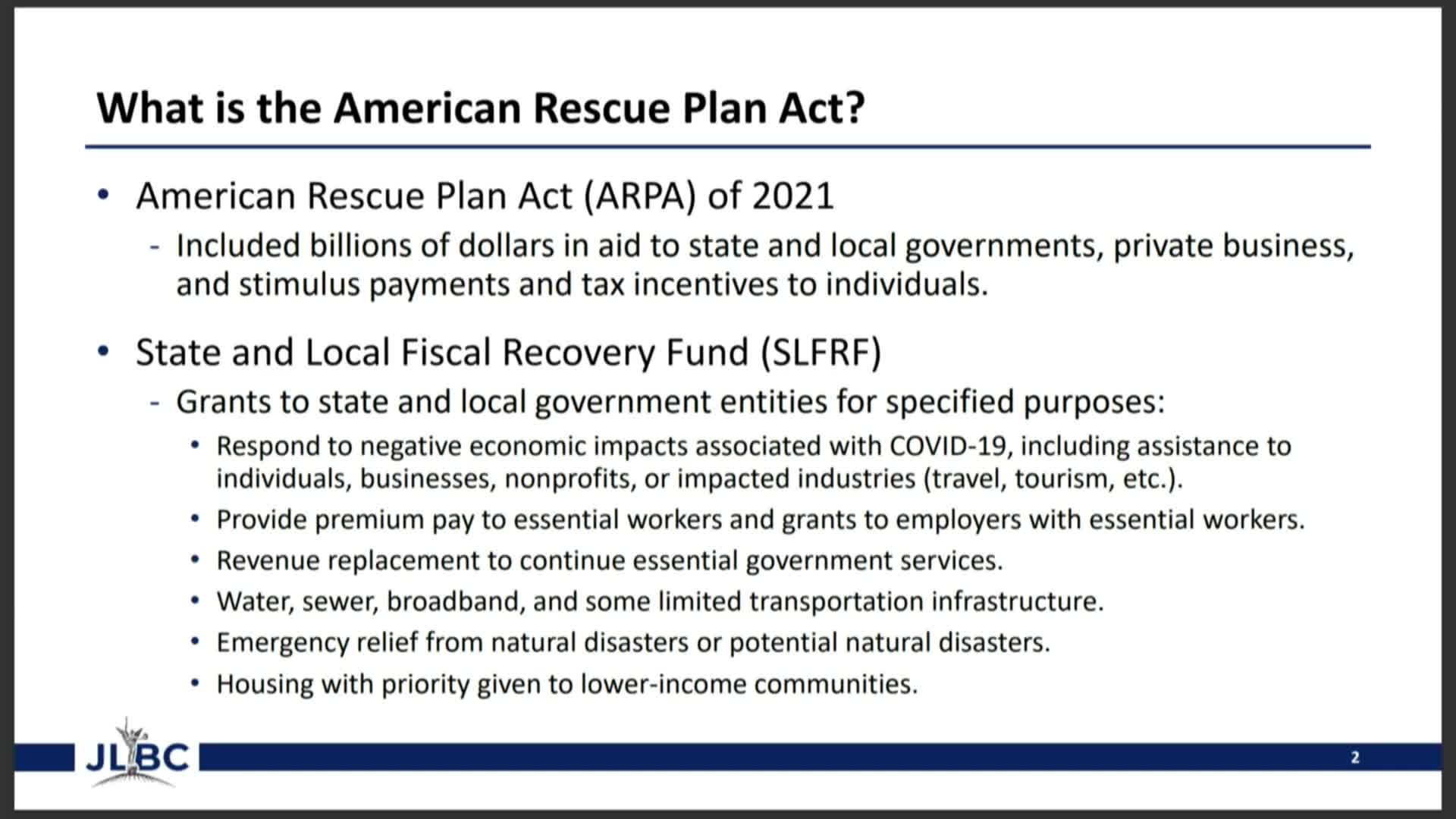
Gordon, a JLBC staff member who presented an overview of the recovery fund, summarized allowable uses and timelines, and walked the committee through the largest allocations reported as of Sept. 30, 2024. He said the state and local fiscal recovery fund "included billions of dollars" and that for the purposes of the FY26 executive budget the recovery fund is the "operative fund." He explained the difference between allocations, obligations and expenditures and noted that quarterly executive reports show allocations that can shift quarter to quarter.
JLBC staff provided the committee a list of the top allocations as of Sept. 30, 2024: a large revenue-replacement line (used in FY2023 largely to backfill corrections and other agencies), replenishment of the unemployment insurance trust fund (about $750 million), a $200 million Water Conservation Grant Fund, emergency rental assistance, trunk broadband projects on I-19 and I-17, a University of Arizona biomedical center (CAMI), state parks wastewater projects, a semiconductor workforce-development item, a federal-funds equalization program for public schools (Education Plus Up) and a state essential-workers premium-pay line that JLBC staff said has been expended. Gordon said some allocations still have details JLBC has not been able to fully disentangle and noted funding for some projects has shifted as tasks moved slower than expected or went over budget.
Gordon told the committee the executive listed 165 separate line items in the recovery funds in the November report: "53 have already been fully expended, with 112 projects that still have some activity that we expect to see through December 2026," he said. He also said the executive is required to submit quarterly reports to JLBC and the legislature that cover allocations and expenditures; the next report (covering allocations and expenditures through Dec. 31, 2024) was expected at week’s end and should better show obligations as well.
Committee members pressed staff about which uses the executive intends to backfill with state general fund after the ARPA dollars expire. Gordon pointed to several items the executive proposed to backfill in FY27, including parts of victim-services funding (VOCA-related grants and compensation), adult protective services case management costs, victim compensation fund support and county probation officer salary increases. He said the first four listed items in the FY26 executive budget were considered ongoing and that if federal dollars disappear the state will have to decide whether to continue these programs with general fund dollars.
The briefing also flagged a separate ARPA program that provided roughly $1.6 billion to Arizona's Access to Home and Community-Based Services (HCBS). Gordon said some HCBS funding initially supported a parents-as-paid-caregivers program; after federal funding for that program expired the state covered some of those costs and the committee asked JLBC staff for a timeline of the HCBS allocation and of changes to the parents-as-paid-caregivers program.
The committee also discussed budget timing and longer-term fiscal planning. Chairman David Livingston and other members noted that as ARPA- and other federal one-time funds expire, the Legislature will face decisions about which programs to continue and which to scale back. One member quantified the total ARPA-related dollars discussed in the briefing — $4.18 billion in the state and local recovery fund plus roughly $1.6 billion in HCBS funds — and said the combined total approaches $5.78 billion.
The committee asked JLBC staff to provide the requested timeline and to update members when the executive's Dec. 31 report was posted. JLBC staff said they post a summary and a detailed appendix on their website and compare quarter-to-quarter changes in allocations and expenditures.
Ending: JLBC staff urged members to watch the upcoming quarterly report for finalized allocations and obligations; committee members said those final figures will shape FY27 budget negotiations and potential general-fund backfills.