Get Full Government Meeting Transcripts, Videos, & Alerts Forever!
Get email alerts on the Civic Engagement topic
No spam. Unsubscribe anytime.
Arizona lawmakers, community leaders urge civic engagement at African American Legislative Day
Summary
State lawmakers and African American community leaders used the 23rd annual African American Legislative Day at the Arizona State Capitol to press for increased civic participation, representation on commissions and local advocacy on issues from housing and water to education and public safety.
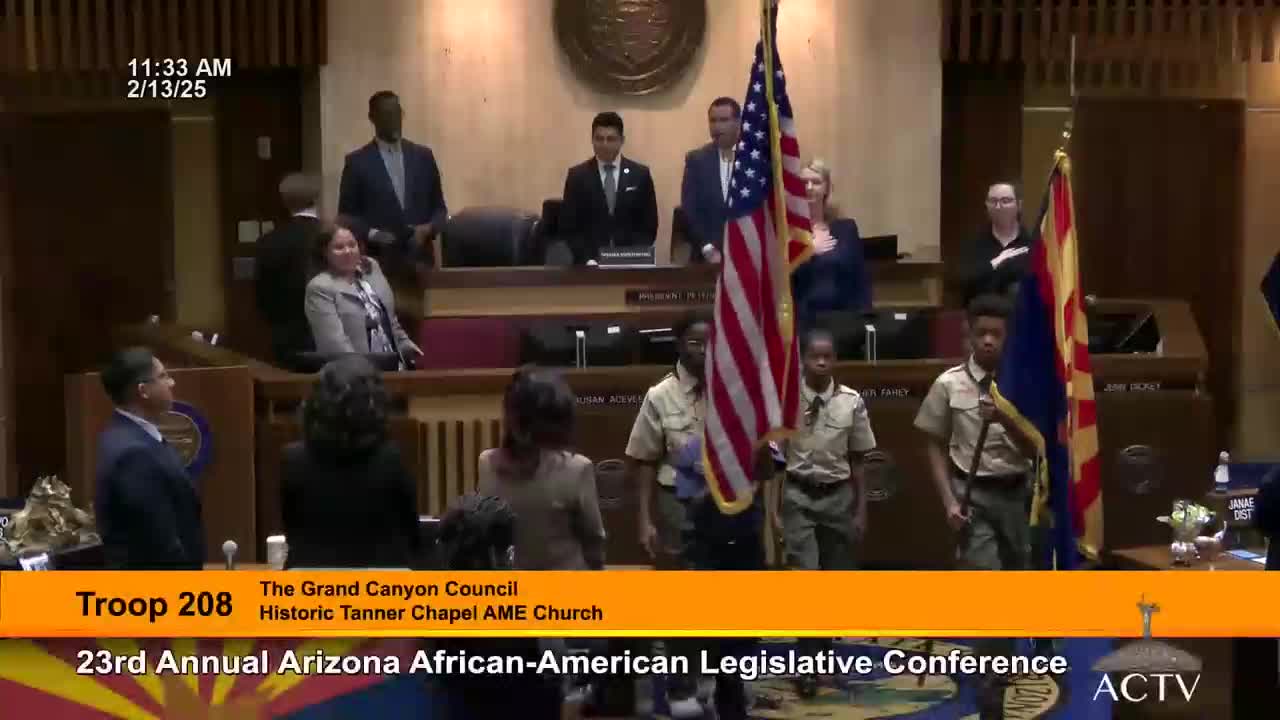
State lawmakers and community leaders urged stronger civic engagement and representation for Black Arizonans during the 23rd annual Arizona African American Legislative Day at the State Capitol on Feb. 14, 2025.
Legislators and commission leaders framed participation in elections, appointments and everyday advocacy as necessary to protect gains and shape policy affecting housing, schools, jobs and public safety. Representative Quanta Cruz, delivering what she called a "state of Black Arizona" address, said civic engagement "is a muscle" and must be exercised regularly to protect communities against policy rollbacks.
The ceremony opened with brief remarks from state lawmakers including Senator T.J. Shope and House Speaker Steve Montenegro, who welcomed attendees and highlighted priorities lawmakers discussed this session. Shope, identifying himself as the state senator from Legislative District 16, said lawmakers were working early in the session on issues including rental taxes, homeownership, water, school choice and public safety. He noted Randolph, Arizona, as an example of the state's older, predominantly Black communities.
Representative Quanta Cruz, in a roughly 30-minute address, tied a civic-engagement message to historical examples and current challenges. "The status quo has failed us," Cruz said, adding that protections once taken for granted have been lost and that "if you don't work the legislative process, it will work you." She urged constituents to "come down here and visit with your legislators," to build relationships and to use commissions, advisory boards and other non-elected roles to shape policy. Cruz cited a 2015 statistic — "over 200 people" moving to Maricopa County each day — as evidence of fast growth that she said creates both opportunity and strain on infrastructure.
Jerry McPherson, executive director of the Arizona Commission of African American Affairs, echoed the call to stay engaged beyond Election Day. "Voting is just the beginning," McPherson said, arguing that accountability and participation in commissions, advisory boards and policy committees sustain power for marginalized communities.
Leah Landrum Taylor, a founder of the Arizona Commission of African American Affairs and a former state Senate majority leader, reviewed the commission's pillars — education, justice, health, sustainability and environment, youth, and economic development — and announced related programming at the multiday conference, including a youth day at the Capitol the following day and an "unsung hero" celebration that evening.
Ashley Anderson, chair of the commission, thanked organizers and encouraged attendees to participate in pillar workshops and other sessions scheduled that afternoon.
Speakers also highlighted community-led projects as examples of local initiative, citing Base Arizona, Grassroots Bookstore, Archwood Exchange, the Center for the Study of Race and Democracy and Project Humanity as efforts that grew from local organizing to provide academic, cultural and civic spaces. Cruz referenced incoming major employers — specifically naming TSMC — as part of a broader growth trend requiring updated policy and planning.
The session closed with invitations to work with legislators and commission leaders and with practical advice from lawmakers on how to sustain engagement: brief, personal outreach and relationship-building, the lawmakers said, often opens pathways to ongoing communication and influence.
Organizers and legislative leaders used the event to press for long-term, organized participation in government beyond voting and urged attendees to seek appointments to commissions and advisory roles to influence policy affecting the African American community in Arizona.