Tempe reports about 14,700 tons diverted from landfill; commercial recycling lags at 9%
Get AI-powered insights, summaries, and transcripts
SubscribeSummary
City staff told the council Tempe diverted roughly 14,733 tons from landfills in 2024 but commercial diversion remains below the city's 15% goal. Staff outlined current diversion rates, pilot programs for inert-material recycling and sludge reuse, and planned outreach tools including a QR code on new containers.
Tempe solid waste staff on Tuesday updated the City Council on the city's landfill-diversion programs, reporting roughly 14,733 total tons diverted from the landfill in 2024 while commercial diversion remained below target.
"Our operators, supervisors, and coordinators do a great job in handling the municipal waste that we get," Deputy Director for Field Operations David Tavares said, opening the presentation. Staff said city targets include a 15% commercial diversion goal and a 20% citywide target. For 2024 they reported diversion rates of about 19% (residential), 9% (commercial) and 14% (citywide).
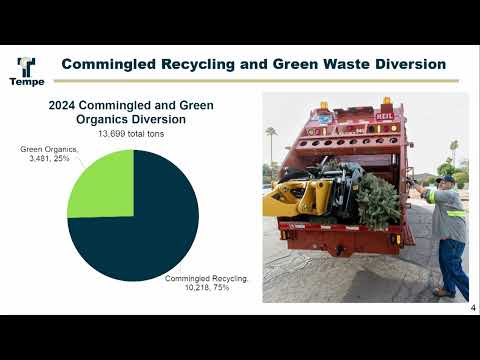
Staff gave a breakdown of diversion by stream and program: commingled recycling, green organics, and inert materials (from construction sites). Presenters said roughly 14,000 tons were diverted citywide (figures given as approximately 14,733 total tons), with residential commingled recycling and green organics making up the largest share. Staff described periodic material audits handled by the city's contractor and noted common contamination items such as plastic bags and food-soiled cardboard; contamination is removed at the material-recovery facilities and the nonrecyclable fraction is sent to landfill.
The department described other programs and pilots: a household hazardous waste collection center (reported as having received about 60,000 drop-offs since 1999 and roughly 7.5 million pounds of material collected), a new inert-materials recycling effort for concrete and brick tied to construction projects (with an example at the Tempe Municipal Operations Center), and ongoing research with the Strategic Management Innovation Office and Arizona State University’s School of Engineering on possible reuse for water-treatment sludge. Staff said sludge programs could divert a large additional volume if reuse solutions are adopted; staff provided an estimate for potential additional diversion but did not present a final economic analysis.
On outreach and operations, staff said they are piloting neighborhood audits and targeted postcards, intend to expand green-organics collection to more neighborhoods, and plan to imprint a persistent QR code on new city containers so residents can scan for current recycling guidance.
There was no formal council action during the update; council members complimented staff and asked about targeted outreach, sticker/QR-code communication, audit frequency and potential council field trips to facilities.