Get Full Government Meeting Transcripts, Videos, & Alerts Forever!
Get email alerts on the Elections topic
No spam. Unsubscribe anytime.
Senate Elections Committee recommends SF 1071 to let local governments adopt ranked‑choice voting
Summary
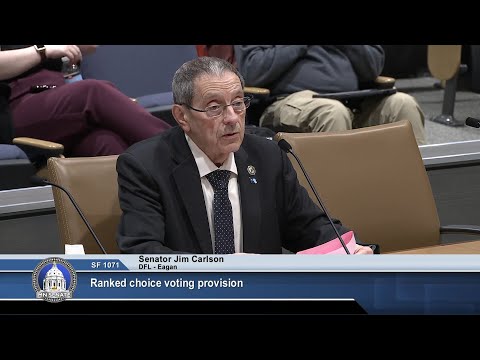
The Senate Elections Committee voted 6–5 to recommend passage of Senate File 1071, the Local Voices Local Choices Act, which would let Minnesota cities, counties and school districts choose to use ranked‑choice voting (RCV) and require state standards and equipment certification.
Senate File 1071, the Local Voices Local Choices Act, was recommended for passage by the Minnesota Senate Elections Committee after a 6–5 roll call vote that referred the bill to the State and Local Government Committee. The bill would allow cities, counties and school districts to adopt ranked‑choice voting as a local option and directs the secretary of state to set standards and certify RCV tabulation systems.
Senator Eric Carlson, sponsor of SF 1071, told the committee the bill is about ‘‘local voices [and] local choices’’ and stressed it is optional for jurisdictions: "This is not a mandate. It is a matter of choice," Carlson said. He described RCV as a way to ensure winners have majority support and to encourage more positive campaigns.
Supporters told the committee RCV can increase turnout in comparable local elections, expand candidate diversity and eliminate some low‑turnout local primaries. Minnesota Secretary of State Steve Simon said the bill levels the playing field by removing a two‑tier system that currently lets only some charter cities adopt RCV, and he welcomed the bill’s statewide standards for implementation. "That is an extremely helpful part of this bill from our standpoint in the Office of Secretary of State," Simon said.
Testimony from local officials and advocates emphasized practical effects in places that already use RCV. Minnetonka City Council Member Paula Grama, who ran and won in a 2023 RCV election, said RCV eliminated costly low‑turnout August primaries for her city and increased participation: Ward 3 turnout rose from about 17% in 2019 to nearly 35% in 2023. Grama also said the city’s election staff handled counting and a recount efficiently but recommended specialized software for reallocating votes. Hennepin County Commissioner Kevin Anderson urged the committee to adopt statewide standards to reduce administrative and financial burdens on counties and cities that run elections. Columbia Heights Mayor Amanda Marquez Simula said Columbia Heights, a diverse city, saw 81% turnout in 2024 and supports RCV as a way to increase inclusion and civility in campaigns. Clean Elections Minnesota intern Elily Abe Bissell and Tom Wiesen of Veterans for All Voters also testified in favor, citing the system’s potential to reduce the "spoiler" effect and encourage candidates to seek broader support.
Committee members questioned implementation, transparency and constitutional concerns. Several senators pressed staff and witnesses on how exhausted ballots (ballots that have no remaining ranked choices after successive eliminations) affect final tallies and whether the majority threshold is calculated from a shrinking pool of continuing ballots. Ms. Margaret Massey, a bill stakeholder and committee technical witness, explained the mechanics: ranked ballots combine what would be two rounds (primary and general) into a single ballot and the sequential elimination proceeds round by round; if a voter chooses not to rank additional candidates, that is the voter’s choice and those ballots may not continue into later rounds. "All we're doing is combining a two‑round runoff with a single election runoff," Massey told the committee.
Several senators raised concerns about ballot exhaustion and voter enfranchisement. Senator Matt Matthews argued that when a voter's ranked choices are all eliminated, "it disenfranchises the voter from impacting the outcome of the election," and said limitations in the bill (the bill limits how many candidates a voter may rank) would make exhaustion more likely in contests with many candidates. Supporters and Ms. Massey responded that courts have repeatedly upheld ranked‑choice systems and that certification of tabulation software can allow jurisdictions to produce timely, auditable results.
The bill explicitly keeps adoption at the option of local jurisdictions; it does not mandate RCV statewide. The sponsor and witnesses said the bill also directs the secretary of state to develop certification standards for voting equipment and tabulation software so RCV contests can be tabulated efficiently and reported the same day as other races. Secretary of State staff said the office would continue to report first‑round results on the statewide site and link to local jurisdiction websites for subsequent tabulation rounds under the bill’s current language.
On a procedural motion moved in committee, SF 1071 was recommended to pass and referred to the State and Local Government Committee. The roll call produced six ayes and five nays; the committee clerk recorded the motion as prevailing.
Votes at a glance
- SF 1071, Local Voices Local Choices Act — committee recommendation to pass and refer to State and Local Government Committee; outcome: recommended to pass (6 ayes, 5 nays).
Context and next steps
SF 1071 would expand RCV eligibility beyond the limited set of charter cities that currently may adopt RCV, allow adoption by resident vote in local jurisdictions, and authorize the secretary of state to promulgate rules and certify tabulation systems. Proponents pointed to Minnetonka and Bloomington, where voters retained RCV after repeal attempts, and to evidence from jurisdictions that have used RCV showing higher participation and more diverse candidate pools. Opponents focused on implementation complexity, the potential for exhausted ballots and concerns about transparency and trust in multi‑round tabulation. The bill now goes to the State and Local Government Committee for further consideration.