Get Full Government Meeting Transcripts, Videos, & Alerts Forever!
Get email alerts on the Capitol Space Planning topic
No spam. Unsubscribe anytime.
Senate committee approves joint resolution endorsing long-range legislative branch capital plan
Summary
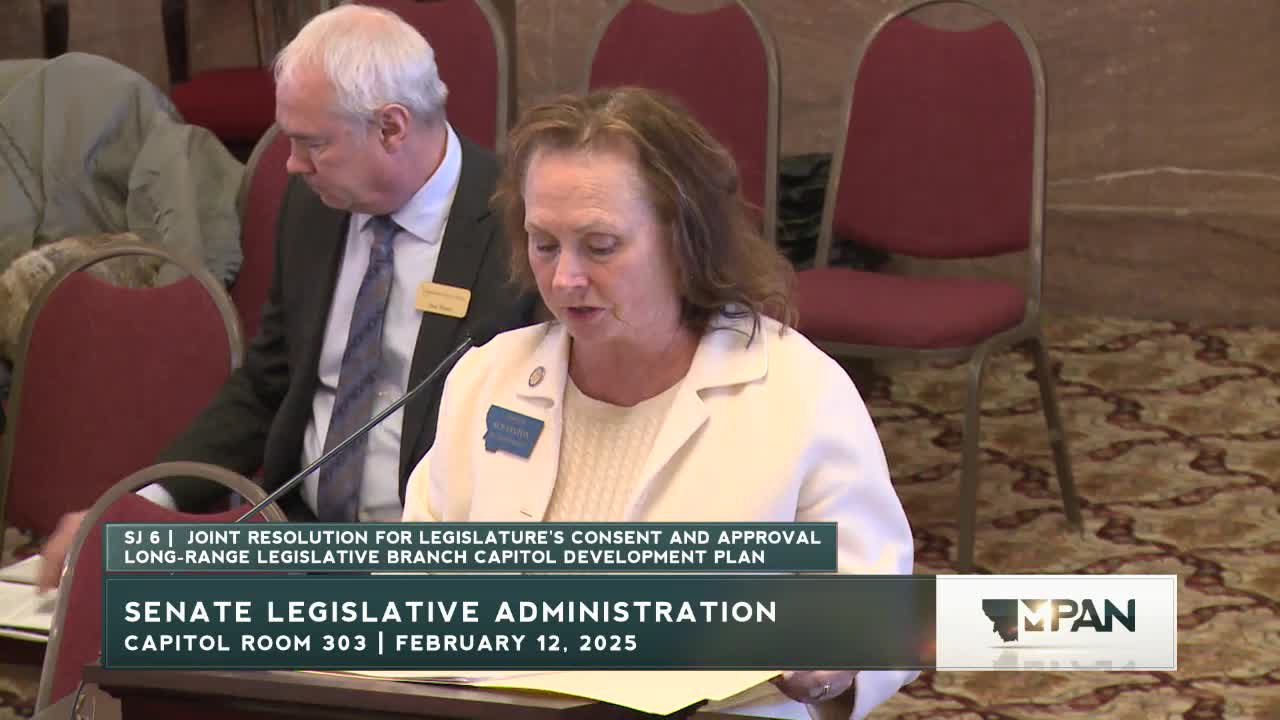
The Montana Senate Committee on Legislative Administration voted to pass Senate Joint Resolution 6, recommending legislative consent to a long-range legislative branch capital development plan led by an independent architectural team and legislative work group.
The Montana Senate Committee on Legislative Administration voted to pass Senate Joint Resolution 6, recommending legislative consent and approval of a long-range legislative branch capital development plan. Senator Sue Vinton (R.), sponsor of SJ 6, described the plan’s development, scope and next steps; the committee approved the resolution in executive action.
Vinton told the committee the long-range plan was led by an independent architectural consulting firm with participation from six legislators, three directors of permanent legislative staff, the chief clerk of the House and the secretary of the Senate and the State’s Architecture staff. The working group began in June 2023 and the plan was adopted by the Legislative Council on March 14, 2024, she said. The plan identifies priority functions and space needs and offers a planning and feasibility template for future capital development decisions.
Joe Triem, deputy director of the Legislative Fiscal Division and the legislative staff liaison for the plan, said the process was intended to be transparent and to inform future budget decisions rather than to obligate a specific project. Triem and Russ Katherman appeared as informational witnesses to describe the process and answer technical questions. Katherman said the information gathering and space evaluation “flowed very well” and aligned with typical space-planning evaluations.
Committee members asked whether cost estimates were included and how implementation would proceed. Triem said an earlier version of the plan included comprehensive cost estimates but the chair of the space planning work group did not want legislators constrained by a fully priced document; the current version omits full pricing to avoid implying legislative approval of specific projects. He confirmed there are cost estimates for a mid-range plan and that the 2023 Legislature appropriated $12.5 million for planning and improvements to legislative spaces. Triem said an additional $12.5 million exists in a legislative branch capital projects account but has not been appropriated; that money remains available for future decisions by the Legislature.
The work now proceeds in a phased approach, Triem said. Short-term and mid-range items identified for design and implementation include creating an additional Class 1 hearing room on the first floor with improved public access, consolidating legislative services bill drafters and staff into fewer, adjacent workspaces, relocating certain offices (including portions of the Legislative Audit Division), structural modifications (including removing a column to create a hearing room), and renovating an IT room into more communal office space for chairs and vice chairs. Vinton and witnesses emphasized that preserving the historical character of the Capitol building was a stated priority for the work group.
Vinton and Triem said the mid-range improvements are in design and will be put to bid with work anticipated during the interim ahead of the 2027 session; some short-term improvements have already been implemented within the existing appropriation (for example, bullpen and staff-area changes). The committee’s discussion repeatedly stressed that the long-range plan offers nonbinding recommendations and that further legislative approvals and appropriations will be required before major capital projects begin.
Vice Chair Emerich moved that SJ 6 do pass; the motion was seconded and carried by voice vote. The committee recorded the motion as approved and closed the hearing on SJ 6. The plan and final report are available on the Legislative Council page of the Montana Legislature website under the March 14, 2024 meeting materials.