Get Full Government Meeting Transcripts, Videos, & Alerts Forever!
Get email alerts on the Property Tax Relief Hb155 topic
No spam. Unsubscribe anytime.
Committee hears HB 155, sponsor says plan would rebalance post‑reappraisal property-tax burden
Summary
House Bill 155 would restructure residential property taxation to restore class shares closer to pre‑2023 reappraisal levels, provide an estimated $163 million in residential relief statewide, and reduce an apparent excess in the 95‑mill school account; proponents said it restores balance, opponents warned of complexity and tax shifting to other
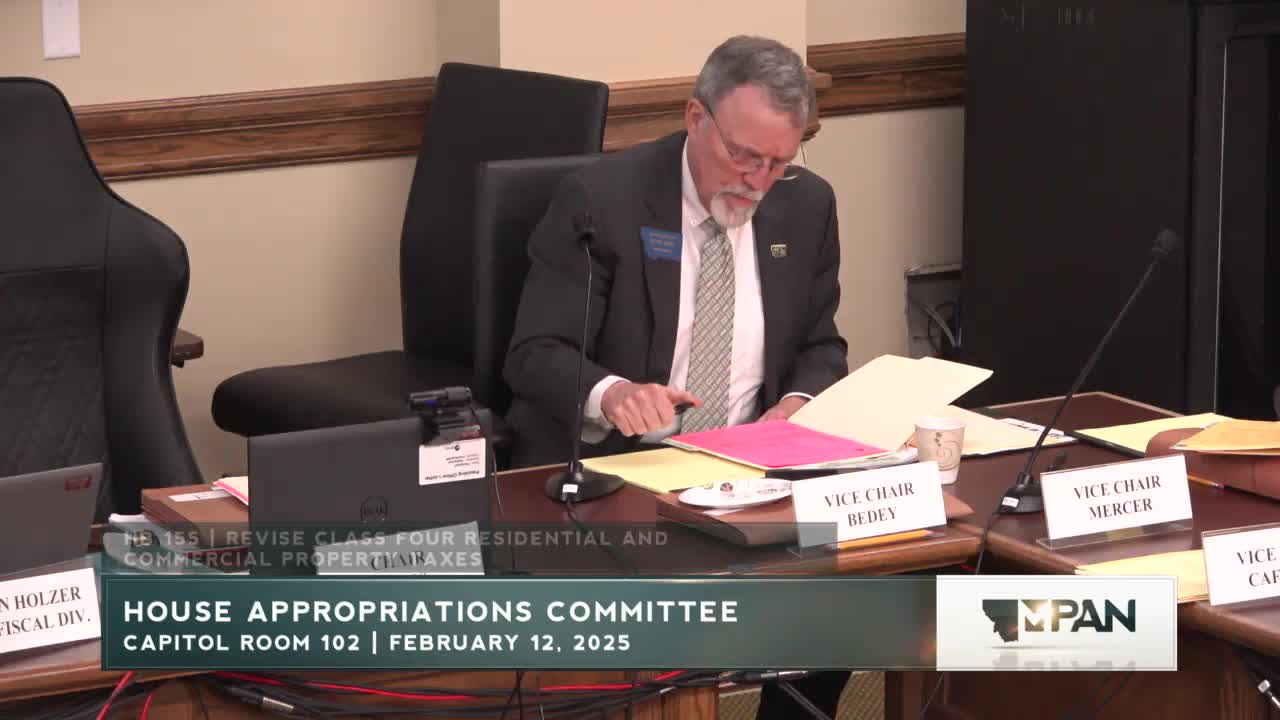
The House Appropriations Committee heard House Bill 155, sponsored by Representative Mark Thane, a proposal to change the structure of residential property taxation and rebalance property‑tax burdens among classes after the 2023 reappraisal cycle.
Thane told the committee HB 155’s intent is to return the share of property-tax responsibility across classes to levels close to 2022, before the most recent reappraisal. He said legislative fiscal modeling shows the bill would provide about $163 million in property-tax relief to class‑4 (residential) properties while leaving required state funding for school equalization intact, and that most of the apparent reduction in state revenue would come from not collecting excess revenue already being generated by the 95‑mill school levy (the sponsor cited $62,296,000 of the $74,000,000 general‑fund figure as SEPTA account revenue the bill would leave in taxpayers’ pockets).
Sponsor Mark Thane (representing House District 89) walked the committee through handouts and a fiscal matrix from the Legislative Fiscal Division showing class shares and projected post‑bill taxes. “House Bill 155 provides about $163,000,000 in property tax relief to class 4 residential,” Thane said, and he maintained the bill would not harm the budget authority of cities, counties or local schools because local mills would float as required by funding formulas.
Proponents included Sam Moyer on behalf of the City of Missoula and Margie MacDonald representing Big Sky 55 Plus. Moyer said the bill “rebalances the disproportionate tax burden on Montana residents while evening out tax responsibility across the property tax classes.” MacDonald testified the bill targets relief to middle‑ and lower‑value homeowners and “keeps your communities whole.”
Opponents raised complexity and tax‑shift concerns. Bob Story of the Montana Taxpayers Association said the bill’s graduated structure makes it difficult for taxpayers to calculate their bills and argued that lowering the taxable base would force local governments to raise mills to meet budgets, effectively shifting taxes among classes. “It’s not simple,” Story said. He also pointed to county‑level examples (Daniels County, Lincoln County) in which exemptions in the bill would remove taxable base and require remaining taxpayers to cover local budgets.
Nicole Rolfe of the Montana Farm Bureau Federation opposed the bill because she said in some counties the burden of any shift would fall mainly on agricultural (class 3) landowners. Rolfe summarized the Department of Revenue language in the fiscal note that “almost all jurisdictions will see a decrease in the taxable value from class 4 property and resulting shift in taxes to other classes.”
Department of Revenue economist Jared Isom and Legislative Fiscal Division staff assisted with questions about the fiscal modeling; Isom told the committee DOR can administer the schedule of rates in the bill. Committee members questioned whether the bill treats nonresident or second homes differently (it does not; class 4 residential is not split into primary vs. secondary residences in this draft) and whether the City of Billings’ charter, which relies on mills rather than dollar levies, poses special implementation issues; the sponsor said Billings is unique and that the charter distinction may require local clarification.
The hearing included discussion of an amendment to change the commercial provision (originally an exemption on the first $200,000 of assessed commercial value modified in amendment to an exemption on the first $400,000) and the sponsor said that change removed the need for a proposed 14 additional Department of Revenue FTEs, leaving a net estimated increase of roughly 0.5 FTE to administer multifamily exemptions. The sponsor closed by reiterating the goal to restore a fair share of tax burden to classes other than residential and urged a due pass recommendation.
Ending: The hearing closed without a committee vote; the committee scheduled executive action the following day on other bills referenced during the session.