Get Full Government Meeting Transcripts, Videos, & Alerts Forever!
Get email alerts on the Public Service Commission Overview topic
No spam. Unsubscribe anytime.
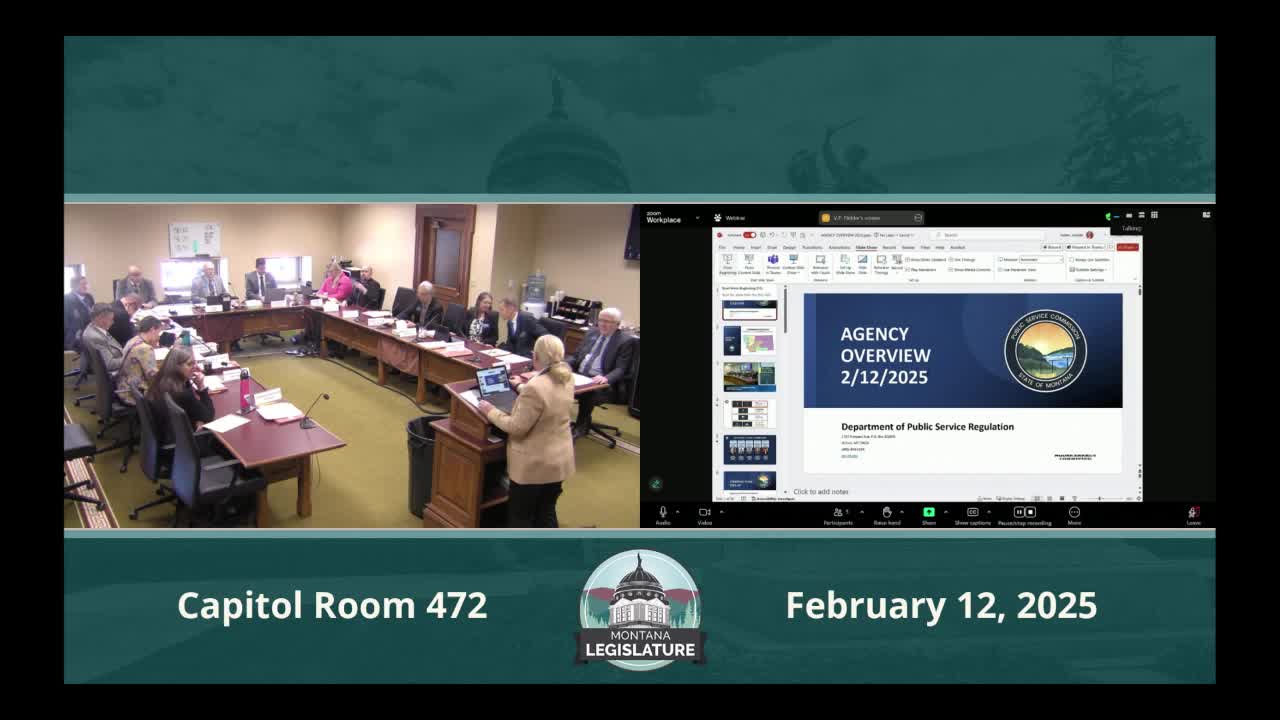
Public Service Commission outlines safety, rate and consumer programs to House committee
Summary
Officials from the Montana Public Service Commission briefed the House Energy, Technology and Governmental Affairs Committee on the agency’s structure, safety programs, rate-analysis work and consumer-assistance functions.
The Montana Public Service Commission told the House Energy, Technology and Governmental Affairs Committee on the Legislature’s interim session that it has reorganized to improve operations and to clarify roles between commissioners and staff. "We created an executive director position to work with the commission and serve as a buffer between individual commissioners and staff," said Jennifer Fielder, vice president of the Montana Public Service Commission.
The commission described itself as a quasi‑judicial body that regulates privately owned monopolistic utilities — including electric, natural gas, water, sewer and landline telephone companies — and oversees programs such as pipeline and railroad safety. "These industries are monopolistic, industries that are privately owned, and they have a captive customer audience," Fielder said, explaining why state regulation exists for those businesses.
The PSC said it has completed a multi‑year strategic planning process begun in 2021 to address organizational and audit shortcomings, standardize internal policies and stabilize staffing levels. "We tackled organizational structure to resolve prior audit shortcomings, and we also instituted firm and specific internal policies that require higher standards of conduct," Fielder said. She added the commission had been working with the Legislature to restore staff positions that had been cut earlier in the decade and that the agency is close to reaching its historic staffing level of about 40 employees.
Lucas Hamilton, chief legal counsel for the Department of Public Service Regulation, summarized the legal division’s role in contested cases, rulemakings and public records. "We facilitate the commission’s contested case proceedings and rule makings," Hamilton said, noting the division also represents the commission in litigation and processes formal filings. Will Rosequist, regulatory division administrator, described the rate‑analysis team and its role in evaluating rate cases and recommending orders. "The rate analyst team is about evenly split between economists and financial accounting analysts," Rosequist said, explaining the three core issues in rate cases: revenue requirement, cost allocation and rate design.
Program managers described safety and compliance activities: Joel Tierney, pipeline safety program manager, said PSC inspectors work under a partnership with the U.S. Department of Transportation’s PHMSA for intrastate pipelines and reported recent perfect scores on federal performance audits. Dan Sherwood, railroad program manager, said state railroad inspectors are certified under the Federal Railroad Administration and recently identified overheated wheel bearings and thin flanges during inspections that otherwise might have gone undetected. Tina Shorten, supervisor of regulatory compliance, described the PSC’s consumer‑assistance work, dispute negotiation and administrative tasks including processing registrations and monitoring numbering resources for Montana’s 406 area code.
Committee members asked procedural questions and were directed to PSC staff for follow‑up. No formal committee action was taken on the presentation; the session proceeded to bill hearings and executive action.
The PSC urged lawmakers to rely on staff briefings and to contact agency offices for detail on technical questions, and committee members were encouraged to follow the PSC’s public outreach channels for updates.