Get Full Government Meeting Transcripts, Videos, & Alerts Forever!
Get email alerts on the Dependency Neglect Taskforce topic
No spam. Unsubscribe anytime.
Bill would renew dependency-and-neglect task force to continue court reforms
Summary
Senate Bill 268 would extend the statutory dependency-and-neglect task force for two more years to continue work improving Montana’s DN court practices. Supporters said the interim task force produced multiple reforms (for example, changes to 5‑day hearings and show-cause processes) and recommended renewal to advance additional legislation; the
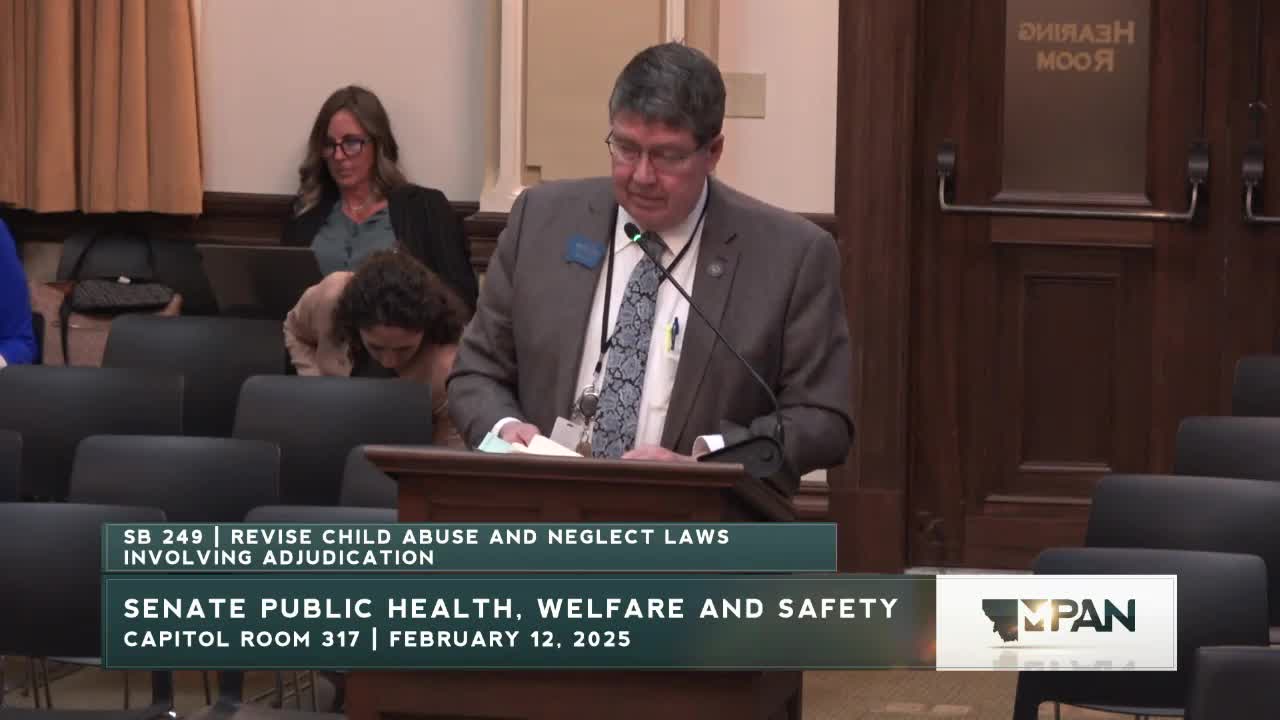
Senate Bill 268, presented Feb. 12 to the Montana Senate Public Health Committee by the sponsor, would renew the Dependency and Neglect (DN) Task Force for another two years to continue study and recommend improvements to Montana’s DN court system and related statutes.
The sponsor said the task force spent the interim examining whether a separate statewide DN court system was feasible and concluded that creating a separate statewide DN court lacked sufficient traction because of unanswered questions about judge appointment and funding. The bill therefore seeks to refocus the task force on reforming the existing DN process, including examining terminology, strengths and weaknesses of current practice, and producing recommended statutory changes.
Proponents included Montana CASA/GAL Association, the Division of Child and Family Services, the Montana Coalition Against Domestic Violence, and the Montana Family Court Awareness Project. April Barnings (spelled in testimony as Barnings), representing CASA/GAL, said the task force had brought stakeholders together and produced bills that improved outcomes for children and families. Nikki Grossberg (DCFS) and Kyla Hailstone (Montana Family Court Awareness Project) also supported renewal and credited the task force with producing meaningful interim reforms. The sponsor said previous task-force work contributed to legislative changes such as 5-day hearing modifications and show-cause hearing changes, and estimated the cost to fund the task force at about $80,000 over the biennium based on the prior cycle.
Committee members asked about tangible results from the prior task force; the sponsor pointed to the reforms that did move forward and said continuing the task force would allow further stakeholder collaboration. No opponents testified. The sponsor closed by asking for a due pass; the hearing concluded.
Senate Bill 268 hearing record: task-force renewal was presented by the sponsor and supported by advocates and state agency representatives who emphasized cross‑stakeholder work to produce statutory improvements to DN processes.