Get Full Government Meeting Transcripts, Videos, & Alerts Forever!
Get email alerts on the Environmental Trust Fund topic
No spam. Unsubscribe anytime.
Senate committee advances $103.3 million LCCMR package, sends bill to finance panel
Summary
Senate members on Thursday recommended passage of Senate File 506, the Legislative‑Citizen Commission on Minnesota Resources (LCCMR) package that would authorize $103,326,000 in spending from the Environment and Natural Resources Trust Fund and re‑refer the bill to the Senate Finance Committee.
Senate members on Thursday recommended passage of Senate File 506, the Legislative‑Citizen Commission on Minnesota Resources (LCCMR) package that would authorize $103,326,000 in spending from the Environment and Natural Resources Trust Fund and re‑refer the bill to the Senate Finance Committee.
The bill contains 124 appropriations that LCCMR staff and commissioners packaged after a multistage competitive process; the commission received 214 proposals requesting roughly $183 million and limited awards to fit the available $103,326,000. The committee approved the recommendation by voice vote after a presentation from the LCCMR director and brief questions from senators.
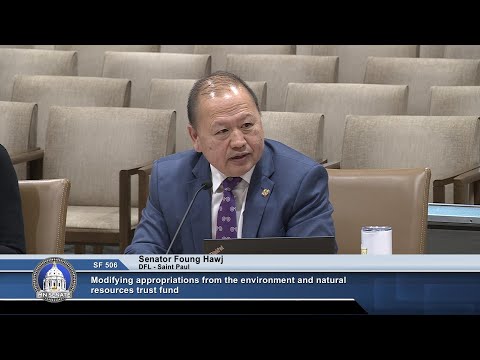
"Senate File 5 0 6 is a bipartisan bill," said the bill’s sponsor, Chair Senator Her, who presented the LCCMR package to the committee. "This bill has been vetted by the LCCMR."
Becca Nash, director of the Legislative‑Citizen Commission on Minnesota Resources, told the committee that LCCMR is a 17‑member joint commission that vets proposals and recommends appropriations from the constitutionally dedicated Environment and Natural Resources Trust Fund. "The trust fund is a permanent fund in the state treasury that was created by voters through a constitutional amendment to support activities that protect, conserve, preserve, and enhance Minnesota's air, water, land, fish, wildlife, and other natural resources," Nash said.
Nash summarized the commission’s process: a request for proposals based on LCCMR priorities, multiround scoring, applicant presentations, and external scientific peer review. The commission’s package includes both new awards and carryforwards of prior appropriations; subdivisions of the bill lay out funding categories and conditions of funding.
Key category totals listed in the bill are: foundational data and information, $22,084,000 (36 appropriations); water resources, $11,812,000 (23 appropriations); environmental education, $11,965,000 (19 appropriations); aquatic and terrestrial invasive species, $6,713,000 (2 appropriations); air quality/climate/renewable energy, $11,744,000 (7 appropriations); methods to protect or restore land, water and habitat, $12,188,000 (19 appropriations); land acquisition, habitat and recreation, $19,553,000 (14 appropriations); and administration and emerging issues, $7,267,000 (4 appropriations). Nash said the bill also includes standard conditions of funding addressing reporting, work plans, acquisition requirements and other compliance items, plus carryforwards of previously appropriated projects.
Committee members questioned how specific pieces would be administered and raised concerns about the balance between research and on‑the‑ground projects. Senator Green pressed LCCMR staff about funding for university research and whether grant dollars supplement faculty salaries. "When researchers come to ask for funding from us, we will only pay for their summer research salary," Nash replied, saying LCCMR funding is limited to direct, necessary project costs and is not intended to supplant traditional funding.
Senator Green also asked whether a $280,000 appropriation for DNR administrative services covers additional grant administration tied to a recent constitutional change. Nash said the November 2024 constitutional amendment increased the allowable drawdown from 5.5% to 7%, creating an additional 1.5% allocation to be managed by the Department of Natural Resources for a separate community grants program; Nash said the community grants program funding is separate from the 5.5% that LCCMR recommends and that details about how DNR will allocate administrative costs for the new program were outside LCCMR’s purview.
John Waters, government relations unit supervisor at the DNR, and Nash each provided estimates for land acquisition in the bill: DNR acquisitions tied to Scientific and Natural Areas were estimated at about 90 acres, an approximate 100 acres were listed for local parks/trails/natural areas grants (to be acquired by local governments), and the City of Chaska requested 5.7 acres through a separate item. Nash cautioned that the 100‑acre figure is an estimate pending local applications and competitive grant results.
Senator Wiesenberg and other members questioned the value of repeated or narrowly focused studies and urged scrutiny of research proposals that appear to duplicate prior work. Nash and commission staff said proposals undergo peer review and multiple scoring rounds, and that staff and commissioners weigh applicability and necessity during selection.
After discussion, Chair Senator Her moved that the committee recommend passage and re‑refer Senate File 506 to the Finance Committee. The motion carried on a voice vote; the committee recorded no roll call or numeric tally.
The bill will proceed to the Finance Committee for further consideration. LCCMR staff and DNR representatives said they will follow up with committee members on specific line items and administrative questions raised during the hearing.