Get Full Government Meeting Transcripts, Videos, & Alerts Forever!
Get email alerts on the Child Family Services topic
No spam. Unsubscribe anytime.
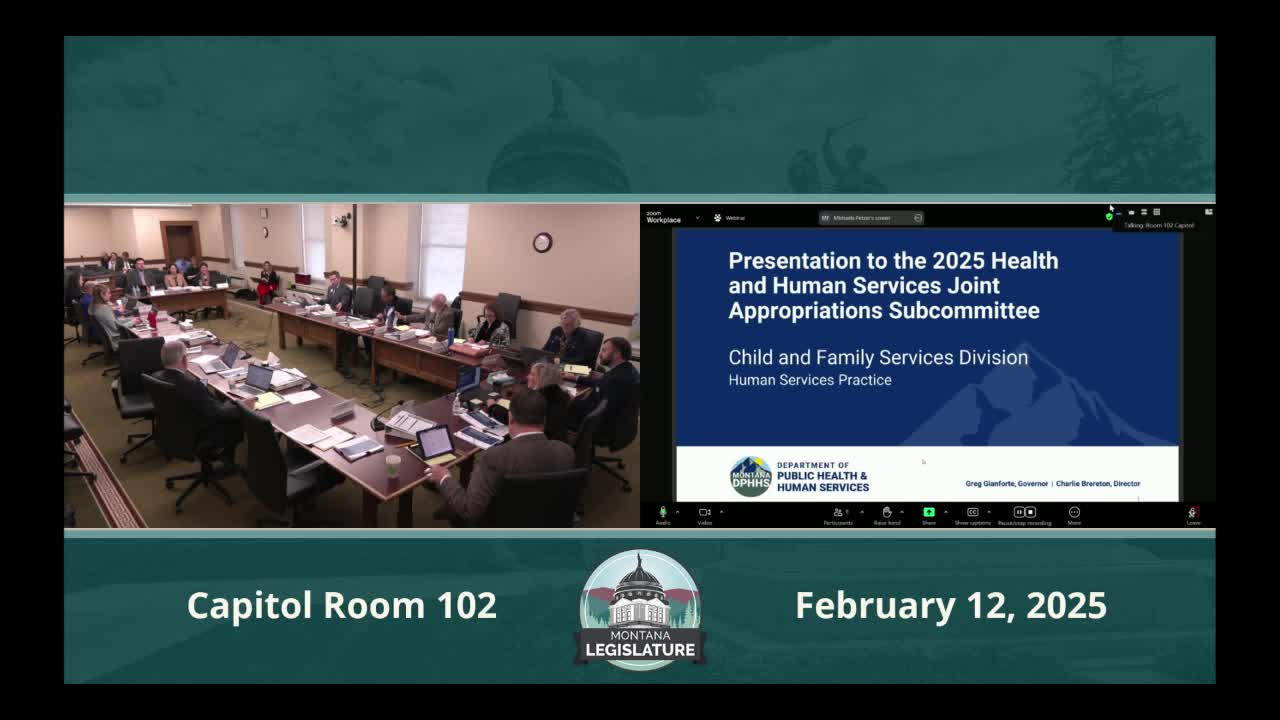
Appropriations subcommittee opens weeklong deep dive on Child and Family Services, federal review and budget pressures
Summary
Department of Public Health and Human Services officials briefed the subcommittee on the Child and Family Services Review (CFSR) process, the department’s 2025–2029 Child and Family Services Plan, federally required performance measures, and budget pressures tied to Title IV‑E eligibility, provider rates and general fund reliance.
The Legislature’s appropriations subcommittee began a multi‑day, in‑depth review of Child and Family Services at the Department of Public Health and Human Services (DPHHS), focusing on the federal Child and Family Services Review (CFSR), how federal laws shape child‑welfare practice, tribal coordination and current budget pressures.
Nikki Grossberg, division administrator for Child and Family Services, said the state must submit a five‑year Child and Family Services Plan to the federal Children’s Bureau and undergo an on‑site CFSR; Montana’s next review is scheduled for August 2025 and the plan now covers 2025–2029. Grossberg described the review as a structured, layered process that combines a statewide assessment, structured case reviews and stakeholder interviews. “The review informs the plan,” she said.
Grossberg and other DPHHS staff outlined the CFSR mechanics: the federal review team examines 65 cases (40 foster‑care cases and 25 in‑home cases), conducts interviews with children, parents, caregivers and justice system stakeholders, and evaluates outcomes in safety, permanency and well‑being plus a set of systemic factors such as statewide information systems, training, licensing and quality assurance. States receive scores for case items and systemic factors; no state has ever “passed” a CFSR, and areas needing improvement lead to a program improvement plan with six‑month progress reviews.
The department told lawmakers that Montana’s 2017 review data underlies the present plan and that permanency outcomes — specifically children remaining in care more than 24 months — were a key area requiring continued focus. State officials said Montana increasingly places children with relatives (about half of children in foster care) and noted the state is preparing for a new CCWIS case management system to address documented limitations in the legacy CAP system.
DPHHS also reviewed federal statutory context that has shaped child‑welfare policy and funding: the Indian Child Welfare Act (ICWA, 1978), the Adoption and Safe Families Act (ASFA, 1997), the Fostering Connections to Success and Increasing Adoption Act (2008), the Families First Prevention Services Act and more recent trafficking‑related requirements. Officials said these laws change both practice expectations and eligibility rules for federal funding streams.
On finances, DPHHS outlined the split among general fund, federal Title IV‑E and other grants. Officials said Title IV‑E continues to fund maintenance payments for eligible foster care, adoption subsidy and some guardianship cases, while Title IV‑E prevention (available for evidence‑based services under Families First) remains a small but growing category. The department reported approximate Title IV‑E spending in its base year: foster care about $5.6 million, adoption subsidies about $16 million, and guardianship subsidies about $4.4 million (figures presented by staff). The department also described multiple smaller federal grants (Chafee, CAPTA, Safe and Stable Families), and pass‑through Title IV‑E administrative funds to tribes, county attorneys, the Office of Public Defender and others.
Committee members asked for additional materials: a history of audits and past CFSR reports, the prior five‑year plan and program improvement plan, tribal IV‑B plans and examples of county agreements used to claim pass‑through Title IV‑E administrative dollars. Officials said some funds (for example, a federal Children’s Justice Act grant of roughly $99,000) have been moved to a nonprofit (Children’s Alliance of Montana) as a pass‑through and no longer run through DPHHS, and they acknowledged counties sometimes decline Title IV‑E administrative claims because of the documentation burden.
DPHHS committed to providing requested documents, clarifications on the federal eligibility rules that drive IV‑E claiming, and further breakdowns of grant recipients and pass‑through agreements. The committee scheduled follow‑up sessions later in the week to examine caseload drivers, placement types and the department’s budget change packages.