Get Full Government Meeting Transcripts, Videos, & Alerts Forever!
Get email alerts on the Gaming Regulation topic
No spam. Unsubscribe anytime.
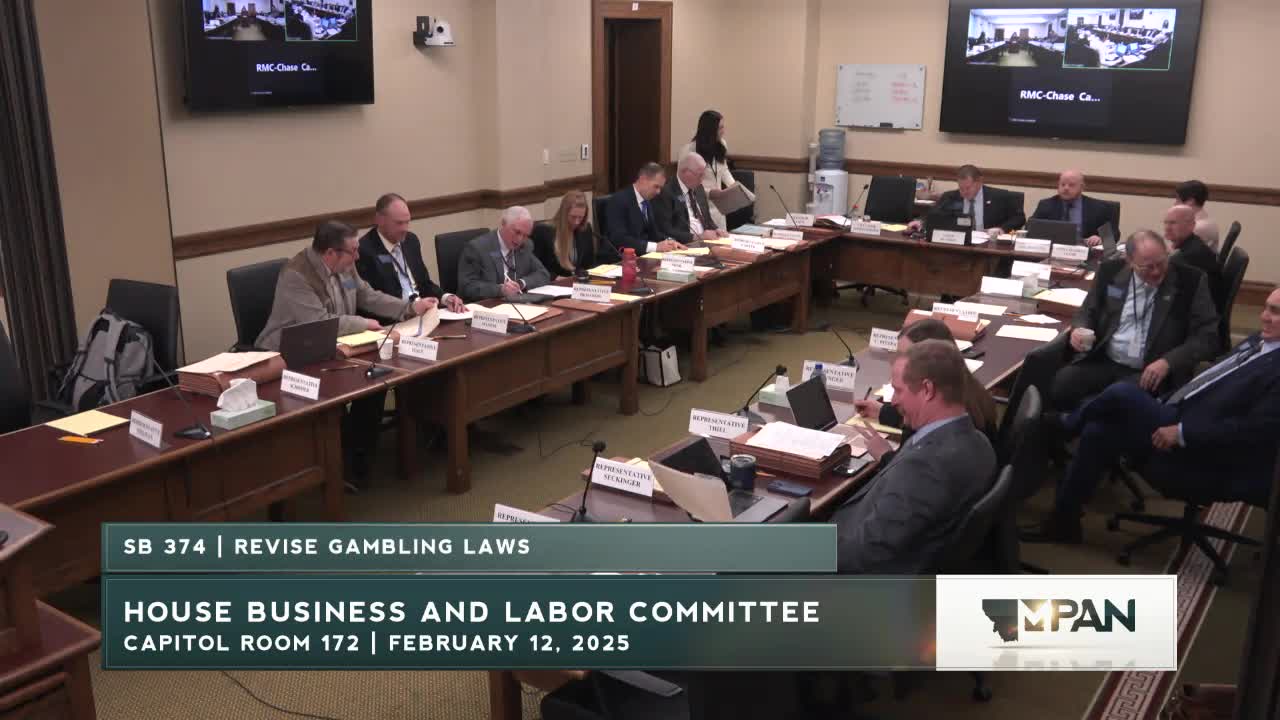
Bill to allow expanded nonprofit ‘casino nights’ draws split testimony over regulation and tribal compacts
Summary
Supporters said House Bill 374 gives Montana nonprofits another fundraising tool; opponents warned the change would expand gambling, raise regulatory questions, and could trigger tribal‑compact renegotiations under federal law.
Representative Alana Griffith told the committee House Bill 374 would permit nonprofits to hold an expanded form of “casino night” once per year, providing another fundraising option for organizations that face donor fatigue.
Proponents including Marielle Boutan of Morning Star Learning Center and Kevin Sylvester of Eagle Mount said the bill responds to nonprofit fundraising challenges and is intended to be a limited, once‑a‑year option. Boutan told the committee she was “delighted” by the idea of a casino night fundraiser and “devastated” when she learned some events were currently unlawful; she asked members to “embrace this common sense bill.”
Opponents — including representatives of Montana’s coin‑machine operators, the Gaming Industry Association, and the Montana Tavern Association — said the change looks minor but could broaden allowable gaming and create complex regulatory and federal‑compact consequences.
Rhonda Wiggers of the Montana Coin Machine Operators Association warned that the state’s definition of nonprofit is broad and that permitting expanded casino‑style games could require renegotiation of tribal gaming compacts under the Indian Gaming Regulatory Act (IGRA). Wiggers said the practical effect could be far greater activity than sponsors intend: “If we allow casino nights for non profits in the state of Montana, we do have to consider that we will need to renegotiate and be federally required, if they ask, to renegotiate all of our tribal compacts,” she said.
John Iverson of the Montana Tavern Association said the bill is “a fairly good sized expansion in gambling” and described a regulatory distinction between poker (a player‑versus‑player game) and house‑banked games like blackjack, where the house has an incentive to run the table and keep revenue. Shauna Helford of the Gaming Industry Association opposed the bill on the grounds that it lacks rules, oversight and enforcement mechanisms.
Sponsor and supporters’ responses: Representative Griffith said the bill applies only to nonprofits and only once per year, and described typical nonprofit casino nights as events where patrons buy “paper money” with real cash and use the paper money to play games and later redeem it for auction items or prizes. Griffith said she had examined other states’ models and that in practice nonprofit events often use a flat‑fee contract with a vendor to provide tables and dealers.
Committee discussion: Members asked whether events could be run with real cash, and opponents explained that house‑banked games create a profit motive for the venue and noted current law permits poker tournaments because poker is player‑versus‑player. Sponsor and supporters emphasized intent to limit expansion and described existing business models that rent equipment and dealers to nonprofits. Committee members also asked about safeguards to prevent an expansion beyond the once‑a‑year limit; opponents said legislative changes in subsequent sessions could expand scope.
Outcome: The committee closed the hearing without a vote. In a later executive session the committee did not record a direct vote on HB 374 in the provided transcript.
Ending: Supporters urged the committee to allow an additional fundraising tool for Montana nonprofits; opponents urged the committee to consider regulatory detail, enforcement, and potential implications for tribal gaming compacts before advancing the bill.