Get Full Government Meeting Transcripts, Videos, & Alerts Forever!
Get email alerts on the Criminal Justice Child Endangerment topic
No spam. Unsubscribe anytime.
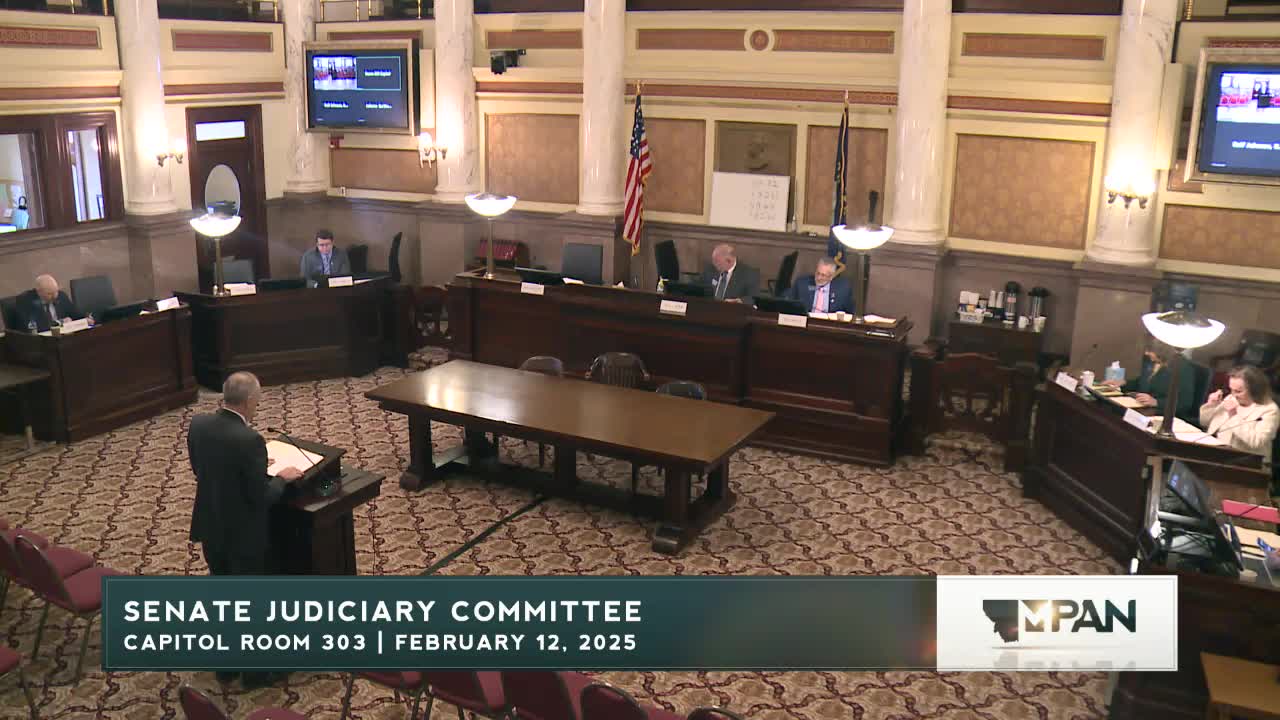
Committee hears bill to expand child‑endangerment law to include exposure to fentanyl and marijuana products
Summary
Senate Bill 261 would broaden Montana’s criminal endangerment statute to cover causing or permitting a child to inhale or ingest marijuana products and to account for fentanyl exposure in searches; the attorney general and prosecutors urged passage while lawmakers pressed for safeguards on testing and intent standards.
Senators on the Judiciary Committee heard testimony on Senate Bill 261, a proposal to expand Montana’s criminal endangerment statute to include exposure of children to marijuana (including THC products) and to make fentanyl‑related production and exposure grounds for child endangerment charges.
Senator Greg Hertz, sponsor of SB 261, told the committee the bill adds items to the existing offense of endangering the welfare of a child. The changes cited in committee include language on "causing or permitting the child to inhale, be exposed to, or ingest marijuana including marijuana THC products such as ingestible foods or drinks," and language addressing human trafficking and assisting a child to enter locations tied to drug production or adult‑use dispensaries.
Austin Knudsen, Montana attorney general, testified as a proponent and said the bill corrects an omission in past fentanyl‑related statutes so law enforcement can charge criminal endangerment when officers find fentanyl or precursors during a search of premises where children are present. "That was the big intent behind this bill ... we wanted to add and make sure that officers, when they're conducting those kind of searches, if they come across fentanyl, which is extremely dangerous... we need to be able to," he said.
Celine Koepke, an assistant attorney general in the Appellate Services Bureau who helped draft the bill, and representatives from law enforcement including the Montana Police Protective Association and the Division of Criminal Investigation's narcotics bureau supported the bill in committee. The chemistry supervisor for the Montana Forensic Science Division also appeared as an informational witness.
Committee members raised practical and legal questions. Senator Mansella described a custody dispute example in which low levels of marijuana metabolites were found in a child and asked whether the bill governs testing methods; witnesses said the bill does not dictate testing protocols. On the subject of proof, Koepke and Attorney General Knudsen told senators a criminal charge would require proof a person knowingly exposed a child to a drug; the prosecutors said intent and facts and circumstances would determine whether charges would be brought.
Senator Ricky asked whether listing "scheduled" drugs requires specific enumeration; Koepke responded that the statutory schedule covers categories of controlled substances and individual drugs need not be listed in the bill.
Other senators raised concerns about the bill's reach into private residences and whether secondary exposure (for example, secondhand smoke) would be prosecutable. Knudsen and Koepke emphasized prosecutors would need to prove knowing and purposeful exposure under Title 45 and said routine secondary exposure would be difficult to sustain as criminal intent.
No formal committee vote occurred during the hearing; the bill was left for further consideration. Committee discussion included questions on testing methods and thresholds, the standard of intent required for criminal charges, and whether the bill's language about assisting a child to enter an adult dispensary or a place of manufacturing should be narrowed or clarified.