Lifetime Citizen Portal Access — AI Briefings, Alerts & Unlimited Follows
Montana bill would let licensees share alcohol proceeds on ‘net’ as well as ‘gross’ sales
Loading...
Summary
Supporters of House Bill 391 told the House Business and Labor Committee the change is a narrow, two‑word fix to ease accounting and reduce frequent amendments to concession agreements; opponents urged additional vetting of concessionaires because they can effectively operate like licensees.
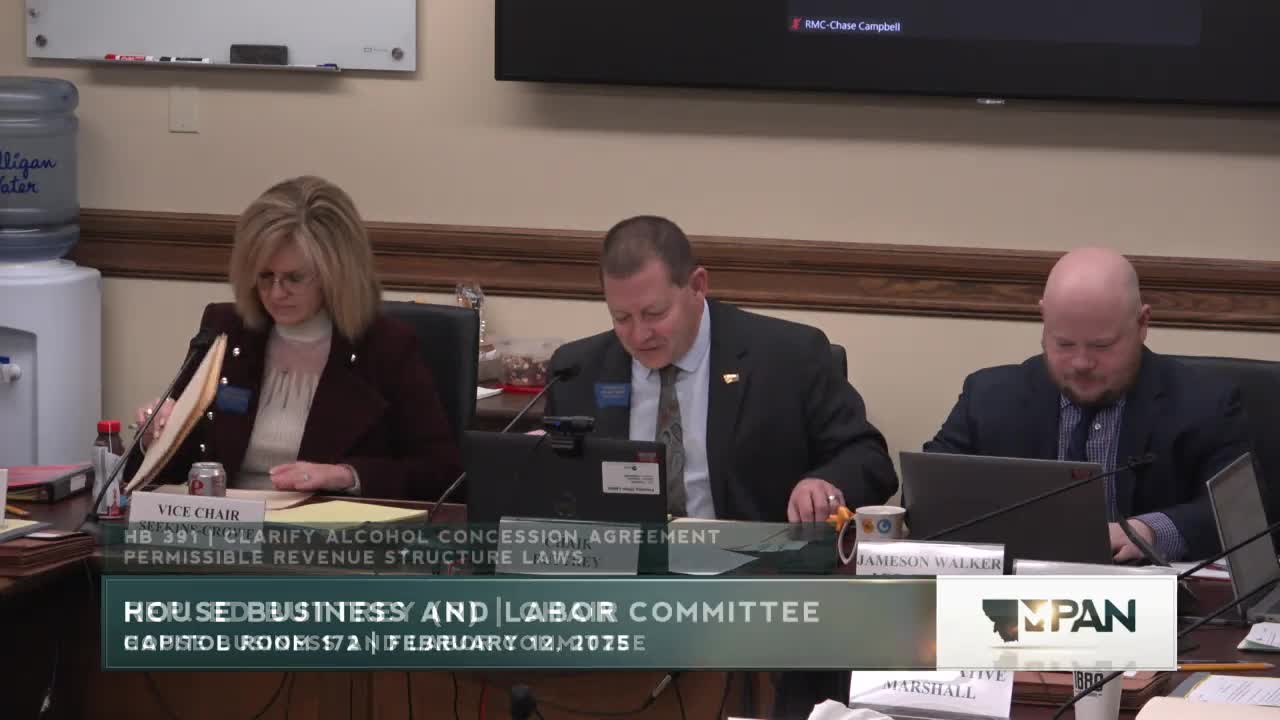
Representative Curtis Schomer, sponsor of House Bill 391, told the House Business and Labor Committee that the bill would add the word “net” to the statutory language governing compensation in concession agreements between alcohol licensees and concessionaires.
The change would allow parties to calculate a share of alcoholic beverage sales either on gross alcoholic beverage sales or on net alcoholic beverage sales, giving licensees and concessionaires another option for structuring compensation, proponents said.
Why it matters: Concession agreements let unlicensed entities in the same building as a licensed premise participate in alcohol sales. Proponents — including Jesse Luther of the Hospitality and Development Association of Montana, Brad Griffin of the Montana Restaurant Association, Jennifer Hensley of the Montana Distillers Guild, and several attorneys representing licensees — said the bill is a narrow, common‑sense fix that eases accounting and reduces the need to amend concession agreements frequently.
Jesse Luther, testifying for the Hospitality and Development Association of Montana, said the current inclusion of the word “gross” in statute creates accounting difficulties and frequent amendments, and that offering “net” as an option will “streamline accounting and simplify these agreements.” Luther asked the committee to pass the bill as drafted.
Several online and in‑person proponents echoed that view. Attorney Michael Lawlor said being able to calculate compensation on net revenue “would be tremendously helpful” for businesses and for state staff who review concession agreement amendments. Attorney Jessica DeMouris described the amendment as “very, very narrow” and said concession agreements are a practical tool for complex ownership structures such as hotels and resorts.
Opponents raised compliance concerns. John Iverson of the Montana Tavern Association said the bill “further cements” a shift in which concessionaires operate more like licensees and argued the state should require background checks for concessionaires if they are to share profits and liabilities. Iverson told the committee, “if we’re gonna background check, let’s background check all parties.”
Becky Schlau, Alcoholic Beverage Control Administrator at the Department of Revenue, answered committee questions about current vetting practices: she said the department vets license owners who own 15% or more of a license and vets location managers, but it generally does not vet concessionaires and sometimes only knows the entity name rather than the individuals behind it. Schlau told the committee the department enforces statute as written and would need a change in law to expand vetting.
Discussion and limits: Committee members asked whether the bill would trigger broader vetting or other policy changes; proponents said the bill is intentionally narrow and should not force changes to existing agreements that are working. Schlau and several members emphasized that liability ultimately remains with the licensee, but that the structure of concession agreements — including whether employees are shared or separate — affects enforcement and exposure.
No formal committee vote on HB 391 appears in the transcript from this hearing. The committee closed the hearing after the sponsor’s final remarks, during which Representative Schomer said, “This bill is a Monday bill,” urging the committee for a “do pass.”
Ending: The committee closed the public hearing on HB 391 and moved to the next item on its agenda. If the committee advances the bill later, lawmakers and stakeholders flagged two topics to watch: whether the statute should require background checks for concessionaires and how the Alcoholic Beverage Control Division will implement guidance for net‑based revenue shares.