Get Full Government Meeting Transcripts, Videos, & Alerts Forever!
Get email alerts on the Higher Education Funding topic
No spam. Unsubscribe anytime.
Higher-education budget hearing puts Sellinger formula cuts at center of debate
Summary
Analysts recommended steep cuts to the Sellinger formula and replacing it with a needs-based grant program; Maryland Higher Education Commission and independent colleges urged retaining the formula, warning cuts would reduce financial aid to Maryland students and strain small private campuses.
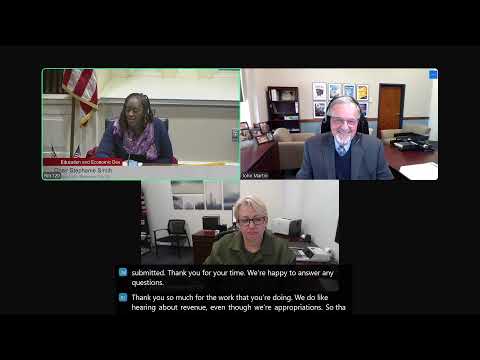
The Education and Economic Development Subcommittee heard competing proposals on the future of the Sellinger funding formula and other higher-education budget changes during a Maryland Higher Education Commission (MHEC) budget briefing and panel of university and association representatives.
The Department of Legislative Services (DLS) analyst Sarah Baker summarized fiscal recommendations and data, saying the DLS recommended reducing Sellinger-related funding by 50% and restricting the remaining $36,700,000 for a grant program to be administered by MHEC; DLS also recommended amending statute to permanently eliminate the Sellinger formula and replace it with a competitive grant program (DLS presentation, transcript blocks starting at 748.485). MHEC Secretary Sanjay Rai and multiple independent-college leaders opposed the recommended change.
Why it matters: Sellinger funding has historically provided an annual, predictable allocation to independent nonprofit institutions in Maryland and is frequently used by those institutions to provide student financial aid. Speakers said steep cuts or a shift to a competitive, needs-based grant would reduce predictable aid for Maryland students, force institutions to carve into other operating areas, and could weaken smaller campuses critical to local economies.
DLS analysis and MHEC response
Sarah Baker (DLS analyst) walked the subcommittee through exhibits showing enrollment shifts, the student loan debt tax credit program, and the fiscal 2026 allowance. Baker noted DLS recommends reducing Sellinger formula funding by 15% in one proposal and, in a stronger recommendation, by 50% in another, with the restricted remaining funds used for grants awarded based on institutional financial need. The DLS paper also recommended amending statute to replace the formula with a grant program and cited projected state budget constraints in support of the change.
Secretary of Higher Education Sanjay Rai, appearing with MHEC staff, opposed eliminating the Sellinger formula and asked the General Assembly to fund the program at the governor’s allowance. Rai argued the per‑FTE allocation is an objective, predictable mechanism for distributing funds to independent nonprofit institutions and that a state-administered competitive needs assessment would be “extensive and burdensome” for MHEC to implement. Rai also emphasized the administration’s broader budget request to support statewide higher‑education priorities.
Independent colleges and university testimony
Representatives of the independent sector described the program as a long-standing compact between the state and private colleges that supports student aid and institutional stability.
- Maria Tilden, vice president for government, community and economic partnerships at Johns Hopkins University, told the committee that “the financial support that Sellinger grama provides is essential to that goal,” adding that Sellinger awards currently support aid packages that keep Maryland students in state, particularly during a period of federal funding uncertainty for research universities.
- Matt Power, president of the Maryland Independent College and University Association, said the sector has already absorbed a 50% reduction in the formula in the prior year and warned another 50% cut over two years would “result in a 73% reduction over the last 2 years” for independent colleges’ share of state higher‑education funding.
Institution leaders from St. John’s College, Notre Dame of Maryland University, Washington Adventist University and others described Sellinger dollars’ direct use for institutional financial aid: several presenters said institutions apply 70–89% of Sellinger funding to student financial assistance and that steep reductions would force layoffs, program cuts or reduced aid for Pell‑eligible and first‑generation students.
Johns Hopkins settlement and other fiscal items
Baker also summarized a separate, recent federal antitrust settlement in which Johns Hopkins University agreed to an $18.5 million settlement in a multi‑institution case alleging collusion over financial‑aid practices. The transcript records DLS noting the settlement and the underlying litigation (transcript blocks 1199.23–1205.325). MHEC and witnesses referenced that litigation as context but did not propose statutory change directly linked to that settlement at the hearing.
Outcome and next steps
No formal vote was taken by the subcommittee during the hearing. DLS recommendations remain part of the budget bill drafting process; MHEC and the independent college coalition asked lawmakers to reject the DLS proposal and fund Sellinger at the governor’s allowance for fiscal 2026. Committee staff signaled they had heard the testimony and would process the DLS-required releases of withheld funds where appropriate (DLS recommended release of $100,000 contingent reporting; DLS and MHEC concurred that the reporting requirement had been met).
Ending
The committee set no immediate decision during the hearing; members and MHEC staff signaled continuing negotiations as the budget bill language is finalized. The Sellinger proposal remains an open item for the General Assembly’s budget and policy decisions later in the session.