Get Full Government Meeting Transcripts, Videos, & Alerts Forever!
Get email alerts on the Wildlife Trust Large Projects topic
No spam. Unsubscribe anytime.
House TRW advances $30M+ in wildlife trust large projects including Kemmerer migration crossing
Summary
The House Travel, Recreation, Wildlife & Cultural Resources Committee approved Senate File 88 after hearing about a slate of large landscape projects from the Wyoming Wildlife Natural Resource Trust, including a $31 million Kemmerer migration crossing package and statewide cheatgrass control efforts.
The House Travel, Recreation, Wildlife & Cultural Resources Committee voted unanimously to approve Senate File 88, advancing a set of large-scale projects recommended by the Wyoming Wildlife Natural Resource Trust (WWNRT), the committee heard Wednesday.
The measure funds multiple landscape-scale habitat and infrastructure projects, including the Kemmerer 189 migration project — a $31,000,000 multi-component highway crossing package featuring fences, underpasses and one overpass — and a suite of invasive-grass (cheatgrass) control initiatives across several counties.
Why it matters: The projects target wildlife movement, sagebrush-ecosystem restoration and cheatgrass control on tens of thousands of acres. Director Bob Budd of the Trust told the committee these are the largest-dollar “large projects” the board has submitted for legislative approval and said they respond to legislative direction to address invasives and migration mortality.
Director Bob Budd, director of the Wyoming Wildlife Natural Resource Trust, described project types and scale. “If you’re treating 50,000 acres, as an example, with invasive species, you’re taking out the seed source for everything downwind and you’re protecting that particular area,” Budd said. He also described fence modification, erosion-control structures, removal of approaching conifers and water developments that benefit mule deer, antelope, sage grouse and other sagebrush-obligate species.
Committee members and the director walked through major items in the package: - Thunder Basin Habitat Project: rangeland restoration including fence modification, erosion-control structures and removal of conifers; listed as work on roughly 50,000 acres across multiple counties. - Baggs Valley Headwaters phase 4: a continuation of previous phases; this iteration requests $750,000 and reports more than $5,000,000 in total investment to date. - Kemmerer 189 migration project: described as a high-priority product of a Game and Fish migration working group; a $31,000,000 package that includes a U.S. Department of Transportation grant and uses a previously legislatively‑allocated $10,000,000 match. - Multiple cheatgrass projects (Northeast Wyoming invasive grasses working group and Western Wyoming cooperative): regional cooperative efforts targeting cheatgrass on mapped priority acres; one regional request was $4.5 million for Sheridan/Johnson/Campbell/Crook counties, another $4.8 million for western counties with an initial focus on Lincoln County. - River and fish-habitat projects: examples include a multi-mile restoration on the North Fork of the Shoshone in Park County.
Budd described the Trust’s scoring and numbering system for applications and said the board emphasizes leverage: “right now statewide on all things we’re averaging just over 5 and a half across the board. So every $100,000 that we spend, there’s $550,000 coming in from other sources.” Several projects cited lower leverage ratios in counties with fewer partner resources.
Public comment at the committee hearing was strongly supportive. Jess Johnson of the Wyoming Wildlife Federation, John Harris of the Wyoming Wild Sheep Foundation and representatives of the Rocky Mountain Elk Foundation and other sportsmen’s groups urged committee approval.
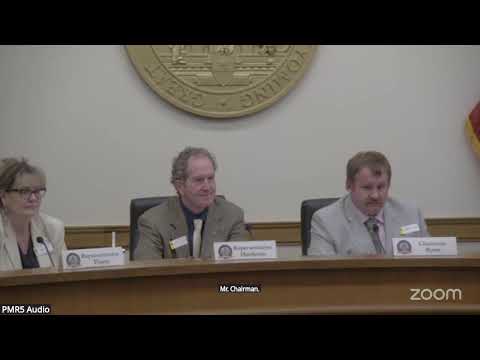
Representative Thayer moved the bill; Representative Provenza seconded. The committee took a roll-call vote and recorded nine ayes; the motion passed. The director said the $9,000,000 allocated the prior year for cheatgrass has been spent and the board added $2,000,000 from its regular funds to supplement that work. Budd and others also explained that deferred projects were those not yet ready (permitting, landowner consultation) and that declined projects were those the board determined not ready to fund.
The Trust staff and board emphasized that projects are site-visited before funding and that many proposals are cooperative across federal, state and local partners. Budd noted federal and private matching sources, competitive grants (such as RCPP) and recent higher trust earnings as reasons the Trust expanded funding this cycle.
Votes at a glance: - Senate File 88 — motion to approve large projects packet recommended by the Wyoming Wildlife Natural Resource Trust. Mover: Representative Thayer. Seconder: Representative Provenza. Committee roll-call: Representative Campbell (Aye); Representative Connolly (Aye); Representative Harshman (Aye); Representative Jarvis (Aye); Representative Provenza (Aye); Representative Storer (Aye); Representative Thayer (Aye); Representative Wharf (Aye); Chairman Beyer (Aye). Outcome: approved (9–0).
What’s next: Committee staff indicated the approved bill will move “upstairs,” and members volunteered to carry the measure forward. Several legislators encouraged local sportsmen and landowners to participate in site visits and interim topic suggestions.
Ending note: Committee members and the Trust repeatedly framed the work as cooperative, landscape-scale efforts to protect migration corridors, restore sagebrush ecosystems and reduce the spread of invasive annual grasses.