Get Full Government Meeting Transcripts, Videos, & Alerts Forever!
Get email alerts on the Parental Rights topic
No spam. Unsubscribe anytime.
Minn. committee adopts amendment to parental-rights bill and re-refers HF22 to education policy committee
Summary
Representative Dawn Gilman introduced House File 22 and an author’s A1 amendment the committee adopted; after public testimony and detailed member questions about child protection, health consent and statutory placement, the committee voted to re-refer the bill to the Education Policy Committee.
Representative Dawn Gilman introduced House File 22, which she said ‘‘establishes a broad parental rights to direct the education, upbringing, religious instruction, health, and privacy of a child without government interference.’’ The committee adopted an author's A1 amendment that, according to Gilman and a legal testifier, adds a ‘‘standard of review that requires any violation of parental rights to satisfy the most stringent legal standards.’’ After public testimony and member discussion, the committee voted to re-refer HF22 to the House Education Policy Committee.
Why it matters: The bill would codify parental authority over a wide set of matters — from curricula to health decisions — and the amendment raises the legal bar for government actions that could be challenged in court. Supporters said the proposal would give parents clarity and protect families; opponents — including school and child-protection professionals — warned it could complicate routine education and safety practices and could have unintended effects in child-protection cases.
The adopted A1 amendment and immediate effect Representative Gilman told the committee the A1 amendment ‘‘will add a standard of review that requires any violation of parental rights to satisfy the most stringent legal standards.’’ Legal testimony in the hearing described that standard as strict scrutiny: William Wagner, vice president of the Parental Rights Foundation and a former federal judge, told the committee that ‘‘a court applies what's called strict scrutiny when reviewing government actions that interfere with a citizen's fundamental rights, including the fundamental right, of a parent.’’ The committee then voted to adopt the amendment; the record shows the amendment was adopted with a voice vote.
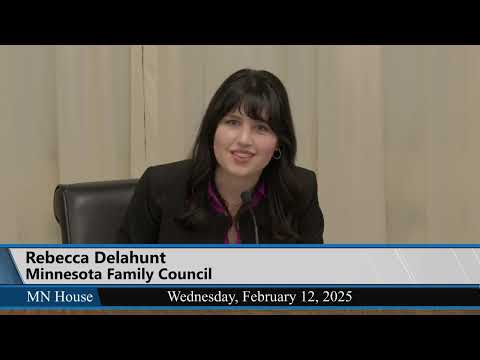
Public testimony: supportive and cautionary perspectives Supporters of HF22 urged lawmakers to act. Alicia Levisca, identifying herself as co-director of Minnesotans for Health and Parental Rights, said her organization submitted written testimony titled "HF22 MHPR written testimony" and described ‘‘more than 15 accounts from families’’ to the committee. Rebecca Delahunt, director of public policy at Minnesota Family Council, called parental authority ‘‘the safest ultimate authority’’ for most children. Several other parents and advocacy groups — including Minnesota Parents Alliance and the Protective Parent Coalition — testified in favor of the bill, citing personal experiences they said showed parents had been excluded from decisions affecting their children.
Opponents warned of risks for schools, students and child-protection practice. Meg Luger Nikolai, an attorney with Education Minnesota, told the committee the bill ‘‘could subject members of my organization to summary, termination, and other discipline merely for doing their jobs.’’ She cited Minnesota Statute 120B.20 (an opt-out law) and said the bill ‘‘makes no distinction between the act of teaching and whatever a reader may concede of as interference with parental rights.’’ Nikolai also raised concerns that routine school services such as vision and hearing screenings could be depressed if an opt-in requirement was imposed.
Committee members pressed on statutory placement, scope and enforcement Members asked why the bill was drafted in chapter 260C (the juvenile court act). Vice Chair Hansen explained that chapter 260C covers juvenile protection proceedings and warned that drafting choices could create ambiguity about where and when the new language would apply. Hansen asked whether placing the language in 260C might make the provision apply only in child-protection proceedings; nonpartisan staff and other members said chapter placement does not necessarily restrict application but recommended further review to avoid confusion.
Members also raised enforcement and practical questions. Vice Chair Hansen described a hypothetical in which a medical exam needed to collect evidence in a non–life-threatening child-abuse case might be delayed if parental consent rules were applied narrowly; she warned that could impede abuse investigations. Representative Hicks and others asked about adolescent confidentiality, noting that teenagers may avoid counseling if they expect parents to receive mental-health records. Representative Hemmingson Yeager highlighted clinical and newborn screening concerns, noting some diagnostic tests are time-sensitive and can prevent life-threatening outcomes if performed early.
Clarifying details cited in testimony and discussion - Written testimony: ‘‘HF22 MHPR written testimony’’ submitted and described as containing more than 15 family accounts (Alicia Levisca). - Amendment A1: described by Representative Gilman and a legal testifier as adding a strict-scrutiny/compelling-interest standard for government actions affecting parental rights. - Statutes cited in testimony: Minnesota Statute 120B.20 (opt-out law for some instruction) and chapter 260C (juvenile court/child-protection statutes) were mentioned repeatedly by testifiers and members. - Homeschool count cited: a witness said ‘‘Parents have also chosen homeschooling for nearly 30,000 children across the state of Minnesota’’ (Karen Miller).
Outcome and next steps The committee adopted the author’s A1 amendment by voice vote and, at the end of the hearing, voted to re-refer House File 22 to the Education Policy Committee. Committee members across the hearing urged the bill author to work with stakeholders — including child-protection specialists, health-care providers, school representatives and nonpartisan staff — to clarify statutory placement, definitions (for example, ‘‘parent’’ and ‘‘moral training’’), enforcement mechanisms and protections for children in abuse or neglect proceedings.
What remains open Committee members and witnesses pointed to a number of unresolved issues the bill’s author said she is willing to address: whether the language should be placed in chapter 260C or elsewhere, how the bill would interact with existing child-protection law, how to treat split custody or joint legal parents, how to protect adolescent confidentiality in counseling, and how to accommodate time-sensitive medical and newborn screenings. The bill will proceed to the Education Policy Committee for further consideration.