Get Full Government Meeting Transcripts, Videos, & Alerts Forever!
Get email alerts on the Homeowners Associations topic
No spam. Unsubscribe anytime.
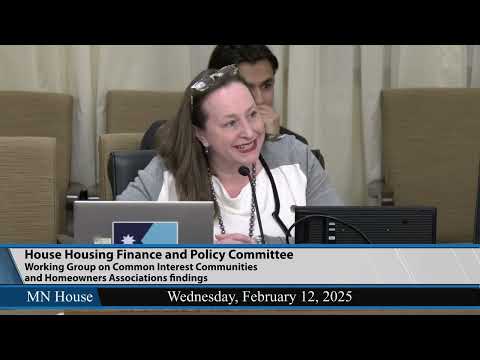
Minn. committee hears 41 recommendations to reform HOAs and common‑interest communities
Summary
Legislators and Legislative Coordinating Commission staff presented a 41-point package of recommendations to update Minnesota law on common‑interest communities and homeowners associations, proposing registration, disclosure, new dispute‑resolution tools and limits on foreclosure for small fines.
Legislative Coordinating Commission staff and lawmakers on the House Committee on Housing Finance and Policy on Tuesday reviewed a 41‑recommendation report from an interim working group aimed at reforming Minnesota’s rules for common‑interest communities (CICs) and homeowners associations (HOAs).
Andrew George, nonpartisan staff with the Legislative Coordinating Commission, told the committee the working group “finalized 41 recommendations and reforms generally to 5 15 B.” The group, created during the 2024 legislative session, studied how CICs and HOAs affect housing access, affordability and governance and met from September through January.
The recommendations target eight topic areas identified by the working group: governance; financial interests and reporting; insurance and reserves; dispute resolution; registration and licensing; education and training; assessments, fines and fees; and foreclosure and municipal interactions. Members described both routine and extreme homeowner complaints gathered during local listening sessions in Maple Grove, Maplewood and Burnsville.
Why it matters: a growing share of new construction is governed by HOAs, and committee members said those governance structures can affect affordability, homeowner protections and access to housing. Representative Bahner said, “this isn't a Minnesota problem. It is a national problem,” and argued the state’s statutes lack clear guardrails to protect homeowners and volunteer board members alike.
Key proposals in the packet and committee discussion include: - A public registration database of associations, property managers and board members housed at the Office of the Secretary of State, combined with consideration of privacy protections for volunteer board members; - Licensing requirements for HOA managers and a requirement that associations provide homeowners basic information about rights and responsibilities without charge; - Standards for board transparency and conflict‑of‑interest rules, and required annual financial accounting for associations; - Limits and clearer notice rules for assessments and fee increases, including a 30‑day notice for non‑emergency fee increases and a 60‑day notice for special assessments (proposal); - A recommendation that HOA boards not foreclose a lien for fines under $2,500 and that statute require pre‑foreclosure notice and a right to postpone sheriff sales for homeowners; - Creation of a housing advocacy center and an ombudsman/offices to facilitate mediation and provide templates and resources for homeowners and boards; and - Prohibitions on making purely aesthetic rules a basis for foreclosure and encouragement for Minnesota Housing and cities to use Housing Improvement Area (HIA) loans to finance repairs and common‑area work.
Committee members and working‑group members recounted homeowner stories gathered at listening sessions. Representative Mecklen described cases in which homeowners faced sudden large assessments tied to infrastructure or hail damage, and noted instances where contracts and bids raised conflict‑of‑interest concerns. Lawmakers said those anecdotes motivated proposals for vendor‑bidding rules, minimum record retention for bids and limits on requiring associations to use a specific vendor.
Several legislators emphasized balancing homeowner privacy and the need for public information. Representative Myers and others expressed concern that a public database of volunteer board members could discourage volunteers; Representative Bahner said draft legislation is exploring options to classify some contact details as private while still improving transparency.
Lawmakers also discussed next steps. Committee members were told the policy omnibus bill is in final drafting stages and that separate, likely companion bills would address registration/database costs, an ombudsman office (which would require funding), and insurance issues (which the working group said need a deeper, commerce‑level review).
No formal legislative actions were taken during the meeting; testimony and discussion were informational. Committee leadership said members can expect bill language to be released to the committee in the coming weeks for formal consideration.
The committee hearing closed after members asked follow‑up questions and emphasized the intent to pursue a bipartisan legislative package this session. The chair said the committee will reconvene on Tuesday the 18th at its regular time to continue work on housing matters.