Get Full Government Meeting Transcripts, Videos, & Alerts Forever!
Get email alerts on the House File 6 topic
No spam. Unsubscribe anytime.
House File 6 advances to finance committee after hours of debate over literacy, local control and mandate relief
Summary
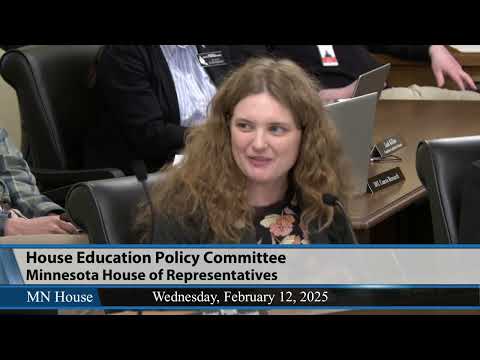
The House Education Policy Committee on Feb. 12 voted 7-6 to refer House File 6 to the Education Finance Committee after a three-hour hearing that featured bill authors, educators, district leaders and dozens of public testifiers weighing in for and against the measure.
The House Education Policy Committee on Feb. 12 voted 7-6 to refer House File 6 to the Education Finance Committee after a three-hour hearing that featured bill authors, educators, district leaders and dozens of public testifiers weighing in for and against the measure.
House File 6, offered by Rep. Peggy Bennett, would revise the Read Act’s implementation, create a new Office of Achievement and Innovation at the Minnesota Department of Education, and allow school boards limited authority to transfer unencumbered funds and delay implementation of laws enacted in the 2023–24 biennium through the 2028–29 school year.
Why it matters: Supporters said the bill aims to give districts time and flexibility to implement multiple recently enacted mandates with greater fidelity and to prioritize foundational literacy instruction using the science of reading. Opponents said the same provisions could create a patchwork of varying standards across districts, weaken statewide equity protections enacted in 2023, and threaten benefits and training for hourly school employees, including paraprofessionals.
Bennett opened the committee presentation and formally moved the bill. “I move House File 6 before the committee to be referred to the Education Finance Committee,” said Representative Peggy Bennett, chair of the Education Policy Committee. The committee carried the motion on a roll call vote of 7 to 6.
What’s in the bill and what authors said - Article 1 revises the Read Act and affirms an emphasis on the science of reading. Representative Patricia Mueller, who led the committee explanation of Article 1, said the goal is to ensure teachers and teacher-preparation programs are trained "with fidelity in the science of reading" and to create an independent assessment of teacher preparedness. Mueller said the bill would end Minnesota’s partnership with the Center for Applied Research and Educational Improvement (CARI) on June 30, 2025, and direct MDE to take a lead role in assistance to districts. "Literacy is learning," Mueller said, adding that the proposal is aimed at making the Read Act implementable.
- Article 2, described by Representative Ben Baeckburg, creates a user-friendly school performance report, consolidates existing innovation programs into a new educational innovation chapter, and converts the Department’s equity, diversity and inclusion center into an Office of Achievement and Innovation whose guidance would be advisory rather than binding. "Local control is innovation," Baeckburg told the committee, saying the proposal trusts locally elected boards and educators to design programs tailored to district needs.
- Article 3 would allow school boards, by public resolution, to transfer unencumbered funds (so long as transfers do not trigger additional state aid or local levy) through the 2028–29 school year and to delay implementation of statutes enacted in the 2023–24 biennium (the bill lists chapter citations included in committee testimony). Authors said the measures are intended as short-term relief while the Legislature evaluates mandates and funding.
Supporters at the hearing emphasized local fiscal strain and implementation challenges. Brandon Lunick, representing Moorhead Area Public Schools, said the transfer authority "is not about asking for new money, but rather using existing resources more effectively" and that the option could prevent staff reductions or local referenda. John Magas, superintendent of Duluth Public Schools, told the committee his district recently "displaced over 40 employees" and asked for additional funding to implement the Read Act with the professional development and curriculum updates it requires.
Opponents urged caution, pointing to equity, labor and special education concerns. Multiple paraprofessionals and union representatives warned that Article 3’s mandate relief could be used to roll back unemployment insurance eligibility for school-year employees, earned sick and safe time, paid family and medical leave, and training requirements. Paraprofessionals described improved retention after eligibility for summer unemployment insurance and said losing that protection would worsen staffing shortages.
Advocacy groups and educators also argued that allowing districts to delay statutes enacted in 2023 could erode statewide protections: testimony cited the pre-K–3 dismissal ban, seclusion bans, and other measures intended to reduce exclusionary discipline and improve supports for vulnerable students. The coalition Solutions Not Suspensions said section 2 "would do immense damage" by weakening those protections. School counselors and special education advocates warned that a patchwork of district decisions would widen disparities and complicate compliance and oversight.
State education officials raised administrative and accountability concerns. Adosh Unni, director of government relations for the Minnesota Department of Education, said MDE has "serious concerns" about the fund-transfer and mandate-relief proposal, warning it could create a confusing mosaic of expectations across districts and complicate oversight of state funds. Unni also cautioned about eliminating funding for the EDI center and said components of the bill’s performance reporting would carry costs.
Committees, process and next steps Representative Bennett’s motion to refer HF6 passed on a roll call; the clerk read the members and votes and the chair announced: "The bill prevails, House File 6 prevails to be passed on to the committee on Education Finance, 7 to 6." Committee members who recorded aye votes included Chair Peggy Bennett (aye), Representative Patricia Mueller (aye), Representative Mary Lawrence (aye), Representative Drew Roach (aye), Representative Marge Fogelman (aye), Representative Jimmy Gordon (aye) and Representative DeBell (aye). Members recorded no votes included Representative Lee Jordan (no), Representative Robert Biermann (no), Representative Alex Falconer (no), Representative Julie Green (no), Representative Josiah Hill (no) and Representative Heather Keeler (no). (Roll-call text in the transcript contains short-form reporting; the committee chair announced the final numerical result.)
Several members asked for additional committee stops and technical review. Representative Sydney Jordan and others urged the bill be vetted for impacts across labor, early childhood and other policy domains; Representative Jordan noted potential federal unemployment insurance and constitutional uniformity concerns raised in testimony and questioned whether the bill’s changes could conflict with federal UI rules or Article XIII, section 1 of the Minnesota Constitution, which calls for a general and uniform public school system.
What remained unresolved at adjournment The committee took public testimony and substantial Q&A but did not amend the bill on the floor. Authors said the intent is to provide short-term flexibility while lawmakers consider funding and potential statutory changes; opponents said the proposals risk weakening protections and benefits. Committee members requested additional technical information—particularly about unemployment insurance funding levels (testimony cited roughly $33,000,000 remaining in the UI account), federal compliance and the administrative cost of proposed reporting changes—before final action in later committees.
Votes at a glance - Motion: Refer House File 6 to the Committee on Education Finance. Mover: Representative Peggy Bennett. Second: not specified on the record. Outcome: Passed (7–6).
Ending The committee concluded after referring the bill to Education Finance; authors said the bill components would also be introduced as stand-alone proposals and would move through additional committees as needed. Committee members and testifiers left the record with requests for fiscal analysis, federal compliance review, and clearer timelines for implementation if mandate relief is permitted.