Get Full Government Meeting Transcripts, Videos, & Alerts Forever!
Get email alerts on the Parental Rights topic
No spam. Unsubscribe anytime.
Committee refers parental-rights bill to Education Policy after amendment adopting strict-scrutiny standard
Summary
The Minnesota House Committee on Children and Families voted to refer House File 22 to the Education Policy Committee after adopting an author amendment that requires courts to apply a strict standard of review to alleged infringements on parental rights.
The Minnesota House Committee on Children and Families voted to refer House File 22 to the Education Policy Committee after adopting an author amendment that adds a strict judicial standard for challenges to parental rights.
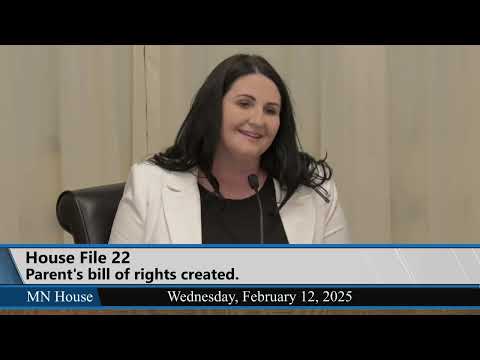
Representative Dawn Gilman, the bill’s author, opened the committee hearing and offered an A1 amendment. Committee members adopted the amendment before hearing public testimony. The amendment, as described at the hearing, “will add a standard of review that requires any violation of parental rights to satisfy the most stringent legal standards.”
House File 22, as presented by Representative Dawn Gilman, would codify a broad parental-rights statement into state law asserting that parents have the right to direct their children’s education, upbringing, religious training, health care and privacy "without government interference." Gilman said the bill does not create new rights but “recognizes the rights parents already have” and that it applies to public, charter, private and home education.
Supporters told the committee they want clearer statutory protections. Alicia Levisca, co-director of Minnesotans for Health and Parental Rights, said in written and oral testimony that families have faced inconsistent court interpretations since Troxell v. Granville and that the bill would provide “clear, consistent protection for parents and families across Minnesota.” Christine Truin, founder and executive director of Minnesota Parents Alliance, and other parents described instances where they say school or medical staff acted without parental consent and urged passage.
Opponents, including Meg Lugar Nikolai, an attorney with Education Minnesota, warned the bill’s language is broad enough to interfere with routine school practices and child-protection processes. Nikolai said Minnesota already has an opt-out law for instruction (Minn. Stat. 120B.20) and raised specific concerns that the bill could make routine vision and hearing screenings or behavioral supports illegal without parental opt-in. She also said placing the parental-rights language in chapter 260C — the juvenile court/child-protection chapter — would raise the burden for judges to protect children in abuse or neglect cases.
Legal testimony was mixed. William Wagner, a professor emeritus and vice president of the Parental Rights Foundation, supported the author amendment and argued courts should apply strict scrutiny to actions that burden parental rights; he cited state and U.S. Supreme Court precedent referenced in his written testimony. At the hearing Wagner said the amendment “fixes” the prior drafting by aligning the statute with the “compelling state interest” test that courts use for fundamental rights.
Committee members asked detailed procedural and substantive questions. Vice Chair Hansen pressed the sponsor on why the bill was drafted in chapter 260C and warned that language placed in the juvenile-protection chapter might be read as applying only in child-protection proceedings; nonpartisan staff said placement does not automatically limit the bill’s scope but raised that the choice could create confusion. Hansen also sought clarification about the bill’s effect on situations where one parent may oppose medical testing needed to investigate abuse and whether the bill could inadvertently impede evidence collection in cases of alleged maltreatment.
Other members questioned definitions and enforcement: several asked the sponsor to clarify who qualifies as a “parent” under the bill, how the term “moral training” would be interpreted in schools, and how schools and health providers would be expected to comply with the statute given there is no appropriation or enforcement mechanism in the draft. Representative Hicks expressed concern about adolescent confidentiality in mental-health care and whether mandatory parental access to records would deter 15– to 17‑year‑olds from seeking help. Representative Hemmingson Yeager raised newborn-screening and diagnostic examples to caution against unintended barriers to necessary medical testing.
The hearing gathered diverse testimony from parents and parent-rights advocacy groups, faith-based advocates and school and child-welfare professionals. Rebecca Delahunt, director of public policy for Minnesota Family Council, urged support, saying parents are typically the safest ultimate authority for children; Meg Lugar Nikolai recommended a no vote, saying the bill could make it harder to protect or educate children. Several speakers, including Jill McLaughlin Grunewald of Protective Parent Coalition and Dori Trossen, described personal experiences they said motivated support for clearer parental-rights language.
After more than an hour and a half of testimony and member questioning, Chair West renewed a motion to refer House File 22 to the Education Policy Committee. The committee voted, voice only: “All those in favor say aye.” “Aye.” “All those opposed? No.” The chair announced that the motion prevailed and the bill was referred to Education Policy.
Gilman told the committee she is open to further stakeholder conversations and technical drafting changes as the bill moves forward. The committee did not adopt additional substantive changes at the hearing.