Get Full Government Meeting Transcripts, Videos, & Alerts Forever!
Get email alerts on the Paid Family Medical Leave topic
No spam. Unsubscribe anytime.
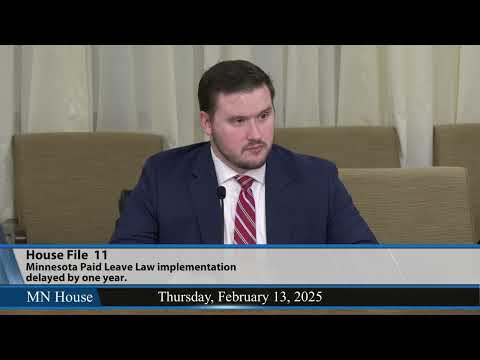
Minn. committee hears competing testimony on bill to delay paid family and medical leave
Summary
Testimony at a Minnesota House committee hearing split along employer and worker lines over House File 11, which would postpone the state'run paid family and medical leave program for one year. Business groups cited administrative and fiscal concerns; employees, unions and child-health experts urged keeping the 2026 start date.
Representative Baker moved House File 11, a proposal to delay implementation of Minnesota''s Paid Family and Medical Leave program by one year, and the House Workforce, Labor, Economic Development Finance and Policy Committee heard more than two hours of testimony Monday on the measure.
The bill's sponsor, Representative Baker, told the committee the pause "will just allow us to hear from more" people and to address outstanding questions about the program's design and fiscal calculations. The committee recessed to the call of the chair and planned additional discussion later the same day and follow-up with authorizing committees.
The hearing drew sharply divided testimony. Representatives of chambers of commerce, trade associations, school officials and business groups urged a delay, citing unresolved administrative rules, uncertainty about payroll tax impacts and concern that small employers lack the payroll and HR systems to comply by Jan. 1, 2026. Lauren Shothorst, policy director at the Minnesota Chamber of Commerce, said, "We are fundamentally opposed to the idea of the state mandating an employer benefit," and argued the program could create an "undue or uneven financial burden on employers."
Small-business and trade witnesses repeated those concerns. John Beshe, state director for the National Federation of Independent Business in Minnesota, said the extra year would give employers "time to adjust financially, explore innovative solutions, and meaningfully engage with state led education and other resources." Gavin Hansen of the Minnesota Business Partnership urged technical safeguards and recommended an independent audit and a beta test of the department's IT systems before launch.
School districts and other public employers told lawmakers a midyear start poses special budget and timing problems. Kim Lewis, representing the Minnesota School Boards Association and several affiliated school groups, said the law as written creates an unfunded mandate for districts and noted that a 0.88 payroll tax rate would cost large districts millions: "Anoka Hennepin... would cost them approximately $2,500,000," she said, adding that districts receive revenue on a fiscal-year cycle and asked for more time to plan.
Witnesses who opposed a delay argued that families and health outcomes depend on the program starting as scheduled. Erin Thompson, an English teacher and new mother from Eagan, said she had "10 days of paid maternity leave" and described how that was insufficient after a surgical birth. Pediatric and early-childhood experts also urged implementation on schedule. Roger Sheldon, a neonatologist testifying for several early-childhood coalitions, said, "We have only 1 chance to give young children a healthy start in life," and warned that delaying the law would deny benefits to families who are already planning around the Jan. 1, 2026 start.
Other opponents of delay included unions and health-care workers. Bernie Burnham, president of the Minnesota AFL-CIO, described the statute as a long-standing legislative priority and cautioned against what he called efforts to "take away paid leave from working Minnesotans before we even have it." The Minnesota Nurses Association likewise opposed postponement, saying delay would undermine contract negotiations and worker protections.
Several small employers and retailers told the committee they support the 2026 start date. Jessica Peterson White, a small bookstore owner and Northfield city council member, said a statewide fund would "help my business compete for the best employees" and cautioned that a delay would disproportionately harm small employers and their workers. Lynn Gert, co-owner of Northern Waters Smokehouse in Duluth, said her company has prepared and does not see a need for postponement.
On administrative questions, witnesses repeatedly raised concerns about software readiness and customer service capacity at the state Paid Leave Department. The Minnesota Business Partnership and other witnesses referenced MNsure's 2014 technology failures and urged third-party IT audits and robust testing.
Representative Baker and committee staff said the bill would receive additional committee attention; Baker noted conversations about sending the bill to the House Ways and Means Committee for further review. The committee recessed to the call of the chair and planned to reconvene later in the day for additional testimony and member questions.
The hearing produced no final vote on House File 11. Lawmakers and stakeholders signaled continued negotiation on timelines, implementation details, funding impacts and how the state program will interact with collective bargaining agreements and existing employer-provided leave.