Get Full Government Meeting Transcripts, Videos, & Alerts Forever!
Get email alerts on the Estate Tax Phaseout topic
No spam. Unsubscribe anytime.
Committee hears bill to phase out Minnesota estate tax; advocates say farms at risk
Summary
The Minnesota House Tax Committee heard testimony on House File 170, which would phase out the state estate tax over several years. Supporters said the change would protect family farms; opponents said it would benefit wealthy heirs and reduce general fund revenue. The committee laid the bill over for further consideration.
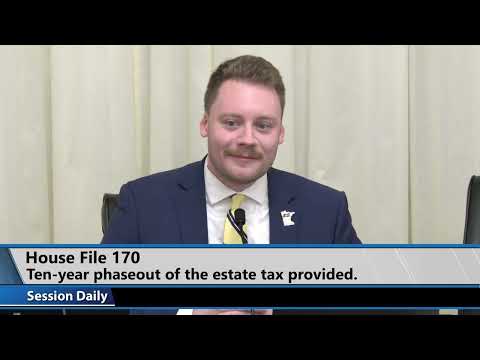
House File 170, a bill to phase out Minnesota’s estate tax, was discussed at a House Tax Committee hearing where sponsors, state staff and agricultural advocates debated the measure’s scope, fiscal cost and likely beneficiaries.
House Research staff described the bill as a phased elimination: “House File 170 would reduce the rate under each one of the rates in the bracket structure of the estate tax by 1.6 percentage points over a period of 10 years until each one of the rates hit 0,” the nonpartisan staff told the committee. The staff added the phase-out would take roughly seven to 10 years for all rates to reach zero.
The bill’s author, Representative Davids (Chair), and witnesses framed the proposal as a protection for family farms. Hunter Peterson, public policy specialist for the Minnesota Farm Bureau Federation, told the committee estate tax calculations use market value and that persistent land appreciation can push farm estates above current exemptions. “Estate taxes are a particular concern for farm and ranch families because they're based on the market value of assets,” Peterson said, and gave an illustrative example of farmland values and an estate-tax bill that could force land sales.
Department of Revenue staff provided revenue context. “Estate taxes, in fiscal 26, generated about $280,200,000,” staff member Templeton said, adding the revenue estimate packet forecasts an increase afterward. Committee members and witnesses noted that the current statutory protections include a $3 million general exclusion and a $2 million subtraction for qualified farm or small-business property under Minnesota law, which together can protect up to about $5 million for some estates when conditions are met (see clarifying details).
Supporters said the bill would prevent forced sales of illiquid farmland to pay estate taxes. Representative Davids said he would like to “phase it out,” and characterized the proposal as targeted at smaller family farms in his district. Testifying as a farmer, Representative Russell Harder described tight profit margins and the difficulty of producing cash to pay large tax bills, saying he feared losing a family legacy if forced to sell land.
Opponents cautioned the bill would reduce general fund revenue and primarily benefit wealthy households. Representative Smith said the broader context is a multitrillion-dollar intergenerational transfer of wealth and called unrestricted repeal a step toward concentrating wealth: “a transfer of wealth between generations based on circumstances of your birth … it's called aristocracy,” Smith said. Committee members also asked for data on how many estates are currently subject to the tax; House research staff said that percentage is small and that follow-up data would be provided to the committee.
Committee action: Representative Davids renewed his motion to lay over House File 170. Committee members laid the bill over for further consideration and possible inclusion in the omnibus tax bill; no final vote on the merits of the bill occurred at the hearing.
The hearing included discussion of policy trade-offs (supporting family farms versus reducing revenues for the general fund) and requested follow-up information from nonpartisan staff and the Department of Revenue on the number of estates currently subject to the tax and updated fiscal estimates. The committee plans further work on tax bills in coming weeks.