Get Full Government Meeting Transcripts, Videos, & Alerts Forever!
Get email alerts on the Hospitality Tourism topic
No spam. Unsubscribe anytime.
State and local leaders press hospitality, hotels and workforce as keys to Mission and RGV growth
Summary
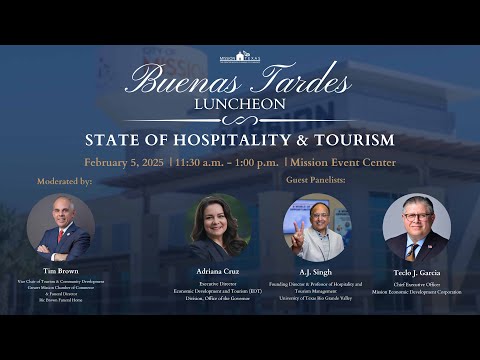
At a Greater Mission Chamber luncheon, state and local economic development officials, UTRGV educators and private hoteliers outlined hotel projects, workforce training and small-business supports aimed at expanding tourism in Mission and the Rio Grande Valley.
Mission and regional leaders on hospitality and economic development used a Feb. luncheon in Mission to outline ongoing hotel investments, workforce training and small-business programs intended to grow tourism and related economic activity in the Rio Grande Valley.
Adrianna Cruz, executive director of the Texas Economic Development and Tourism Office, told the Greater Mission Chamber audience that tourism is a major economic driver for the state. “Tourism and hospitality is such an important part of our economy,” Cruz said, adding that visitors to Texas spent nearly $95 billion in 2023, generating an economic impact of about $194 billion and supporting roughly 1.3 million jobs statewide.
The panel included private developers and local economic leaders who described several near-term projects and programs that organizers say will increase visitor stays in Mission. Nita Kassan, vice president of operations at Ocean Gate Hospitality, said Ocean Gate is investing in local hotels, naming an IHG Avid and Candlewood Suites dual-brand property and a Marriott Residence Inn as upcoming developments. “For us, hotels are more than just buildings,” Kassan said, adding the projects are intended to serve multiple customer segments and create jobs.
Teklo Garcia, chief executive officer of the Mission Economic Development Corporation (MEDC), emphasized the fiscal and employment effect of hotel development. “If we go recruit a hotel, that's a big force multiplier,” Garcia said, noting a typical large hotel can create dozens of jobs and generate property and hotel-motel tax revenue. Garcia said Mission collected about $700,000 in hotel-motel tax receipts last year and that MEDC and its partners directed roughly $600,000 to local small businesses through multiple programs in the previous year.
Education and workforce were central themes. Dr. Ajay Singh, founding director of the University of Texas Rio Grande Valley (UTRGV) Hospitality and Tourism Management program, described the program’s aim to prepare business-skilled hospitality employees. “We've grown to about a hundred students right now,” Singh said, noting the major began enrolling students in 2019 and is the University of Texas system’s only hospitality and tourism management program.
Singh described program emphases — hotel operations, food and beverage/culinary training and meeting-and-event planning — and said UTRGV is developing partnerships with local high schools and industry for internships, certifications and a proposed concierge/ambassador approach to improve visitor experiences across Valley communities.
Panelists also highlighted other regional assets and initiatives. Cruz said the governor’s office launched a Tourism Friendly Texas certified community program that provides training and planning support; she reported 80 communities completed the certification in its first year and identified McAllen as a community that signed up for the next cycle. The Michelin Guide’s recent entry into Texas was raised as a perception opportunity for the state’s culinary offerings.
Panelists discussed market demand and visitor segments. Garcia and others noted “extended-stay” hotels are a growing niche and that seasonal visitors known as “winter Texans” contribute significant local spending; Garcia cited a regional study estimating winter visitors spend about $1.2 billion to $1.5 billion annually in the Rio Grande Valley. Panelists also described hotel occupancy patterns they said may reach high levels for some properties, with averages in the market near 70 percent and select properties occasionally reaching higher occupancy.
Speakers identified workforce alignment as a priority. Cruz described the Texas Workforce Investment Council’s role in statewide workforce strategy and said the state coordinates workforce, higher education and training programs to prepare candidates for targeted industries. Panelists urged local employers and schools to expand vocational and certificate pathways so graduates can move directly into hospitality, culinary and related service roles.
Local small-business support drew attention as complementary to tourism growth. Garcia described MEDC programs such as Ruby Red Ventures and downtown support, and noted the city’s recent years of double-digit retail sales growth. He framed tourism and hotel growth as helping restaurants, retail and service businesses throughout Mission.
The panel closed with a repeated theme that regional collaboration matters: panelists urged Mission, neighboring cities and state agencies to coordinate on marketing, workforce and infrastructure to attract employers, visitors and additional investment.
Votes at a glance: no formal motions or votes were recorded at this event.
Ending: Panelists said multiple hotel projects, workforce initiatives and certification programs are moving forward; details such as exact construction timelines, financing sources and final investment amounts were described as in development and not fully specified in the luncheon remarks.