Get Full Government Meeting Transcripts, Videos, & Alerts Forever!
Get email alerts on the Land Value Tax Split Rate topic
No spam. Unsubscribe anytime.
Committee lays over permissive bill allowing local land-value taxation experiments
Summary
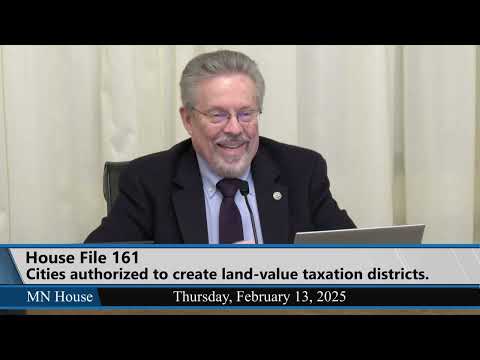
House File 161, a permissive bill enabling municipalities to experiment with land value (split-rate) taxation in redevelopment districts, was presented, discussed by proponents and opponents, and laid over for potential inclusion in the omnibus tax bill.
The House Taxes Committee on Oct. 12 laid over House File 161, a permissive bill that would allow Minnesota cities to experiment with land value taxation — commonly described as a “split-rate” system that taxes land and structures at different rates — within designated redevelopment districts.
Representative Elkins, the bill author, opened the discussion and framed the proposal as a tool to discourage land speculation, encourage redevelopment, and better align taxes with land use. “Under our current property tax system, if you improve or redevelop your property, your property taxes will go up. And if you neglect your property or leave it for value, your property taxes will go down,” Elkins said in overview of the policy objectives.
Joshua Hudak (Sierra Club Minnesota North Star Chapter), identified as the senior program manager for land use and transportation, testified in favor, saying, “Land value tax is about local control. It's about, a policy tool that can help with these situations,” and argued the measure would incentivize reuse of vacant and underused urban land.
Brian Cook, director of tax, fiscal policy and elections for the Minnesota Chamber of Commerce, testified with concerns about shifting the property tax burden. Citing a working paper from the Lincoln Institute of Land Policy, Cook warned that split-rate systems can shift tax burdens toward commercial and industrial parcels and said Minnesota businesses already shoulder a disproportionate share of property taxes.
Committee members asked how the proposal would interact with tax-exempt properties, zoning and comprehensive plan designations, tax increment financing and negotiated developer agreements. Elkins said the measure is permissive and intended for targeted redevelopment districts; he noted assessors will need reliable land-only valuations for implementation. Several members said they wanted more analysis on rate structure and distributional effects, so Elkins moved to lay the bill over for possible inclusion in the omnibus tax bill.
Why it matters: Land value taxation changes incentives by lowering taxes on improvements while increasing taxes on undeveloped or underutilized land; proponents say it can spur redevelopment and housing supply, while business groups fear unintended tax shifts onto commercial and industrial property if used broadly.
Next steps: House File 161 was laid over for possible inclusion in the omnibus tax bill; the committee signaled more technical work and stakeholder negotiations would be necessary before any final action.