Get Full Government Meeting Transcripts, Videos, & Alerts Forever!
Get email alerts on the Fraud Bureau Transfer topic
No spam. Unsubscribe anytime.
Lawmakers, regulators and insurers spar over governor's executive order moving Commerce Fraud Bureau to BCA
Summary
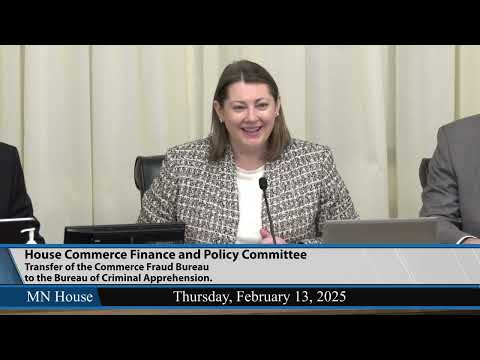
The House Commerce and Finance Committee on Feb. 13 heard testimony about Governor Walz’s executive order transferring the Minnesota Commerce Fraud Bureau from the Department of Commerce into a new Fraud and Financial Crimes section at the Bureau of Criminal Apprehension.
The House Commerce and Finance Committee on Feb. 13 heard more than two hours of testimony about Governor Walz’s executive order moving the Minnesota Commerce Fraud Bureau from the Department of Commerce into a new Fraud and Financial Crimes section at the Bureau of Criminal Apprehension (BCA) within the Department of Public Safety.
The change, effective Feb. 7, transfers 27 FTEs and the bureau’s investigative work to the BCA; the administration says the move is meant to consolidate financial‑crime resources, while some legislators and industry representatives warned it risks deprioritizing insurance‑fraud work and weakening regulatory enforcement.
Why it matters: Insurance fraud investigations are funded in part by insurer assessments that ultimately affect premiums, and lawmakers at the hearing said they are concerned about preserving the Commerce Fraud Bureau’s focus, reporting and independence even as officials said the new structure will provide law‑enforcement support and administrative efficiencies.
Commissioner Grace Arnold, head of the Minnesota Department of Commerce, told the committee the Commerce Fraud Bureau had been a nationally recognized unit that handled complex insurance‑fraud investigations and that funding sources (an insurance assessment, a legislative appropriation tied to workers‑compensation fraud, an administrative auto‑theft fee and an auto‑theft prevention grant) will continue to underwrite the work. "Fraud is increasing and there are all kinds of interesting ways, in the most Minnesotan way, that people are, out to get money," Arnold said, describing the bureau’s caseload and the reasons the state had previously housed sworn investigators inside the Commerce Department.
Bob Jacobson, commissioner of the Department of Public Safety, and Drew Evans, superintendent of the BCA, described the new, stand‑alone Fraud and Financial Crimes section as a way to centralize investigators and analysts for the range of financial crimes they will investigate: insurance fraud, wage‑theft and misclassification, traditional financial crimes, and state‑program fraud. Evans said 27 FTEs moved to the BCA and emphasized that "They will not be asked to work homicide or drug cases. They will be asked to investigate fraud." He added the move provides access to a wider statewide field office network, forensic laboratory resources and criminal intelligence analysts.
The administration and BCA provided several operational numbers to the committee: the Commerce Fraud Bureau fielded about 2,900 case referrals in the most recent year, criminal investigations the agencies estimate had about a $35,000,000 economic impact, and, as of December 2024, the bureau reported roughly 170 active investigations (down from about 200 referrals in December). The BCA officials also said they track agent hours and administrative time and intend to combine and report metrics to the committee after the transition.
Several House members expressed strong objections. "This is a really, really bad idea," Representative Davids told the panel, arguing the Commerce Fraud Bureau is "the gold standard" for white‑collar work and that moving it out of the regulator risks diluting enforcement and regulatory leverage. Davids said the executive order bypassed legislative involvement and warned that future priorities could pull investigative resources away from insurance fraud. Representative Stevenson and other members echoed concerns about long‑term ‘‘mission creep’’ if criminal fraud investigators sit inside a broad law‑enforcement agency rather than a regulator.
Industry reaction was mixed but cautious. Aaron Cocking, president and CEO of the Insurance Federation of Minnesota, said the trade group had helped create and fund the bureau in the 1990s and supported its expansion and funding increases last year; Cocking told lawmakers, "I found out about this move, an hour before the executive order was released on January 3." He said the federation will give the BCA the benefit of the doubt but urged statutory protections to keep insurance‑fraud work prioritized. Cocking also cited national estimates that "fraud‑related costs add between $400 and $700 annually to the cost of insurance for each household," a reason insurers have supported active enforcement.
Several legislators pressed for concrete guardrails: reporting requirements, statutory protection of funding streams and performance metrics that would make clear whether insurance fraud receives the same focus under the BCA. Superintendent Evans and Commissioners Jacobson and Arnold told the committee they would work with legislators on statutory language and reporting, and that they already were meeting weekly with the special agent in charge to manage the transition.
The committee also recorded operational details about subpoenas and case handling: Evans said the practical access to evidence will continue but that subpoenas will be issued through county attorneys or the attorney general’s office rather than under a Department of Commerce commissioner’s delegated authority; he characterized that as a minor adjustment. The administration said the auto‑theft grant program, appropriations related to workers‑compensation fraud, and insurer assessments that partly fund the prior Commerce unit remain connected to the work moving to the BCA.
The hearing closed with commitments to return to the topic. Administration witnesses said they would propose statutory language and reporting to address committee concerns; BCA officials offered to host tours of their facilities for committee members. The committee took one formal action at the end of the meeting: Representative Hewitt moved approval of the Feb. 12 minutes and the motion carried by voice vote.
Next steps: Committee members asked the administration for proposed statutory protections and more detail on performance metrics; several members signaled they expect further hearings before any legislative changes are enacted.