Get Full Government Meeting Transcripts, Videos, & Alerts Forever!
Get email alerts on the State Employee Savings Program topic
No spam. Unsubscribe anytime.
Committee sends bill to let frontline state employees propose savings to General Register
Summary
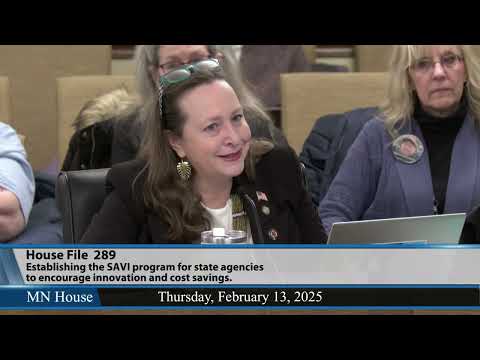
The House Committee of Jurisdiction adopted a technical amendment and voted to refer House File 289, which would let frontline state employees propose cost‑saving measures and split realized savings between the state and a mission fund, to the General Register by voice vote.
The House Committee of Jurisdiction voted to refer House File 289, a bill that would create a mechanism for frontline state employees to propose and share in cost savings, to the General Register after adopting a technical A1 amendment.
Representative Quam, the bill sponsor, said the idea grew from conversations at a faculty union meeting and framed the bill as a way to “empower the actual people doing the job, the frontline people” to flag waste and inefficiency. He told the committee the proposal would split any identified savings roughly half to the state budget and half to a fund “to be spent on the mission,” with campus or agency committees made up of management and workers deciding how mission funds are used.
Supporters said the policy could boost employee engagement and surface savings auditors sometimes miss. Representative Freiberg said she was “comfortable voting for this” while urging work to increase usage. Representative Jones asked about historical underuse and how uptake might improve; Quam cited larger current budgets and renewed opportunities to identify savings.
Several members raised process concerns. Representative Cleburne warned that projects approved by agency management still require Legislative Audit Commission review and that if the LAC does not respond “properly and appropriately and quickly, it's an automatic denial.” Nonpartisan staff member Ms. Roberts clarified that the bill’s account is separate from the Odyssey Fund: “There are 2 separate funds. They don't necessarily interact directly. And, 1 does not trump the other and 1 does not, backfill the other.”
Representative Bonner said managers and staff sometimes disagree about budgeting choices and worried a program of incentives could encourage teams to withhold spending intentionally to create a carry‑forward pool. Quam responded that involving both management and rank‑and‑file in selection would increase credibility with legislators and make it more likely projects receive follow‑on funding.
The committee adopted a technical A1 amendment on a voice vote and then, by voice vote, approved a motion to send House File 289 as amended to the General Register. The committee recorded no roll‑call vote in the transcript.
Votes at a glance
• A1 amendment — adopted by voice vote (no roll call recorded). • Motion to refer House File 289, as amended, to the General Register — approved by voice vote (no roll call recorded).
Background and next steps
Representative Quam said he added a sunset when the measure was last enacted to allow adjustments and that the bill had bipartisan support in a prior session. With the referral to the General Register, the bill moves forward in the House process; the transcript shows no further committee directives or formal roll‑call votes at this meeting.