
BWSR seeks stable funding for wetland-replacement credits, expands CREP enrollment
Get AI-powered insights, summaries, and transcripts
Sign Up Free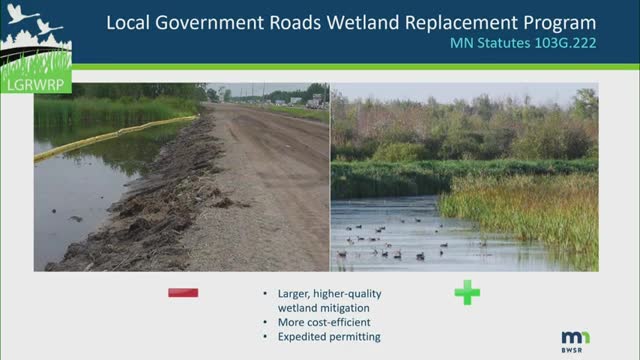
Summary
The Board of Water and Soil Resources urged the committee to provide a reliable funding stream for the local government roads wetland replacement program and detailed an amended CREP agreement that expands eligible counties and increases federal-state leverage.
The Board of Water and Soil Resources (BWSR) told the Capital Investment Committee on Feb. 13 that local governments need a predictable funding stream to secure wetland-replacement credits required for many road projects.
Andrea Fish, assistant director at BWSR, described the local government roads wetland replacement program as “a statutorily mandated program” that lets local road projects buy wetland-replacement credits produced and managed statewide. Fish said some bank service areas have less than a year of anticipated credits, forcing local governments to purchase credits from distant areas at higher cost.
Director John Jasky and Fish reviewed a related federal-state program that uses permanent conservation easements under Reinvest in Minnesota (RIM) and the Conservation Reserve Enhancement Program (CREP). Jasky said a recently amended USDA agreement expands eligibility to additional counties (those with more than 30% agricultural land) and increases the federal-to-state leverage to roughly 7-to-3 for enrolled acres.
Jasky told the committee the state has invested about $175 million into the federal leveraging program over the last seven to eight years and that federal funds have approximately doubled that investment (about $350 million of federal funding mobilized). He said the CREP agreement broadened the program’s geographic reach and added an option to target private well-water protection in some enrollments.
Committee members and BWSR staff said the principal problem is funding stability: when bonding gaps delay state funds, local road projects that rely on wetland credits may be delayed or jeopardized because permits assume mitigation credits will be available. A late-2024 stakeholder workgroup recommended continuing bonding as the most practical funding mechanism provided it remains regular and reliable.
BWSR asked the committee for follow-up and said it would provide the stakeholder workgroup’s findings and additional materials. Jasky also encouraged lawmakers to consider alternative mechanisms for long-term stability while acknowledging that transportation and other agencies would need to weigh in on specific proposals.