Get Full Government Meeting Transcripts, Videos, & Alerts Forever!
Get email alerts on the Dhs Budget Overview topic
No spam. Unsubscribe anytime.
DHS outlines governor's budget priorities, flags long-term care growth and federal uncertainty
Summary
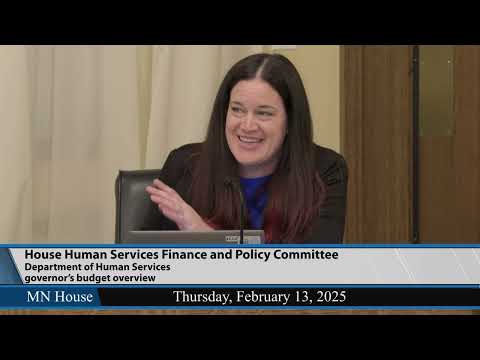
The House Committee on Human Service Finance and Policy heard an overview of the Department of Human Services's portion of the governor's budget on Feb. 17, 2025, with temporary DHS Commissioner Shereen Gandhi and budget director Alyse Bailey presenting the department's spending profile, program drivers and proposed administrative investments.
The House Committee on Human Service Finance and Policy heard an overview of the Department of Human Services's portion of the governor's budget on Feb. 17, 2025, with temporary DHS Commissioner Shereen Gandhi and budget director Alyse Bailey presenting the department's spending profile, program drivers and proposed administrative investments.
Gandhi, who identified herself as "on day 9 of this role," told the committee the department has shifted its mission toward helping "people thrive in community" and emphasized program integrity and continuous improvement as top priorities. Bailey said DHS's fiscal 2026 budget is about $24,000,000,000, with more than half coming from federal funds and roughly $9.4 billion from the state general fund.
The nut graf: DHS told lawmakers that roughly 89% of its spending is on the Medicaid (MA) program and that long-term care and disability waiver services are the fastest-growing cost drivers. The presentation framed the governor's proposals around capacity for oversight, mitigating fiscal cliffs caused by one-time funds or changes in federal match, and curbing forecast growth while aiming to limit impacts on people served.
Bailey walked the committee through program scale: in fiscal 2024, about 1.3 million people received health care through Medicaid, roughly 12,000 people received long-term care in nursing facilities and about 89,000 received long-term care at home. She emphasized the role of federal funding in the forecast and warned that federal-level proposals (work requirements, FMAP changes or per-capita caps) could materially change state options.
Presenters highlighted several structural drivers of cost growth: demographic shifts (more people aging into need), increased prevalence of disability, expanded access after waiver caps were lifted (yielding more younger people on waivers), shifts in service choice toward home- and community-based care, increases in authorized services and units, and rate increases aimed at stabilizing provider workforce. Bailey said about $10 billion of MA spending in fiscal 2026 is estimated for long-term care and waivers (about 46% of MA expenditures).
On administration, DHS said roughly 2% of its budget pays operations (staffing, IT); presenters noted the agency's administrative workload has not kept pace with the growth in claims, providers and oversight needs. The governor's package presented to the committee includes administrative FTEs and analytics investments to strengthen prepayment review, provider eligibility screening and program integrity work.
Ending: DHS staff told lawmakers they will return to the committee for follow-up questions and more detailed budget conversations as the legislative process continues and federal developments become clearer.