Get Full Government Meeting Transcripts, Videos, & Alerts Forever!
Get email alerts on the Veterans Affairs Cemetery Staffing Budget topic
No spam. Unsubscribe anytime.
Veterans Affairs requests property funds, cites staffing and cemetery deadlines in budget testimony
Summary
The Connecticut Department of Veterans Affairs told lawmakers the agency needs property to expand veteran burial options by 2027, is replacing an electronic medical record and is managing staff turnover that produces an annual personnel lapse of about $600,000
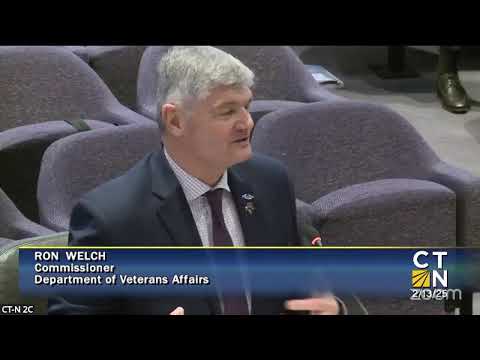
Commissioner Welch of the Connecticut Department of Veterans Affairs told the Veterans and Military Affairs Committee on Feb. 13 the agency’s mission “is serving those that have served,” and outlined capital projects, staffing trends and an urgent need for cemetery acreage to meet federal standards.
The nut graf: The department said it is remodeling residential units with ARPA funds, replacing its electronic medical records system, and pursuing property acquisition to expand cemetery capacity — while projecting a $600,000 personnel lapse driven by routine recruitment and attrition that the agency proposes to reflect in the biennial budget.
Welch said the department serves roughly 146,000 veterans in Connecticut and operates a licensed skilled nursing facility and a residential program. The agency has three ARPA‑funded renovation projects underway that will add 46 short‑term housing units, and it is working with the Connecticut Green Bank and other partners on an energy and solar plan for the Rocky Hill campus. Welch said the department has also begun the procurement process to expand cemetery land and that the Department of Administrative Services submitted an RFP on the agency’s behalf on Jan. 31.
On staffing, the agency presented Mary Grennan, its new fiscal manager, who explained the $600,000 personnel reduction in the governor’s proposal. “The $600,000 reduction is based on historical staffing levels,” Grennan said, adding that the agency is funded for 241 full‑time positions but that recruitment and the time it takes to fill vacancies create a persistent lapse in spending each fiscal year.
Lawmakers asked about staffing at the Rocky Hill health care center: Welch described the health care center as a CMS‑certified facility (the budget documents describe a 125‑bed skilled care center) and said the agency had a moving census and had hired 14 people while 29 left during the prior year. He told the committee the agency remains focused on hiring but characterized turnover as a continuing challenge.
Cemetery capacity and federal compliance were a central concern. Welch said federal Department of Veterans Affairs rules require the ability to provide three burial options (traditional in‑ground 4x8 graves, 4x4 graves for cremated remains, and columbarium interment) and that the department will not meet the 4x4 requirement by 2027 if it does not secure additional land. He said the agency secured $3 million in state bonding for property acquisition and that one 92‑acre parcel in Middletown previously considered was not available after the local council denied the sale; the agency has had at least one immediate response to the RFP from a property owner in the Lebanon area.
Welch also described operational cost pressures that increase the agency’s “other expenses,” including food, utilities and medication reimbursements; he said the federal VA now requires reimbursement for certain medications and that food costs have increased sharply for round‑the‑clock residential operations.
On headstones and burials, staff said the federal reimbursement for an interment (including the foundation fee) is roughly $998 for those interred within the state cemetery; the department does not receive that reimbursement for niche (columbarium) placements.
Ending: Welch told the committee the agency would continue to pursue property, complete the ARPA renovations and finish the electronic medical record replacement work, and asked lawmakers for continued support on bonding and operational funding as the department adjusts to staffing and programmatic demands.