Get Full Government Meeting Transcripts, Videos, & Alerts Forever!
Get email alerts on the Education Youth Services topic
No spam. Unsubscribe anytime.
'Young People First' report urges $545 million ECS boost, regional case management to cut disconnected youth
Summary
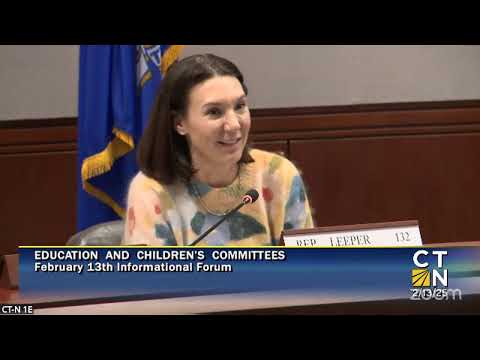
Connecticut municipal leaders and consultants presented the Young People First report at a joint informational session of the Legislature’s Education and Children’s committees, laying out 22 aligned actions designed to reduce the state’s estimated 19,000 at‑risk and disconnected young people by half over the next decade.
Connecticut municipal leaders and consultants presented the Young People First report at a joint informational session of the Legislature’s Education and Children’s committees, laying out 22 aligned actions designed to reduce the state’s estimated 19,000 at‑risk and disconnected young people by half over the next decade.
The plan, developed by the 119k commission with technical work from the Boston Consulting Group and convened by the Connecticut Conference of Municipalities (CCM), recommends coordinated action across four pillars — coordination, conditions, capacity and coalitions — and places special emphasis on integrated case management, expanded K‑12 funding and scaled work‑based programs. “What the commission had decided to do from the very beginning was to attempt to answer a question,” Joseph DeLong, executive director and CEO of the Connecticut Conference of Municipalities and a commission member, said introducing the report.
BCG described the practical and financial contours of the plan. Senior partner Lane McBride said the commission’s strategy includes a statewide oversight role and regional coordinating bodies to support town‑level case management hubs. McBride also told the committee that the P‑20 report was “substantively complete and will be released, I believe next week.” Principal Nikki Axman highlighted specific aligned actions such as redesigning service delivery at local, regional and state levels and boosting K‑12 funding to better support vulnerable students.
BCG and CCM provided the committee two cost estimates. Using program‑level benchmarks, BCG estimated roughly $408 million per year to implement the aligned actions excluding changes to the state’s education funding formula. For the education funding recommendation — changes to the Education Cost Sharing (ECS) formula that would raise current allocations for foundation, economically disadvantaged students, concentrated poverty, multilingual learners and students with disabilities — the commission estimated an additional $545 million in annual funding. BCG explained that those formula changes include an inflation adjustment to the foundation; raising the weight for economically disadvantaged students from 30% to 40%; increasing the concentrated poverty multiplier; boosting multilingual learner funding; and providing a 50% weight for students with disabilities where the formula currently provides none.
The presentation summarized the public engagement and evidence base behind the recommendations: six regional public meetings with more than 400 residents, roughly 281 one‑on‑one conversations with young people in the target demographic, 84 written testimony submissions, five local forums hosted by commission members, and eight national expert briefings. BCG reported recurring themes from interviews and forums: young people cited lack of trusted relationships and program access, a service system that often triages crisis rather than preventing it, and data and program silos that hamper coordinated support.
BCG spotlighted workforce and youth‑employment proposals, including scaling transitional employment, registered apprenticeships and summer employment programs, and creating year‑long fellowships into high‑demand sectors. The consultants recommended expanding recreational hubs and summer programs to address loneliness and improve engagement, and proposed success coaches and mentorship strategies to provide trusted adult relationships for young people.
Committee members asked implementation questions and raised concerns about local variation, family engagement and how the plan would plug into existing programs. Representative Zepkis asked how integrated case management would be organized at local, regional and state levels; BCG and CCM described a hub‑and‑spoke approach with regional bodies (for example workforce boards or other regional entities) identifying local providers to serve as integrated case management hubs and suggested competitive grants or capacity building to elevate successful local models. Several legislators stressed the need to involve families and local cultural context; Representative Perez described a personal experience of early disconnection to underline the need for supports beyond a single policy lever.
No formal votes or committee actions occurred during the session; members treated the meeting as informational. Presenters said the full Young People First report and supporting materials would be shared with committee members and offered CCM and BCG as resources during further deliberations. Office of Policy and Management (OPM) and P‑20 materials were referenced as related work; BCG said the P‑20 report’s release was imminent but deferred to OPM for final timing.
The presentation, as framed by CCM and BCG, positions the Young People First package as a milestone and a starting point for more detailed, locality‑specific planning and financing discussions. Committee members repeatedly noted the practical limits of state and municipal budgets and the need to identify funding sources if the recommendations are advanced.