Get Full Government Meeting Transcripts, Videos, & Alerts Forever!
Get email alerts on the Consumer Finance topic
No spam. Unsubscribe anytime.
Department of Banking outlines package of securities and consumer-credit changes, seeks new enforcement authority
Summary
Department of Banking testified on a bundle of agency proposals including changes to the Connecticut Uniform Securities Act, notice-filing fees for Tier 2 securities, expanded enforcement powers, NMLS bond handling, cosigner-release rules for private student loans and disclosures for shared-appreciation loans.
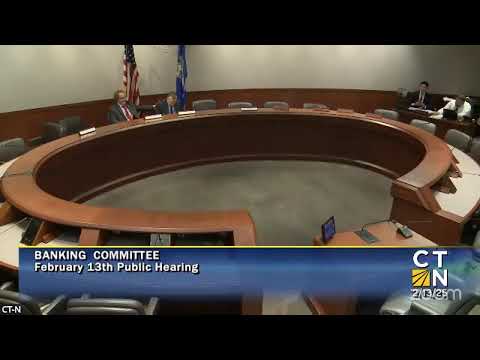
Department of Banking officials told the Banking Committee the agency is asking lawmakers to approve a range of technical and substantive changes to state securities and consumer-credit law.
My name is Matt Smith, Director for Government Relations and Consumer Affairs at the Department of Banking, said the agency is presenting multiple proposals, including HB 6,875 under the Connecticut Uniform Securities Act and provisions in Senate Bill 12-57 affecting consumer credit and commercial financing. "This proposal...creates a state broker-dealer registration exemption for merger and acquisition broker dealers..." Smith said, adding the proposal would also authorize a $250 notice-filing fee for Tier 2 securities offerings and new enforcement tools for securities violations.
The department told the committee the measures are meant to align state law with federal standards and other states, reduce regulatory friction and fill enforcement gaps. Smith said the Tier 2 notice-filing fee mirrors a common state practice; the department receives roughly "20 to 60 notice filings each year" and proposes a $250 fee to match the majority of other states. He also described a proposal to give the banking commissioner authority to "censure or bar a registered broker-dealer, agent, investment adviser, or an investor advisement agent based upon the grounds enumerated in Section 36b-15a," subject to hearing rights, which Smith said would create parity across divisions in the department.
The department presented several consumer-credit changes bundled in SB 12-57. Key provisions described by Smith include: requiring licensees that maintain surety bonds to post and cancel those bonds on the Nationwide Multistate Licensing System (NMLS), allowing electronic-only bond records; removing a physical-address requirement for electronic bonds; creating a mortgage-servicing registration exemption so companies that both originate and service mortgages can attach the appropriate bond records; clarifying that receipt of payments on retail installment and small loans requires licensure; and aligning some registrant renewal windows with licensee timelines (renewal window opens Nov. 1 and closes Dec. 31).
Smith said the bill would shift cosigner-release obligations for private student loans from servicers to the actual loan owners, noting servicers often cannot unilaterally release cosigners because they do not own the loans. The bill also would extend certain suspension, revocation and nonrenewal powers the department has over licensees to registrants in the consumer-credit division, Smith said. He told the committee that registrants (for example, servicers that exclusively service federal loans) currently have more limited examination access than licensees, and the change would extend enforcement parity.
Shared-appreciation loans and consumer disclosures were flagged as a specific product of interest. Smith said the proposal would require product-specific disclosures for shared-appreciation loans. Outside witnesses later raised concerns about how that product is marketed and tracked. Attorney John Diorio warned against allowing privately administered shared-appreciation products without strict consumer protections, saying such arrangements "can be a great public product if it's administered by a state or federal agency" but can be "a dangerous predatory product if it's in the wrong hands." He said Massachusetts-style statutory protections would be more appropriate than a bare-disclosure regime.
Committee members pressed the department for follow-up details. Representative Delnicki asked about the method for calculating an "equivalent APR" for shared-appreciation agreements; Smith said he did not have the formula at the hearing and agreed to provide written follow-up. Delnicki also asked whether borrowers receive continuing notification before a shared-appreciation payoff is due; Smith said there is currently no continuing-notification requirement beyond the initial disclosure but he would confirm and report back in writing.
On innovation banks, Smith described the state-chartered Innovation Bank (formerly the uninsured charter) as a regulatory path for firms that do not take retail deposits and primarily provide business-to-business services such as payment processing. He said Connecticut now charters a small number of such institutions — he cited Banking Circle and Numisma as examples — and the department is proposing updates to the innovation-bank statutes to reflect how these entities operate. Representative Satt asked about examiner staffing; Smith said the department has dedicated examiners and requested two additional examiners in the current budget to support growing applications.
What it means: The department's package mixes administrative streamlining (NMLS, electronic bond handling, renewal windows) with policy-level moves (enforcement parity for registrants, authorization to bar registrants, cosigner-release obligations, product-specific disclosures for shared-appreciation loans). Committee members asked for numeric and operational details on shared-appreciation APR calculations and post-closing notices; the department committed to written follow-ups.
Ending: The department left the hearing with several open follow-ups for committee members, including written detail on shared-appreciation APR calculations and whether additional post-disclosure notices are required under current law. The committee reserved further questions and indicated it would review the technical statutory language before marking up the bills.