Get Full Government Meeting Transcripts, Videos, & Alerts Forever!
Boston public-safety chiefs describe coordinated plans to protect large events
Summary
City public-safety leaders told a Boston City Council committee they use shared planning, intelligence from the Boston Regional Intelligence Center, staging of vehicles and medical resources, drones and neighborhood liaisons to protect large gatherings — and warned that some capabilities rely on federal grant funding.
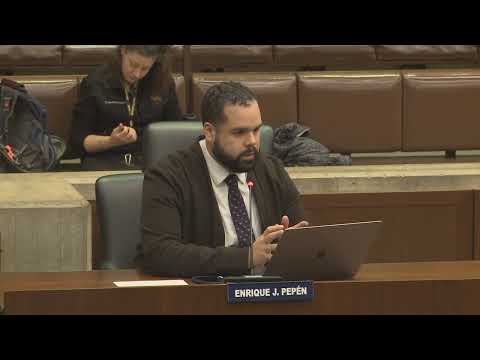
For the record, At-Large City Councilor Henry Santana, chair of the Boston City Council Committee on Public Safety and Criminal Justice, opened a Feb. 13 hearing on docket 0163 to examine “enhanced public safety measures during large events in Boston.”
The hearing brought together city emergency-management and public-safety leaders, who described detailed, cross-agency planning for parades, festivals and other mass gatherings and said they continuously revise tactics — including vehicle barriers, drones and staged medical units — based on intelligence and after-action reviews.
Why it matters: Councilors and agency chiefs said the city’s layered approach is designed both to protect attendees and to preserve citywide emergency coverage when a large event concentrates many first responders in a small area. Panelists also flagged funding risks: training, specialized equipment and some planning functions have been supported with federal grants that face uncertainty.
City officials said planning for large events is a year-round, coordinated process that uses the Boston Regional Intelligence Center (BRIC) to assess threats, an Emergency Operations Center (EOC) to centralize incident coordination, and detailed after-action reviews to change plans when problems occur. Adrian Jordan, chief of emergency preparedness at the Office of Emergency Management, described the EOC as “a centralized hub for coordination and communication during planned events and unplanned events,” and said it can model conditions, track resources and facilitate rapid decisions.
The Boston Police Department,…
Already have an account? Log in
Subscribe to keep reading
Unlock the rest of this article — and every article on Citizen Portal.
- Unlimited articles
- AI-powered breakdowns of topics, speakers, decisions, and budgets
- Instant alerts when your location has a new meeting
- Follow topics and more locations
- 1,000 AI Insights / month, plus AI Chat