Get Full Government Meeting Transcripts, Videos, & Alerts Forever!
Get email alerts on the House Bill 581 Homestead Cap topic
No spam. Unsubscribe anytime.
Burke County holds hearing on House Bill 581 homestead assessment cap; residents say ballot confused them
Summary
Burke County staff explained how House Bill 581 would limit annual assessed-value increases for homesteaded property and outlined local revenue risks if the county and other taxing authorities opt in; residents said the November ballot language confused many voters and raised concerns for seniors on fixed incomes.
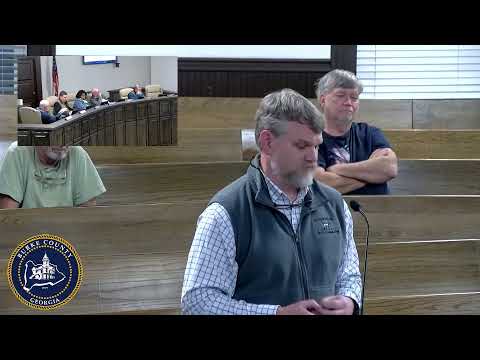
Burke County held the second of three public hearings on House Bill 581 on Jan. 31 as county staff explained how the law would limit annual increases in assessed value for properties with homestead exemptions and as residents voiced confusion over the November ballot question that approved an amendment tied to the law.
Ben Roberts, a staff member in the tax assessor’s office, told the hearing that HB 581 and the related Amendment 1 do not create “a new tax exemption” and instead cap how much a homesteaded property’s assessed value can rise in a given year. “There is no new tax exemption through this,” Roberts said. He told residents the cap would be set annually by the Georgia Department of Revenue’s revenue commissioner and applied to primary residences for taxpayers with a homestead exemption.
The chief appraiser, Philip Rins of the Tax Assessor’s Office, and Roberts advised that the change will not freeze taxes permanently. “I would tell you it’s what it does is slow down the increases,” Roberts said, describing the cap as a year-to-year limit that becomes the base for the following year. He said the State’s index for 2025 was expected to be 0, which would mean “virtually no change” in assessed homestead values for 2025 if local offices likewise record no market-driven value changes.
Why it matters: The hearing focused on whether local taxing authorities in Burke County — the county commission, the school board and the five cities of Waynesboro, Sardis, Midville, Keeseville and Girard — should “opt out” of using the state’s new method. If local taxing authorities opt in countywide, homesteaded properties will be subject to the state-set cap; if they opt out, local valuation practice remains unchanged. County staff warned that opting in could shift tax burden to non-homesteaded property or force millage-rate increases if assessed-value growth slows on the homestead portion of the tax digest.
Staff presented local figures showing homesteaded property shares of city tax digests (Waynesboro and Midville about 18% each; Girard 24%; Sardis 25%; Keeseville 29%) and noted that Plant Vogtle accounts for more than 90% of taxable value in the unincorporated county. Roberts cited an estimated $452,000 of affected value for the City of Waynesboro and about $4,800,000 in affected value countywide as examples of what portion of the digest could be constrained under the new cap.
Officials said the cap applies only to homesteaded residential property and does not directly change values for agricultural, timber, commercial or non‑homesteaded residential property; however, they warned that reduced assessed-value growth on homesteads could require higher millage rates that apply to all property types.
Public comments: Two residents spoke at the hearing. Teresa Voss, a resident of District 4, said she voted in November but was unsure what the ballot question meant: “I have no clue what I voted for. That was the most confusing amendment I ever read,” she said, adding that as a senior on a fixed income she fears higher taxes and urged opting out. William Jackson, another resident, said the three-sentence ballot summary did not convey the length or complexity of the bill: “How can you put a bill pages long in 3 sentences? … We did vote for it, but, no, we didn’t vote for it,” he said.
Timing and next steps: County staff reminded the public that local taxing authorities must decide whether to opt out by March 1 under the current legislative schedule, and that a later extension to May 1 had been proposed in the state legislature but had not been finalized. Officials also advised residents that anyone who does not currently have a homestead exemption must apply by April 1 to receive homestead benefits for the year. County staff said the Commission would continue hearings and that other taxing authorities in the county would consider their own decisions.
The hearing included repeated clarifications from staff that the standard state homestead exemption — the commonly available $2,000 deduction in assessed value referenced at the meeting — reduces county tax liability only by a small amount at current millage rates (staff estimated about $11 on the county portion for the average homestead), and that any local legislative changes to increase homestead deductions would require separate local action in future sessions.
No formal vote on opt-in or opt-out was taken at the hearing. The county’s commissioners and other local taxing authorities will still need to decide whether to adopt the state cap or retain local valuation practice before the statutory deadline.