Get Full Government Meeting Transcripts, Videos, & Alerts Forever!
Get email alerts on the Survey Entry Eminent Domain topic
No spam. Unsubscribe anytime.
Bill would require landowner consent or court order before pre‑condemnation surveys, sparking debate over property rights and project delays
Summary
Senate Bill 2379, introduced by Sen. Keith Behm, would require written landowner consent or a court order before entry onto private property for surveying in advance of public projects or eminent‑domain actions.
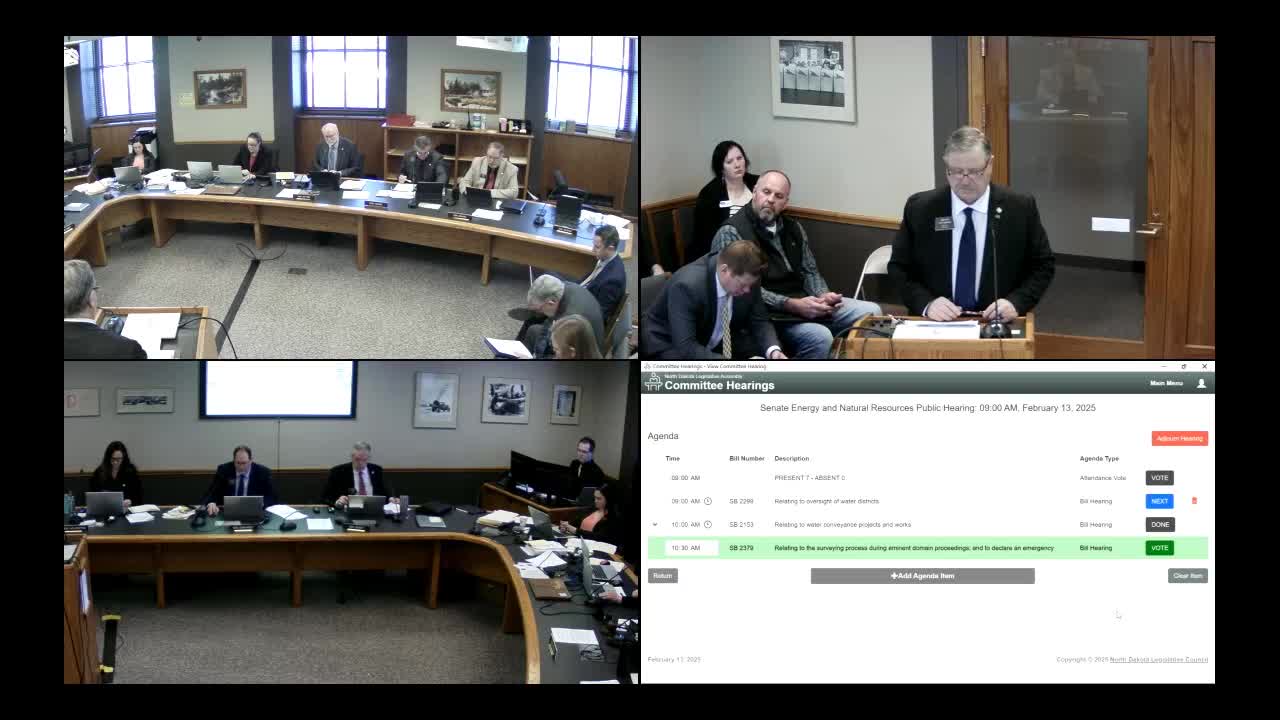
Senate Bill 2379, introduced by Sen. Keith Behm, would require written landowner consent or a court order before entry onto private property for surveying in advance of public projects or eminent domain actions. The Senate Energy and Natural Resources Committee heard pro and con testimony Feb. 7.
Behm described the bill as restoring balance between project needs and private property rights and said the measure would clarify that surveying without consent must be authorized by a court order. "This bill seeks to correct that by requiring written landowner consent or court order before entry for surveys," he said. The proposal also clarifies that landowners may recover damages only if conduct during the entry constituted negligence, wantonness or malice.
Supporters included Northwest Landowners Association and other landowner groups. Troy Koons of Northwest Landowners said the proposal creates an orderly process and that "responsible developers do not object to obtaining a court order when they cannot obtain permission." Derek Broughton, general counsel for Northwest Landowners, added from his practice that "in my experience, the responsible developers, typically do file actions and get court orders when they can't."
Opponents included rural water systems, the Garrison Diversion Conservancy District, the North Dakota Water Users Association and the Association of Counties. Those witnesses said the bill would hamper time‑sensitive preconstruction work — such as cultural and natural‑resources surveys needed to meet federal or state funding requirements — and could push projects into additional seasons or increase costs. Eric Volk of North Dakota Rural Water said the state has about 41,000 miles of rural water pipeline and projects rely on short seasonal windows to complete resource walks; he testified that the bill could add months to projects and materially increase costs. "What this really does is ... we lose a construction season with all the extra layers of collecting signatures beforehand," Volk said.
Dwayne DeCray, general manager of the Garrison Diversion Conservancy District, said his organization typically obtains voluntary easements and has rarely had to pursue condemnation; he cautioned that a requirement to obtain court orders could change how landowners perceive negotiations. "If we know we have to get a court order, that's the first thing we're gonna do ... and the landowner may not even know that unless they went to dispute it," DeCray said.
Witnesses also discussed pending legal issues. Counsel noted U.S. Supreme Court precedent and a recent North Dakota Supreme Court case addressing precondemnation access and whether certain entries amount to a taking; the bill narrows remedies by requiring proof of negligence, wantonness or malice for damages beyond the statutory just‑compensation framework. Some committee questions focused on how the bill would treat absentee owners, lessees and trusts; advocates said courts have procedures (such as service by publication) to reach absentee owners if required.
The committee took testimony from landowner groups, water system representatives, conservation and county associations, and legal counsel. No vote was recorded on SB 2379 during the hearing.