Get Full Government Meeting Transcripts, Videos, & Alerts Forever!
Get email alerts on the Water District Governance topic
No spam. Unsubscribe anytime.
Senate committee hears bill to clarify oversight and election rules for rural water districts
Summary
Senate Bill 2299 would add water districts to state audit authority and add rules for member petitions and candidate access to ballots. Supporters said the bill fills a legal gap; opponents warned standardized election rules could disrupt locally tailored bylaws and slow district operations.
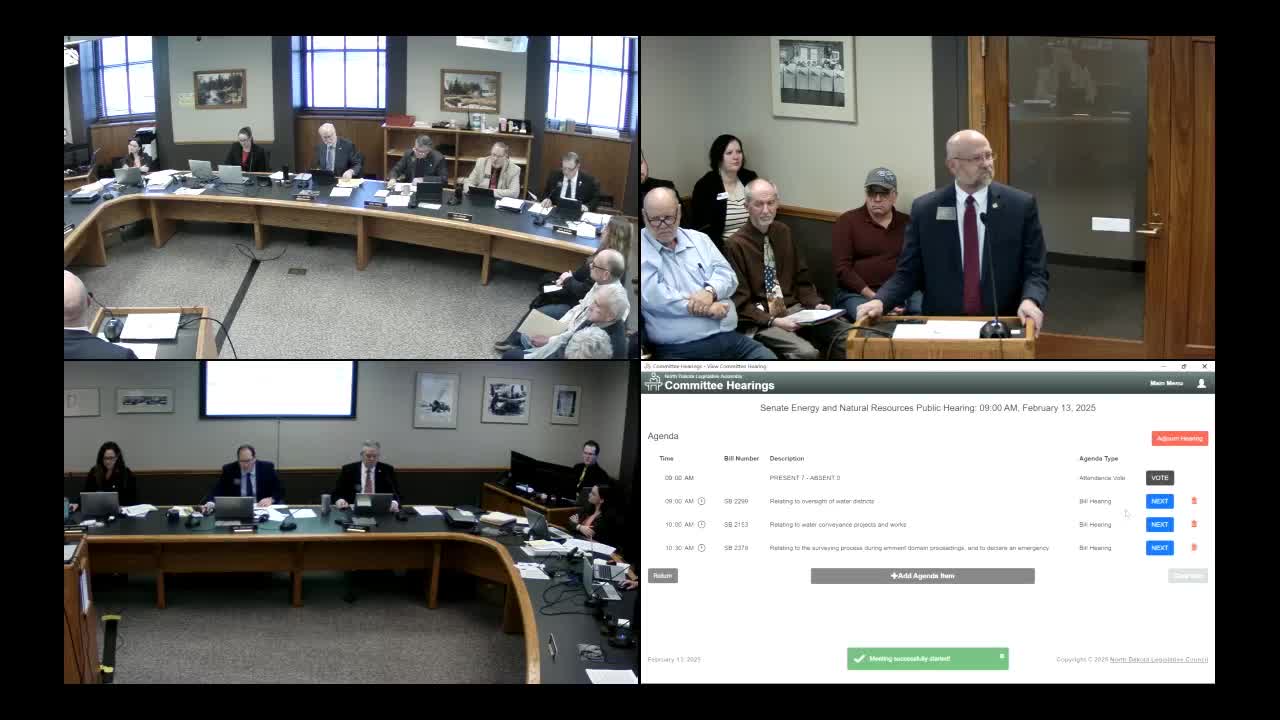
Senate Energy and Natural Resources Committee members heard testimony Feb. 7 on Senate Bill 2299, a measure that would add rural water districts to the state auditor's oversight and set petition and election rules for member-run water districts.
The bill, introduced by Sen. Bob Paulson, R‑Minot, would add water districts created under North Dakota Century Code chapter 61‑35 to the list of political subdivisions subject to review by the State Auditor and would establish a petition threshold and procedural requirements for nominations and election administration. Paulson told the committee he prepared an amendment and asked members to consider it during the hearing.
Supporters told the committee they want clearer, uniform recourse when members believe a district is mishandling elections or finances. "We have discovered that water districts exist in a legal gray area," said Crystal Hendrickson, a North Prairie board member, arguing the measure would give rural citizens a way to request audits and protect access to ballots. Dan Cox, director of audit services for the North Dakota State Auditor's Office, said adding water districts to the auditor's statutory list would require district audits to be submitted to his office for review and would impose little additional workload because many districts already submit audits voluntarily. "Their audit reports would have to be submitted to our office, for approval, for review just like we do with all other local governments that get audit reports," Cox said.
The bill's text, as discussed, contains several parts: section 1 inserts a statutory reference making water districts subject to the auditor; section 2 defines petition thresholds to trigger a state audit (introduced language says at least 10 percent or 150 participating members, whichever is fewer); section 3 would require that members seeking election present a petition with signatures from three participating members at least five days before the election so they are added to the ballot; section 4 clarifies vacancy appointments and requires that elections be conducted so participating members can "plainly observe" the process; and section 5 adds an emergency clause to make the law effective before annual meetings later this year.
Opponents — including the North Dakota Rural Water association, several water districts and counsel for affected districts — said parts of the bill would impose one‑size‑fits‑all rules that could conflict with long‑standing local bylaws and practical operations. Eric Volk, executive director of North Dakota Rural Water, said his members vary widely: "No election process is exactly the same in the 20 districts," he said, and the proposed uniform election rules were not workable for many districts. He and other speakers recommended removing or substantially revising the election‑procedure language while endorsing the audit clarification. Attorneys representing North Prairie said there was already an annual audit on file and cautioned against duplicative audits and rapid changes that would disrupt districts' established election procedures.
Committee members and witnesses also debated petition thresholds. Paulson and several supporters said requiring 300 petition signatures — a number some have suggested to replace the bill's 150 figure — would be difficult to achieve for smaller districts, where total membership can be under 1,000. Opponents urged the committee to allow districts flexibility to set thresholds proportional to membership. Several speakers urged removing or altering the emergency clause so changes would not be forced into districts immediately.
The hearing record included multiple personal accounts about North Prairie Regional Water District annual meetings in 2023–24, contested administration practices, a board code of conduct, and nominations committee procedures. Witnesses reported that a nominations committee in one district submitted a single candidate at a recent election and that multiple members believed they were denied the opportunity to run. Supporters of the bill said statutory change is necessary to protect participating members' rights to nominate and elect directors; opponents said local members can amend their bylaws to address those concerns.
The committee took testimony from municipal and industry groups, the State Auditor's Office and members of affected districts. No committee action or vote on the bill was recorded at the hearing.
If the committee advances the bill, options for amendment raised during testimony include changing the petition threshold to a fixed higher number (300) or tying signature requirements to district size, extending the minimum notice for candidate petitions beyond five days to accommodate mail‑in ballots, and removing the emergency clause to allow later effective dates.
Votes at this hearing: no formal committee vote was taken on Senate Bill 2299.