Get Full Government Meeting Transcripts, Videos, & Alerts Forever!
Get email alerts on the International Physician Licensure topic
No spam. Unsubscribe anytime.
Senate committee hears mixed views on bill to create provisional license pathway for internationally trained physicians
Summary
Supporters told the Senate Workforce Committee the bill would help address physician shortages by licensing qualified international physicians under supervision; the Board of Medicine and others warned the state and boards lack capacity and safeguards and urged delay or amendments.
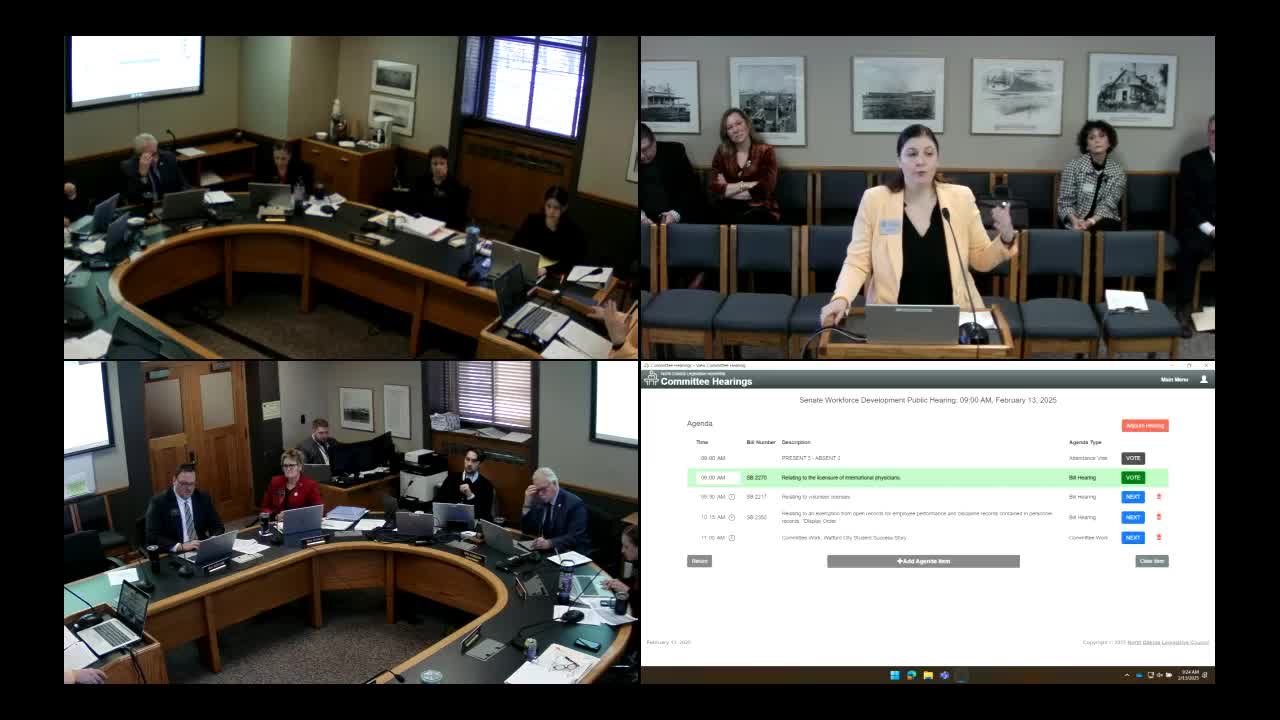
Chairman Wabamah opened a public hearing on Senate Bill 2270 on a proposal to create a provisional licensure pathway for internationally trained physicians to practice in North Dakota under the employment of participating health care providers.
Supporters said the bill would expand the pool of doctors available to treat patients in high-need areas. Donna Thronson, executive director of the North Dakota Medical Association, told the committee “NDMA supports Senate Bill 2270” and said physicians have asked for an alternative pathway that vets education without requiring internationally trained physicians to repeat U.S. residencies. Mike Zimmer of WES (a nonprofit social enterprise that works with internationally trained professionals) said many states are pursuing similar pathways and described national models for training, oversight and data tracking.
The bill would allow qualified international physicians to receive a provisional license if they meet examination and credentialing steps (including evaluation by the Education Commission for Foreign Medical Graduates) and have a full‑time offer of employment from a participating facility. Thronson and Zimmer urged board oversight and employer supervision; Thronson suggested adding a mentorship or supervisor period — “probably 2,000 hours” — and allowing the Board of Medicine to verify training and mentorship before full licensure.
Opponents, including Sandra DePentes, executive director of the North Dakota Board of Medicine, told the committee the Board’s statutory mission is to protect public health and safety and that the bill substitutes the Board’s current residency requirement with a mandate that the Board make substantial equivalency determinations for foreign postgraduate training. DePentes said North Dakota’s board “does not have the capacity to review an international residency training program and verify it has the same standards as our U.S. residency training” and warned that U.S. residency programs also teach system‑specific skills — billing, electronic records, HIPAA, and professional practices — that are not guaranteed by foreign training.
DePentes outlined several open issues she said remain unresolved: lack of an established accreditation or recognition system to verify foreign postgraduate training; questions about whether hospitals will be willing or able to provide the required direct supervision and assessment; whether participants would be eligible for privileging or certification (for example from the American Board of Medical Specialties); and uncertainty about immigration and Medicare/Medicaid participation. She urged delaying enactment until national guidance and verification systems (including work by the World Federation for Medical Education and the Federation of State Medical Boards) mature and until hospitals and the Board have developed workable supervision and verification processes.
Several senators pressed both sides on practical details: how the Board would verify training across many countries, whether mentorship obligations could be met in an already overburdened U.S. healthcare system, and what funding or staffing would be needed for the Board to do the comparative work. An international physician who testified neutrally, Dr. Donald Munkada, described his experience arriving in the U.S. as a refugee, said he and other internationally trained physicians possess clinical knowledge but need time and supervised practice to learn U.S. systems and technologies, and told the committee he would not treat patients without appropriate transition support.
There were no committee votes during the hearing. The committee closed the hearing after taking testimony in favor, neutral, and in opposition and moved on to the next bill.
Why it matters: The bill addresses the state’s physician shortage by attempting to tap internationally trained physicians already practicing abroad, but it raises practical questions about patient safety, the Board of Medicine’s resources and the capacity of health-care facilities to provide structured supervision. Lawmakers and stakeholders signaled support for finding solutions but differed sharply on timing and guardrails.
Next steps: Committee members did not take a recorded vote during the hearing; proponents and the Board of Medicine both said they are open to amendments to add supervision, verification, data‑tracking and safeguards before the bill advances.