Get Full Government Meeting Transcripts, Videos, & Alerts Forever!
Get email alerts on the Agriculture Economic Impact topic
No spam. Unsubscribe anytime.
NDSU: Agriculture contributes about $41 billion to North Dakota economy, study finds
Summary
North Dakota State University presented a new economic-impact study showing agriculture contributes roughly $41 billion in annual output and supports about 123,000 jobs statewide.
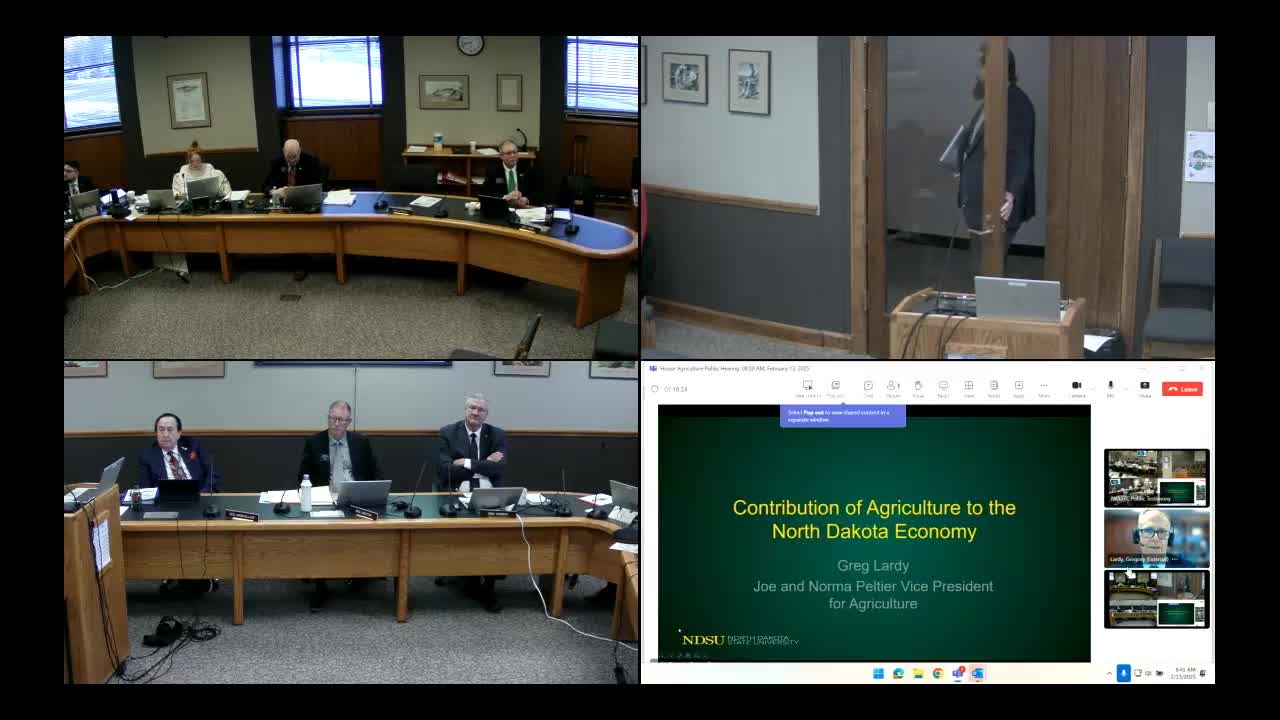
Greg Lardy, vice president for agriculture at North Dakota State University, told the Senate Agriculture and Veterans Affairs Committee that a recently completed study estimates North Dakota agriculture contributes “over $41,000,000,000 to the state's economy.”
The study attributes about $26 billion to direct output and over $15 billion to secondary (indirect) economic activity, Lardy said. He told committee members that the sector supports roughly 46,000 direct jobs and 76,000 indirect jobs for a total of approximately 123,000 jobs statewide.
Why it matters: The report shows agriculture remains a dominant economic engine in North Dakota, accounting for more than one-quarter of the state’s total output and nearly 21% of employment, the presentation said. Lardy credited recent investments in processing capacity — including soybean crush plants and beef/livestock development — as factors in the growth since a comparable NDSU study released in 2022.
Committee members asked about year-to-year comparisons and commodity-price effects. Lardy said the new estimate is the second study of its kind for the state; the prior, released in late 2022, placed agriculture’s contribution at about $31 billion. He told senators the roughly $10 billion increase in the new study reflects both price and structural changes, including more in-state processing capacity. On commodity prices, Lardy said sales at the farm gate and resulting spin-off effects mean price swings do affect the headline totals.
Lardy thanked the study’s authors, Dean Bankson and Nancy Hodor, and the associations and organizations that helped fund the work. He said NDSU’s research, extension network and land-grant mission position the university to continue tracking and supporting the industry.
Looking ahead, Lardy and committee members discussed using the study to inform policy and to promote the industry outside the state. He said NDSU and partner groups are conducting media outreach and are open to working with state lawmakers to translate the findings into programs that support processing and value-added development.
Ending: Committee members thanked Lardy for the presentation; no formal action was taken during the hearing.