Get Full Government Meeting Transcripts, Videos, & Alerts Forever!
Get email alerts on the Public Art topic
No spam. Unsubscribe anytime.
Council authorizes Fremont Park column tiles by Cara Lynch, up to $30,000
Summary
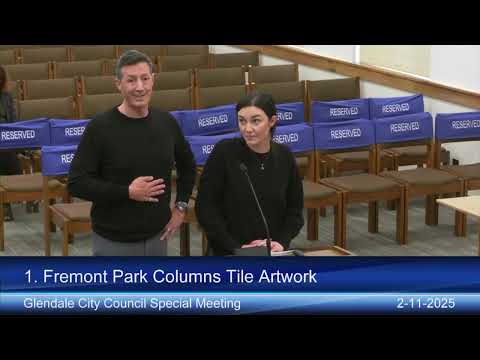
Glendale City Council on Feb. 11 authorized the City Manager to enter into an agreement with artist Cara Lynch to design, fabricate and install a tile artwork titled "Belonging" on Fremont Park columns in an amount not to exceed $30,000 from the Urban Art Fund.
Glendale City Council on Feb. 11 authorized the City Manager to enter into an agreement with artist Cara Lynch to design, fabricate and install a tile artwork titled "Belonging" on columns at Fremont Park in an amount not to exceed $30,000, to be paid from the Urban Art Fund.
The project was selected through an arts request-for-qualifications advertised in November 2023. City staff said roughly 230 applications were received; four artists were shortlisted for the Fremont Park column opportunity and Cara Lynch’s design was recommended by the Arts and Culture Commission and later presented to the Parks, Recreation and Community Services Commission.
City cultural staff and the project consultant described the approved design as a native-wildflower–inspired tile scheme. The presentation identified three column types in the park (labeled C1, C2 and C4) and a total of 20 columns that will receive tile work: four C1 columns, four C2 columns and 12 C4 columns. The C1 columns will receive an 8-by-8-inch tile medallion on two sides; C2 columns will receive a single sided installation of roughly thirty 3-inch tiles; and C4 columns will receive two sides of approximately 30 tiles per side, staff said.
Beau Bass, principal of LaBasse Projects, who presented with the city consultant, said the tiles will be hand-glazed ceramic and are easier to clean than painted surfaces. “The ceramic tiles are actually and historically, if you look at mosaic tile, are actually much easier to clean than if it was, like, a they painted directly to the stucco,” Bass said. He described typical project practice of providing an overage for spare tiles: “Generally, a project like this that will be, like a 10% overage on additional tile, then we'll have to work out, you know, with parks where they store that if they want to store it.”
Council members asked about the columns’ function and durability, and whether tile sizes could be increased. Council Member Brotman confirmed the columns are decorative features from the park design and not structural. Council Member Najarian asked about vandalism and maintenance; staff and the consultant said graffiti can typically be removed by power washing and that glazed tile is resilient to sun and wear. Council members also asked whether plaques or QR codes would explain the native-flower imagery; staff said public-art plaques are typically provided and a QR code could be added.
Council Member Brotman moved to authorize the agreement; Council Member Najarian seconded. The motion carried on roll call; Council Member Brotman, Council Member Garpetian, Mayor Pro Tem Kasakian and Council Member Najarian voted yes. Mayor Asatarian was noted earlier in the meeting as out of town and not participating.
The agreement authorizes design, fabrication and installation only; the Parks Department will handle storage and maintenance logistics for spare tiles and routine cleaning. The Arts and Culture Commission had asked specifically that California native wildflowers be incorporated into the final tile palette, feedback staff said will be reflected in the contract scope.