Get Full Government Meeting Transcripts, Videos, & Alerts Forever!
Get email alerts on the Met Towers topic
No spam. Unsubscribe anytime.
Commission approves six‑year extension for two Morgan Valley meteorological towers; neighbors ask for shorter term
Summary
The Planning Commission approved an amendment (UP24-14) to extend operation of two existing meteorological towers in Morgan Valley through Aug. 25, 2030, while neighbors said they would prefer a shorter term and expressed concern about the towers’ appearance.
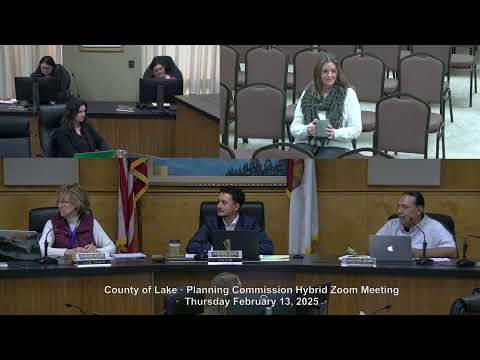
The Lake County Planning Commission on Feb. 13 voted to amend an earlier major use permit to allow two existing meteorological (MET) towers in Morgan Valley to remain in place through Aug. 25, 2030. The towers — installed in 2023 on two private parcels in a remote area of Lower Lake — are collecting wind and meteorological data to evaluate feasibility for a possible future wind energy project.
Laura Holmes, senior planner with the Community Development Department, reviewed the site and legal framework and recommended approval of the amendment. She told commissioners the project was evaluated under the Lake County General Plan and the Lower Lake Area Plan and relied on the prior CEQA review; staff concluded the request to extend the temporary use is consistent with the earlier findings and conditions and recommended approval.
Brandon Walter, a project developer for the applicant, explained that the towers are monopoles with guy wires and that there are no above‑ground electrical lines associated with the meteorological equipment. He described the towers’ purpose: to collect wind speed, direction and other meteorological metrics to assess whether the area is feasible for a future energy project.
Neighbors spoke at the hearing. Wayne Doherty, who lives to the south of the site, said the towers are “unsightly” and that he did not want them left standing indefinitely, though he did not register a formal objection to data collection. Several commissioners acknowledged the neighbors’ concerns about visual impact and about leaving temporary structures in place for multi‑year periods.
Applicant representatives said they requested the full six‑year extension because that timeframe was included by condition in the original permit and because they may need long‑term data to evaluate feasibility. Libby Fortin, who also represented the applicant, said the development team needs the longer collection period to “fully evaluate the feasibility of the site” and that the towers will be removed and the ground restored after data collection is complete.
The commission debated the term length. One commissioner said four years might be more appropriate for neighbors; other commissioners supported the six‑year extension to avoid repeated returns to the commission if additional data were required. The commission then voted in favor of the amendment to UP22-06 (filed as UP24-14) and granted the requested extension with conditions and the findings listed in the staff report.
The approval is subject to the typical seven‑calendar‑day appeal period to the Board of Supervisors. The applicant and staff noted the towers are already constructed and in operation; the amendment simply extends the permit expiration date to allow continued data collection.