Get Full Government Meeting Transcripts, Videos, & Alerts Forever!
Get email alerts on the Cannabis Cultivation topic
No spam. Unsubscribe anytime.
Lake County planning commission continues hearing on Little High Valley cannabis grow after neighbors raise access, grading and water concerns
Summary
After extensive public comment raising questions about grading, road easements and water impacts, the Lake County Planning Commission continued the hearing on a proposed two-acre outdoor cannabis cultivation project (UP21-07) until March 27 for further review.
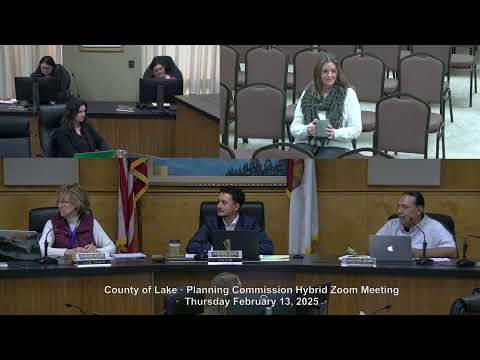
The Lake County Planning Commission on Feb. 13 continued consideration of a major use permit (UP21-07) and its associated environmental review (IS21-07) for the Little High Valley commercial cannabis cultivation project after residents and county staff raised unresolved questions about road access, grading and potential impacts to nearby wells.
Staff said the proposal seeks approval for two Type 3 outdoor cultivation licenses covering two acres of canopy (87,120 square feet) within roughly a 90,620-square-foot cultivation area, plus a 3,500-square-foot processing building and a Type 13 self-distribution (transport-only) license at 17870 Little High Valley Road in Lower Lake. The parcel is about 78.38 acres. Staff noted the project would employ two permanent workers and up to eight seasonal workers during peak activities.
The commission’s staff presenter summarized the regulatory review and status: the proposal was evaluated under the Lake County General Plan, the Lower Lake Area Plan, the Lake County zoning ordinance (Article 27) and state regulations; staff recommended adopting a mitigated negative declaration with mitigation measures in the staff report. The staff report also described a county grading/stormwater inspection that found no enforceable violations after clearing was shown in the record to pre‑date the current applicant and to be limited in depth, and noted a zoning clearance (ZC25-04) issued Jan. 15, 2025.
Neighbors and other members of the public urged the commission to delay action. Joni Henderson, who said she lives directly adjacent to the proposed grow, told the commission that satellite images and a consulting engineer’s letter (Brian Hall) indicate tree and vegetation removal that the neighbors say was not disclosed in the application and that may have required environmental review. Henderson also raised safety and egress concerns tied to the condition and width of the access easement, and argued that homeowners along the easement had not given permission for commercial use.
Mark McDonald, the applicant and owner of Inland Properties, described the site’s history and his interest in a smaller, quality operation. He told the commission the property needed debris removal when he bought it and that he and his team had improved the road and installed a high‑yield well. “We definitely are hoping for an approval today,” McDonald said, adding the goal was a discreet, low‑impact operation that would be a good neighbor.
Project manager Travis Lisenby said initial operations would start at about 20,000 square feet of canopy (roughly 1,500 plants initially) and described steps taken to repair the access road and maintain water bars to control runoff. “If we ever get up to the 2 acres, you would think, you know, about 2,500 to 3,000 an acre,” Lisenby said when discussing plant counts and cultivation approaches.
A number of residents, resort and business representatives and environmental commenters raised overlapping concerns: potential well interference and aquifer impacts, the adequacy and accuracy of the biological survey (citations that the Pine Crest Environmental field survey was from 2020 and predates current conditions), the legality of road widening or grading without permits, fire‑safety and egress on a mile‑long dead‑end road, and how county setbacks apply to nearby private homeschools. Will Peterson, a local well driller, told the commission the site’s volcanic geology generally yields abundant water and that the new well had produced reliably even through recent drought conditions.
County counsel advised the commission that a recent appellate decision (JCC Crandall v. County of Santa Barbara, early 2025) interprets Business and Professions Code provisions to require cultivators to have the permission of all underlying property owners for easements used to access cannabis operations; counsel said that interpretation could apply here and would mean property‑owner permission is required for each parcel crossed by the access easement. Staff confirmed GIS records show the existing easement to the project crosses two other parcels before reaching the project parcel.
Given the unresolved questions about easement permission, the adequacy of some submitted materials as raised by neighbors, and recent case law, the applicant requested a continuance. Planning commissioners voted to continue the public hearing to March 27, 2025, at 9:05 a.m. for further review and for the applicant and staff to address outstanding legal and technical questions.
The commission’s continuance leaves the application pending; staff retained the recommendation to adopt a mitigated negative declaration and approve UP21-07 subject to conditions if the outstanding legal and technical issues are resolved.
Community members and the applicant said they expect to use the continuance to obtain legal opinions, additional technical reports and to seek permission or clarification on the easement issue.
The commission noted the continuance is procedural and does not reflect a final determination on the merits of the project. If the applicant and staff return with additional analyses and any required permissions, the commission will take further public comment and may act on March 27.