Get Full Government Meeting Transcripts, Videos, & Alerts Forever!
Get email alerts on the Public Broadcasting Legacy topic
No spam. Unsubscribe anytime.
Minnesota public television association outlines legacy-funded programming, audience and budget figures
Summary
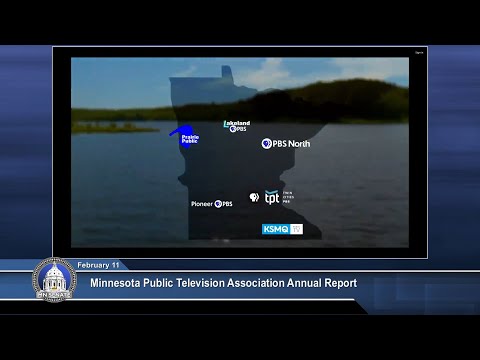
Representatives of the Minnesota Public Television Association presented this year’s annual report to the Senate Environment, Climate, and Legacy Committee, describing legacy-funded programming across six independent public stations, audience and education reach, and recent state funding amounts.
Les Heen, a representative of the Minnesota Public Television Association, told the Senate Environment, Climate, and Legacy Committee on Feb. 11 that the six independent public television stations that make up the association continue to use Legacy funds for statewide programming, education and outreach.
The association’s report, delivered by Les Heen and Patty Meister, president and general manager of PBS North and president of the Minnesota Public Television Association, said the six stations produced more than 2,000 hours of newly produced Legacy-funded programming in the last two years and reached millions of viewers on air, online and in classrooms.
Why it matters: The committee reviews Legacy-funded work to ensure projects advance the purposes of the Clean Water, Land and Legacy Amendment. The association framed its work as statewide: production, classroom materials, and digital distribution that the presenters said extends Minnesota history, arts and STEM content to a broad audience.
Heen provided the committee with recent state funding figures. He said the 2023 Legacy bill allocated $5,000,000 in the first year and $4,500,000 in the second year to the Minnesota Public Television Association (a biennial Legacy total of $9,500,000). He also summarized general fund grants: $1,550,000 per year in matching/operating grants, $250,000 per year in equipment grants, and $500,000 per year in block grants. Heen and Patty Meister stated those general-fund amounts require stations to raise matching dollars in their communities for the matching grants.
Patty Meister described how Legacy funds support local storytelling and classroom resources. She said the association’s stations reported over 2,000,000 web page views and video views of Legacy content in the past year and that the stations produced more than 100 new lesson plans in the last year in addition to over 1,000 prior educational materials. On awards and recognition, Meister noted the association’s Legacy-funded work received 27 Emmy nominations and nine Emmy awards in the past year, which she presented as evidence of quality, not as the primary purpose of the work.
Committee members asked for additional budget detail. Senator Green requested total budget figures and the proportion of station budgets made up by state and Legacy funding; Heen said station-by-station percentages vary and offered to provide breakouts for individual stations. Heen and Meister emphasized the association’s structure: six independent, community-licensed stations governed locally, not consolidated under PBS; as Meister put it, “We are not part of PBS. We are not affiliated in any way other than the fact that we pay membership dues to acquire programming. But we are all independent community owned licenses.”
The committee accepted the report and indicated follow-up questions. Heen and Meister offered to deliver more detailed station-level budget numbers to members who requested them.
Ending: Committee members thanked the presenters and noted they would follow up on requested budget breakouts and other details in future meetings.