Get Full Government Meeting Transcripts, Videos, & Alerts Forever!
Get email alerts on the Soil And Water Conservation topic
No spam. Unsubscribe anytime.
Idaho Soil and Water Conservation Commission reports FY24 figures, highlights high district satisfaction and Waukapa demand
Summary
The Idaho Soil and Water Conservation Commission told the House Agriculture Affairs Committee it met several performance goals in fiscal year 2024, distributed statutory district funds, and saw demand far exceed available dollars for the revived Waukapa cost‑share program.
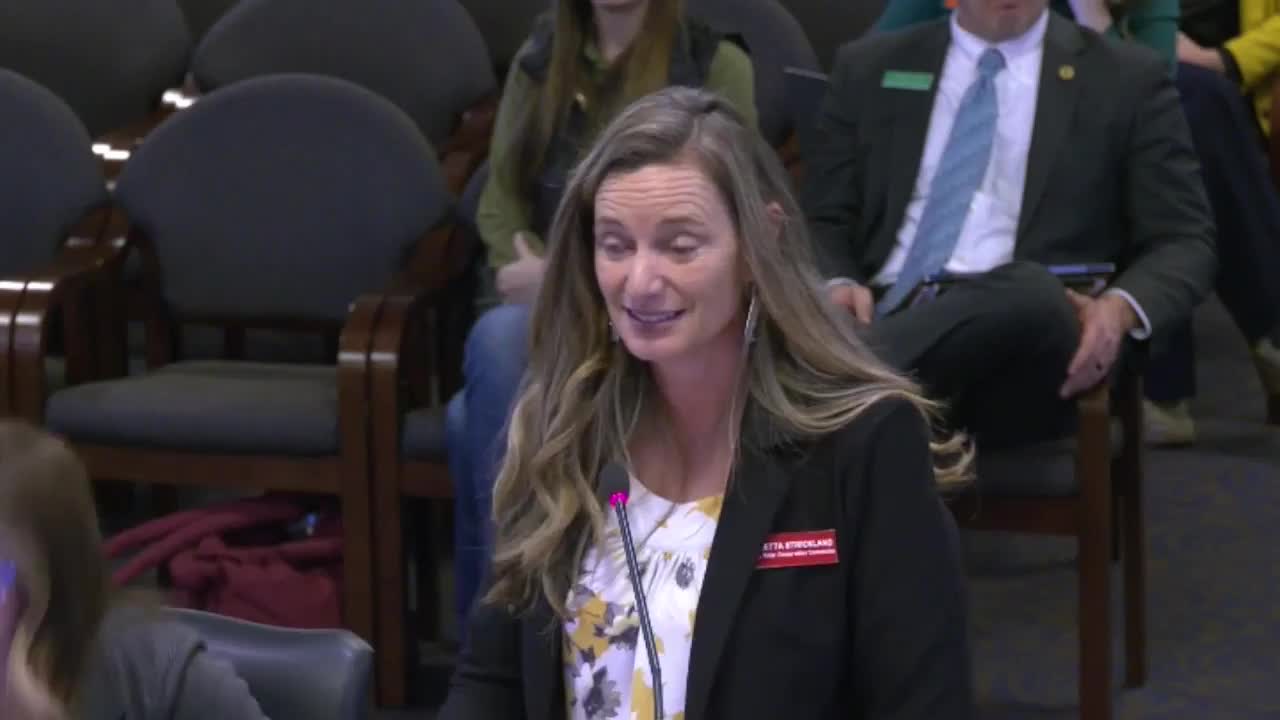
Loretta Strickland, acting administrator and agricultural program manager for the Idaho Soil and Water Conservation Commission, presented the commission’s fiscal year 2024 annual and performance report to the House Agriculture Affairs Committee.
The commission reported roughly $3,950,000 in revenue and slightly more than $7,900,000 in expenditures in FY24. It said $1,580,000 appropriated for distribution to the state’s 50 conservation districts was disbursed per statute and agency rule; the first $725,000 was split equally among districts ($14,500 each) and the remaining $858,800 was allocated as state match based on eligible local support. The report said districts reported strong satisfaction with commission services — 97.5% overall — and that staff provided technical support for programs including CREP and the Resource Conservation and Rangeland Development Program (RCRDP).
The nut graf: the commission emphasized that state support and partner cooperation are central to its work on voluntary, nonregulatory conservation projects, and that interest in the revived Waukapa cost‑share program far outpaced available funds.
Commission staff described core functions as district support, comprehensive conservation services, agency administration, and outreach. The commission said it administers a loan fund (RCRDP), supports CREP (the Eastern Snake Plain Aquifer Conservation Reserve Enhancement Program), and is the designated state agency for developing TMDL implementation plans for agricultural and grazing lands. Agency staff identified a single current field staff vacancy and noted they are authorized up to 17.75 full‑time positions.
On finances, the commission gave a breakdown of FY24 revenue sources (general fund, dedicated fund interest, and RCRDP receipts) and spending categories (personnel, operating, capital outlay, trustee and benefits payments to districts, CREP participant payments and RCRDP disbursements). Staff said the median match allocation to districts in FY24 was $13,834 and that the statewide ratio of match to local support was 1.49:1, about $297,000 short of the statutory 2:1 maximum.
Performance measures on pages 2–4 of the packet showed the commission met several internal goals: 97.5% district satisfaction, 95% satisfaction with communications, and filling 92% of district assistance requests. Staff said they expended nearly 12,000 hours assisting districts and logged additional technical assistance hours for CREP participants; they reported no new EPA‑approved TMDLs in FY24 and said that allowed staff time to focus on implementing the WACPA/Waukapa water quality program for agriculture.
On Waukapa, commission staff said $10,000,000 was appropriated to the program over the 2022–24 period. They reported 170 project proposals requesting about $20.2 million in Waukapa funds; 98 proposals were funded from the $10,000,000 appropriation and, when combined with partner and landowner match, produced an estimated $36.1 million in conservation projects statewide. For FY24 specifically, staff said $5,000,000 was appropriated, 80 proposals were received, and 50 projects were selected; combined with other funds those FY24 projects totaled about $17.7 million, a $3.54 return on each state dollar invested, the commission reported.
Committee members asked about projects that were not funded, whether any proposed projects included aquifer recharge, the mechanics of state funding and how it flows to local districts, and what drove the increase in acres improved with best management practices. Financial manager Melanie Ziegler explained that the commission has a base general fund appropriation that grows by up to 3% annually under current executive guidance, and that larger supplements (for example the multi‑million dollar Waukapa appropriations) were enacted as supplemental legislative actions in 2022 and 2023. Strickland and staff said many funded Waukapa projects supported irrigation infrastructure and efficiency improvements, livestock BMPs, stream bank and erosion practices, and soil health work.
Ending: The commission closed by thanking the committee and standing for questions. Committee members later heard related testimony from the Idaho Association of Soil Conservation Districts (IASCD) about district priorities and local examples of irrigation upgrades, youth outreach and community infrastructure projects.