Get Full Government Meeting Transcripts, Videos, & Alerts Forever!
Get email alerts on the Property Tax Homestead Exemption Hb581 topic
No spam. Unsubscribe anytime.
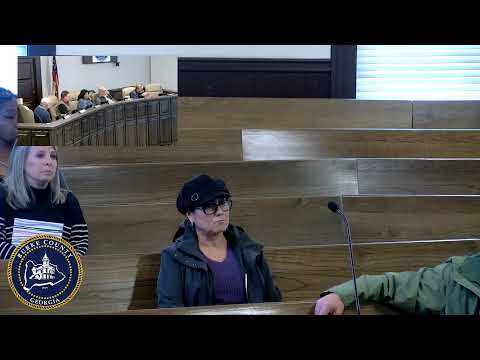
Burke County holds public hearing on HB 581 and whether to opt out of new homestead cap
Summary
County staff and residents discussed House Bill 581, the March 1 opt-out deadline, and how the law's cap on assessed-value increases for homesteaded property could shift tax burdens. Staff said many implementation details remain unresolved and that effects over time are uncertain.
Burke County officials held a public hearing on House Bill 581 (HB 581) to explain how the recently enacted state law and the November ballot measure (Amendment 1) could change the way assessed values for homesteaded properties are calculated and whether the county should exercise a local opt-out by the March 1 deadline.
County staff described HB 581 as a statewide response to rapid increases in property valuations that had spurred public complaints. Ben, a staff member in the Burke County tax assessor’s office, told attendees: "If you opt out you're taking away some sort of tax exemption. That is not at all what is happening." He and other staff emphasized the law limits how much a homesteaded property's taxable value may increase in a given year, using a formula the state revenue commissioner will set (staff said a consumer-price-index–based formula is expected but the exact percentage is not yet final).
The county's explanation focused on what HB 581 does and does not change. Staff said the rule applies only to properties with a valid homestead filing and that the new cap would affect the assessed (taxable) value, not directly change millage rates. As staff explained, a property’s tax bill remains a product of assessed value and locally set millage; if assessed-value growth is constrained under HB 581, the board of commissioners, the school board or a city could still change millage rates to meet revenue needs.
Staff warned of lingering implementation questions. Philip, another assessor's office staff member, said the state is updating the shared appraisal software to calculate the new caps and that the county is continuing to seek clarifications from the Georgia Department of Revenue and the State Revenue Commission. County staff said the law as originally written would have frozen the taxable value for an entire parcel (including large acreage) and that a cleanup bill under consideration would limit the homestead cap to a smaller acreage (staff said a committee-reported change would limit coverage to no more than four acres, but that measure still needed final legislative approval).
Staffers described the appeal process as remaining local: property owners will still file assessment appeals with the county, but the arguments available will differ when a homestead cap is in effect. "You still would appeal your values," Ben said. He added that if the state sets a capped percentage for homesteaded properties (examples of "3%" have circulated publicly), local assessors may still use a lower local adjustment and the State Revenue Commission has said it would not penalize localities that use the lesser figure.
Officials gave several concrete touch points. Staff said the familiar $2,000 standard homestead exemption historically equals roughly $17.25 in county tax relief on a $100,000 home (county portion only) under current millage; they noted that the HB 581 mechanism does not itself increase that exemption amount. Staff also said Burke County voters approved Amendment 1 by about 61% locally; the amendment's passage and HB 581 together create the opt-in/opt-out choice facing local governments.
Residents at the hearing raised concerns about seniors and homeowners on fixed incomes whose taxes rose steeply in recent years. One attendee said, "I have a friend that's 84 years old and her taxes skyrocketed." James Cody, a resident who spoke later, summarized the local perspective: "Whether we stay in or whether we can get out the bottom line is taxes." Several speakers urged the commission to respect the will of voters and criticized the short timeframe and limited public information before the election.
County staff highlighted tradeoffs for opting in or opting out. Staying in the state’s HB 581 framework would cap increases for homesteaded parcels but could shift revenue pressure onto non‑homestead properties (commercial, agricultural, timber, second homes) if the digest shrinks or grows more slowly than before. Conversely, opting out preserves current local assessment rules but leaves homesteaded owners subject to whatever local revaluations occur. Staff noted a March 1 deadline to opt out; if a county opts out it cannot later re-enter the state program, and if it remains in it cannot later opt back out.
Officials warned of long-term uncertainty. Staff described scenarios where capped homestead values would diverge from market values over time and potentially require higher millage rates to replace lost revenue — a shift that could affect owners who do not have homestead exemptions. Staff also said the law leaves local boards of assessors the task of defining when a property change is "significant" enough to change a baseline taxable value (for example, major additions or new structures), and that appeals and local policy will determine how those cases are treated.
The hearing did not include a formal vote. County staff said they will continue seeking clarifications from the Department of Revenue, follow pending cleanup legislation at the state level (including the proposed acreage change), and provide the commissioners with financial projections that attempt to model the many unknown variables — including the number of homestead filings, Plant Vogtle valuation trends, and the percentage the state sets for annual increases. The county scheduled a second hearing at 6 p.m. the same day for further public input.
Without a formal local decision at the hearing, commissioners said they would weigh the technical explanations, pending state guidance, and public comment before deciding whether Burke County should opt out of HB 581 by the March 1 statutory deadline.