Get Full Government Meeting Transcripts, Videos, & Alerts Forever!
Get email alerts on the State Revenue Forecast topic
No spam. Unsubscribe anytime.
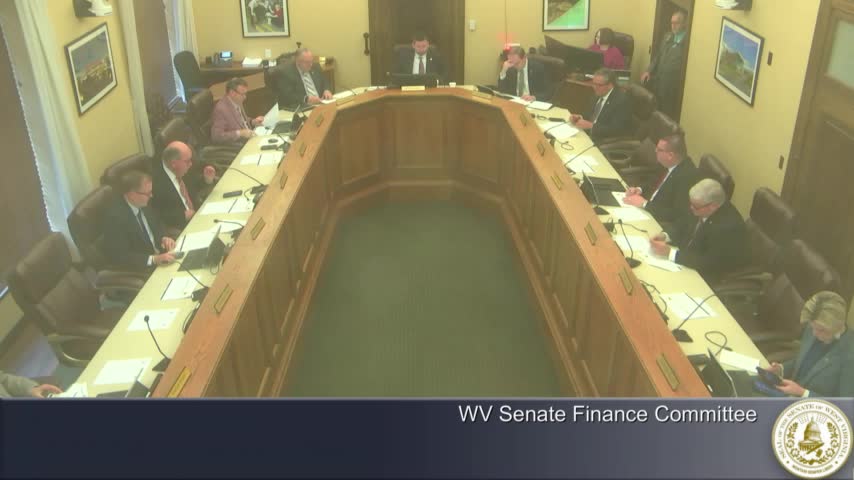
Senate Finance hears West Virginia revenue outlook; FY2026 estimate rises 1.1% amid large tax cuts
Summary
Deputy Secretary Pete Shirley told the West Virginia Senate Finance Committee that the official FY2026 general revenue estimate is $5.323 billion, a 1.1% increase from the FY2025 estimate, but growth is muted by recent personal-income tax cuts and uncertainty in severance and interest income.
At a meeting of the West Virginia Senate Finance Committee, Pete Shirley, deputy secretary for the West Virginia Department of Revenue, presented the department’s revenue outlook and an official general revenue estimate of $5,323,157,000 for fiscal year 2026.
Shirley said the FY2026 top-line shows modest growth — about $58.6 million, or 1.1% — compared with the FY2025 official estimate, but that recent and pending personal-income tax reductions will mute revenue gains and make forecasting more uncertain. "This is our revenue outlook for fiscal year 2026," Shirley said, opening the presentation.
The nut graf: the forecast balances modest continued wage and employment growth against a series of tax changes enacted by the Legislature. Committee members pressed department staff on the drivers of the forecast — particularly severance (coal and natural gas), interest income and the effect of the Legislature’s recent personal-income tax cuts — and raised questions about labor-force participation and local production disruptions.
Shirley summarized the economic inputs behind the forecast: national and state growth that is slowing but still positive; continued wage growth; a small projected uptick in unemployment by 2026; and a mixed outlook for commodity-related revenues. He told the committee the department used an S&P Global baseline forecast and Bureau of Labor Statistics and BEA data in its modeling.
Key numbers and components cited by the department: - FY2026 general revenue official estimate: $5,323,157,000 (an increase of $58,600,000, or 1.1%, versus the FY2025 official estimate). - FY2025 official estimate shown in the presentation: $5,265,000,000 (a decline from FY2024 due largely to personal-income tax changes). - Year-to-date collections through January: $3,154,000,000 collected versus $3,126,000,000 estimated (about $27.9 million ahead of the estimate). - Sales and insurance taxes are forecast to show the healthiest growth among major categories; severance tax is forecast to decline slightly from FY2025 levels in the baseline. - The department forecast $103,000,000 in interest income for FY2026 but described interest income as highly uncertain given expected federal rate cuts and market returns.
Shirley emphasized the role of energy-sector dynamics in recent revenue swings. Natural gas production has expanded and partly offset declines in coal; however, natural gas revenue spikes in FY2022–FY2023 were largely one-time events tied to high prices, and the department does not assume those peak prices recur. The presentation noted that West Virginia’s coal production has fallen roughly 50% from the 2007 peak and that power generation using in‑state coal also declined substantially.
On the state’s labor market, Shirley highlighted a modest improvement in West Virginia’s labor-force participation rate since 2019, closing some of the long-standing gap with the national rate. When asked whether the labor-force participation gain reflected more people working or fewer people being available to work, Shirley said, "I think what you see there is an increase in the number of people that are working." The committee asked for comparative participation data for surrounding states; Shirley said he would provide it on request.
Committee members also pressed the department on several practical and forecast issues. Questions included requests for a metallurgical-versus-thermal coal breakdown (Shirley said the department can provide that), whether localized mine outages (for example, multi‑year mine fires) were reflected in the forecast (Shirley said those events were reviewed but not separately modeled because production was expected to resume), and whether S&P Global’s forecast included specific large economic-development projects (Shirley said the S&P baseline is conservative and typically does not incorporate individual project start dates unless the vendor explicitly models them).
Votes at a glance — procedural motions recorded at the start and end of the meeting: the committee adopted a series of organizational motions (adoption of rules to govern the committee, authorization for the chair to set the agenda, authorization for staff to make technical corrections to bills and for counsel to incorporate bills into committee substitutes, and authorization to count remotely participating members present under Senate Rule 43). All these motions were made from the vice chairman and were adopted by voice vote; the transcript records the motions as adopted with the ayes declared but does not provide roll-call tallies.
During the question period, committee members praised the department staff and asked for follow-up materials including an organizational chart for the Department of Revenue and more granular industry and commodity breakdowns the department keeps (for example, the metallurgical vs. thermal coal and industry-by-industry employment projections). Shirley said the department would provide those materials where available.
The committee adjourned after the presentation. The chair reminded members the committee would reconvene at 3:00 p.m. to consider two tax-update bills and a budget presentation.
Ending: The department’s FY2026 estimate is modestly higher than FY2025’s official number but leaves policymakers with tighter forecasting margins because of recent tax policy changes and ongoing commodity-price uncertainty. The committee requested additional detail on industry and labor inputs the department used to prepare the forecast and scheduled further work on tax bills and the full budget later in the day.