Get Full Government Meeting Transcripts, Videos, & Alerts Forever!
Get email alerts on the Public Safety Noise topic
No spam. Unsubscribe anytime.
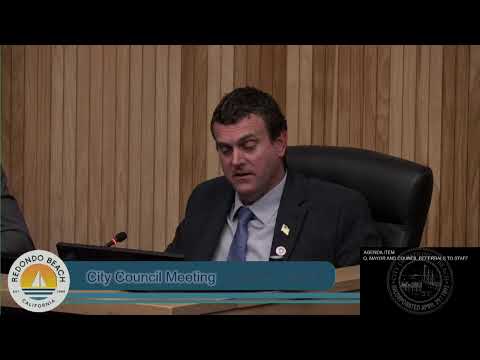
Council directs staff to draft nighttime ban on amplified sound, asks report on enforcement costs
Summary
After repeated public complaints about early‑morning amplified protest noise, the council instructed staff to prepare an ordinance banning amplified sound without a permit during overnight hours and to return with a budget/implementation report on enforcement and longer‑term noise options.
The Redondo Beach City Council voted unanimously to ask staff to draft an ordinance prohibiting amplified sound without a permit during overnight hours and to return with a budget response report on enforcement and on longer‑term changes to the city’s noise code.
The action followed public complaints about early‑morning demonstrations outside a local hotel. Mayor Light and several council members said their offices had received multiple calls describing protesters using amplified sound at 6:00–7:00 a.m., waking nearby residents and affecting hotel operations and occupancy.
City Attorney Mike Webb told the council that the municipal code’s current blanket prohibition on amplified sound without a permit is very old and overbroad, and identified a practical, content‑neutral fix: a time‑of‑day restriction modeled on an existing ordinance in San Francisco. Webb recommended a narrow, immediately enforceable change — a ban on amplified sound without a permit between late evening and morning — and a longer staff study on decibel monitoring and enforcement options.
Police Chief Joe Hoffman told the council that enforcing existing decibel standards is complex. The department and code‑enforcement staff have sound meters and training, but enforcing a citywide decibel limit during protests poses legal and operational challenges: a reading requires calibrated equipment, trained observers and a clear method to identify the responsible individual when multiple people contribute to noise levels. Hoffman said contracting with a certified acoustic consultant would provide defensible ambient readings and expert testimony if enforcement actions were contested.
Council direction: the council voted to (a) direct staff to prepare an ordinance that prohibits amplified sound without a permit during overnight hours (council suggested an initial window such as 10:00 p.m.–9:00 a.m.), (b) prepare a budget/BRR describing costs to obtain professional sound‑monitoring resources and any enforcement staffing needs, and (c) return with draft ordinance language and implementation options. The motion passed unanimously.
Councilmembers stressed the goal of protecting residents’ sleep and hotel operations while preserving lawful protest rights. “I support their right to protest,” Councilmember Lowenstein said, but added that “waking residents at 6:30 in the morning” is the problem the ordinance aims to address.
What happens next: City staff will draft ordinance language for first reading and prepare a BRR that outlines costs and a practical enforcement approach, including options to contract for certified acoustic monitoring if needed.