Get Full Government Meeting Transcripts, Videos, & Alerts Forever!
Get email alerts on the Cannabis Regulation topic
No spam. Unsubscribe anytime.
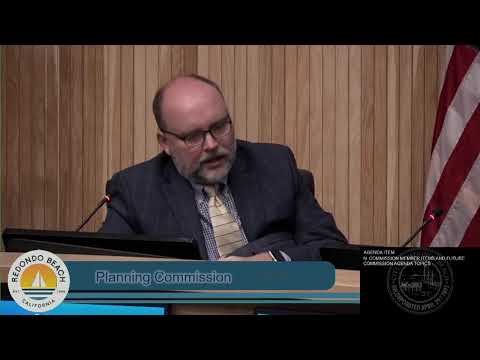
Planning commission backs 1,000-foot separation between cannabis retailers, affirms other zoning refinements
Summary
The Redondo Beach Planning Commission on Feb. 3 reviewed proposed revisions to the city's cannabis zoning and regulatory ordinances and voted to reinstate a 1,000-foot separation between retail cannabis storefronts while otherwise forwarding council amendments for further action.
The Redondo Beach Planning Commission voted Feb. 3 to recommend preserving a 1,000-foot separation between cannabis retailers while forwarding other recommended changes to the city's cannabis zoning and regulatory ordinances to the City Council.
The vote came after a two-hour public hearing and staff presentation on draft amendments to Title 10 (zoning and land use) and the coastal land-use implementing ordinance that would update definitions, clarify allowable activities (storefront retail and retail delivery), and adjust some buffers, including a council-proposed small exclusion near Dale Page Park. Elizabeth Haas, the city's community services director, told the commission the proposed redlines grew out of council direction and staff review and are intended to make the existing ordinances clearer and consistent with state law and council policy.
Commissioners and public speakers focused most of their attention on separation rules for retail dispensaries and on delivery regulations. Several residents urged limits near neighborhood parks and on concentrations along Artesia Boulevard. Jim Mueller, a District 5 resident, said the city faces "more and more multifamily, more population density" and warned of neighborhood impacts. Melissa Deshant, a scientist and District 1 resident, told commissioners that the city's 2022 Measure E vote reflected large opposition to retail cannabis and raised concerns about product safety and youth exposure. Opposing those remarks, Timothy Dodd, CEO of Sweetflower, told the commission, "You have cannabis in Redondo Beach. This is not a question of if, it's a question of how," arguing regulation, testing and local permitting provide protections and tax revenue.
Staff told the commission the draft amendments (ordinance numbers cited to the commission as 3,241-22 and 3,235-22 and a related operational ordinance) refine definitions (for example, explicitly permitting storefront retail and retail delivery and aligning the daycare definition with the California Health and Safety Code), remove a development-agreement pathway, and add clarity about liquid assets and licensing terms. Staff also described council direction to schedule a City Council hearing Feb. 11 on the introduction and first reading of the amendments.
A central point of debate was buffer geography. Council staff had proposed removing a provision that no retailer can be established within 1,000 feet of another retailer to avoid denying operators locations that fall in different council districts but are geographically close (for example, where district lines meet along Artesia Boulevard). Council also proposed a small buffer (roughly 50 to 150 feet, per staff presentation) around commercial parcels adjacent to Dale Page Park; commissioners discussed whether a single-park buffer was defensible or whether any park buffer should be citywide.
After public comment and extended deliberation, the commission adopted a recommendation to the City Council that reinstates the 1,000-foot separation between retail cannabis operators while otherwise moving forward with the council-directed ordinance refinements. The roll-call vote recorded three yes votes and two no votes (three commissioners recorded their votes as yes; two commissioners voted no). Staff said the Planning Commission's action is a recommendation; any final ordinance language and adoption remains the City Council's decision.
The commission also discussed delivery: staff explained the draft text would require any entity delivering cannabis within city limits to obtain a city permit if the city adopts the revised program, and that retail-delivery operators must comply with state track-and-trace requirements. Commissioners asked whether delivery-only operators located outside Redondo Beach could deliver into the city; staff responded that, under the proposed permit program, deliveries into the city would require city permits and payment of local tax, though staff said state law and enforcement realities complicate immediate restrictions on medicinal delivery until the city adopts its permit program.
The public hearing drew speakers for and against expanded retail. Proponents stressed controlling and testing legal sales and capturing tax revenue to fund city services; opponents cited the 2022 Measure E result and public health concerns about product testing and youth use. Staff and commissioners repeatedly clarified that the Planning Commission's role was limited to advising on zoning and the specific amendments before the body and that the City Council retains the ultimate policy decisions.
The commission's written comments and any edits requested by commissioners will be presented to the City Council at its Feb. 11 meeting for the Council's consideration of introduction and first reading. The Planning Commission did not adopt any ordinance itself; its action is a formal recommendation.