Get Full Government Meeting Transcripts, Videos, & Alerts Forever!
Get email alerts on the State Investments topic
No spam. Unsubscribe anytime.
House Appropriations Committee advances Wyoming Gold Act, orders $10 million physical gold hold and a study
Summary
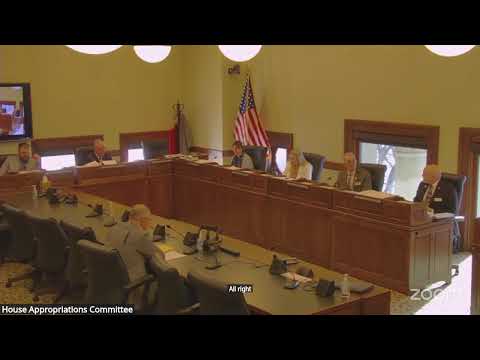
Senator Wright presented Senate File 96, the "Wyoming Gold Act," to the House Appropriations Committee and the panel voted to pass the bill as amended, requiring the state to hold a minimum of $10,000,000 in physical gold and directing a study on accepting gold and silver as payment.
Senator Wright presented Senate File 96, the "Wyoming Gold Act," to the House Appropriations Committee and the panel voted to pass the bill as amended, requiring the state to hold a minimum of $10,000,000 in physical gold and directing a study on accepting gold and silver as payment.
The bill would require the state treasurer to hold not less than $10,000,000 “in specie and specie legal tender in the permanent Wyoming mineral trust fund” for purposes the sponsor described as diversifying the state’s portfolio and preserving capital against inflation and related risks. Senator Wright told the committee the statute also would allow the treasurer to contract with established precious-metal firms to assist with acquisition, storage and related services and would require a study and interim report on how the state could begin accepting gold and silver as a payment medium.
The fiscal and operational implications drew the sharpest questions. Don Williams, Deputy State Treasurer, told the committee the treasurer’s office opposed the bill. “In short, Mr. Chairman, the treasurer’s office is opposed to this bill,” Williams said, explaining that professional investment advisors do not favor physical gold for the state’s funds because physical specie does not generate distributable income and adds custody and transaction costs. Patrick Fleming, the treasurer’s chief investment officer, added that over long time horizons gold has underperformed equities and exhibits higher volatility, a combination that weakens its risk-adjusted return in the office’s portfolio analyses.
Supporters and industry witnesses urged the committee to take a step toward diversification. Josh Fair, who identified himself as a metals-industry operator and owner of storage and minting businesses, described a class 3 vault and said state holdings of $10 million would occupy only a small physical footprint. Joe Cavattani of the World Gold Council and other industry witnesses, including Stefan Gleeson and Mike Ethorn, offered analysis and examples of other states that have made gold allocations and said secure storage and insurance structures exist to support state custody.
Committee members debated scale and implementation. Several members described the $10 million figure as a modest, starter allocation and suggested higher amounts could be considered later; Representative Harrelson and others said the sum could be increased by amendment but acknowledged political and procedural trade-offs. The committee adopted a technical change moving responsibility for the statutory study from the State Treasurer to the Department of Revenue, so the Department of Revenue will submit the study and interim report specified in the bill.
The bill drew questions about storage costs and liquidity. Committee members were told by industry witnesses that storage and insurance fees often are presented in the market at or below the 25-basis-points range the committee discussed; witnesses also said bullion markets provide substantial intraday liquidity. The treasurer’s office contrasted that view with the fund’s spending policy and distribution requirements, saying physical gold holdings would complicate regular distributions and could constrain the investment office’s asset-allocation process.
After public and departmental testimony and floor discussion, Representative Harrelson moved the bill for passage as amended; Representative Aleman seconded. The committee approved the bill on a roll call vote, with five members voting aye, one voting no and one excused. The committee also considered, but did not adopt, an amendment to set an upper $50 million cap on the required holdings (the proposal failed for lack of a second).
What happens next: the committee referred the measure with its amendments to the next stage of the legislative process. The bill text requires the Department of Revenue to conduct the study and submit the interim report required by the statute by October 1, 2025; the bill also authorizes the treasurer to contract for services to implement holdings if the treasurer proceeds.
Votes at a glance
- Senate File 96 (Wyoming Gold Act) — Motion: Do pass as amended. Moved by Representative Harrelson; seconded by Representative Aleman. Roll-call: Alemand/Aleman — Aye; Angelos — Aye; Harrelson — Aye; Pendergraft — Aye; Sherwood — No; Smith — Excused; Chairman Bair — Aye. Outcome: Passed out of committee as amended.
Ending
The committee’s action advances a modest, mandated first purchase of physical gold alongside a directed study of how the state might accept gold and silver as payment. The treasurer’s office publicly opposed the directive, citing institutional investment duties and distribution mechanics; industry witnesses and some legislators argued a small holding is a prudent diversification. The next steps are committee transmittal and floor consideration under the amended language requiring the Department of Revenue to complete the study.